
STALINGRAD, BATTLE OF (AUGUST 1942–FEBRUARY 1943)

When August 23, 1942 to February 2, 1943

Where Stalingrad (today’s Volgograd), an important industrial city of 400,000 people and river and rail terminus on the Volga River

Shrinking Stalingrad perimeter, September 1942–February 1943

Who The German Sixth Army under Gen. Friedrich Paulus (1890–1957); elements of the Fourth Panzer Army under Gen. Hermann Hoth (1885–1971); along with Germany’s satellite armies, the 2nd and 4th Romanian Armies, the Hungarian 2nd Army, and the Italian 8th Armies. Opposing force was the Soviet Army’s Stalingrad Front, principally the Sixty-Second Army under Lt. Gen. Vasily Chuikov (1900–1982).

What German forces, which at the outset numbered 300,000 troops and 2,000 tanks, nearly succeeded in conquering Stalingrad, but with massive losses. Soviet forces numbered 1.1 million strong, with 3,500 tanks. The unexpected Soviet counter­offensive, begun November 12, 1942, trapped 250,000 Germans within the city, where close to 150,000 perished. Some 110,000 troops, weakened by starvation, cold, and typhus, went to almost certain death in Soviet captivity. Only about 5,000–6,000 POWs survived to return home. Soviet losses were 480,000 killed and missing. Between the combatant sides, almost two million lives were lost.

Why The apocalyptic struggle for Stalingrad was part of a German campaign to occupy the Soviet Union’s three major oilfields in the Caucasus south of the city. Stalingrad, with its symbolic name, was initially a secondary target to protect the German left flank. For their part, the Soviets needed a victory at Stalingrad to launch an offensive against the German invaders.

Outcome The failure of Hermann Goering’s Luftwaffe to supply German troops trapped in the Stalingrad Pocket resulted in food and ammunition shortages that sabotaged a German victory in the East. Nazi Propaganda Minister Joseph Goebbels correctly noted in his diary, “We are in danger of bleeding to death in the East.” The Sixth Army’s liquidation was a stunning blow to army and home-front morale and to Hitler’s own plans to liquidate the Soviet Union (Operation Barbarossa). It was a turning point in World War II and marked the beginning of the Axis defeat on the Eastern Front as 4.5 million Soviet troops began a cascading series of offensives that engulfed every­thing before them. It was Chuikov, twice-decorated Hero of the Soviet Union, who accepted the surrender of Berlin’s garrison on May 2, 1945.


The Battle for Stalingrad, August 1942 to February 1943

httpv://youtu.be/Aupnv5n19K4
Similar Posts

  • LONDON SURVIVES OVERNIGHT AIR RAID

    London, England · December 29, 1940 On this date in 1940, when President Franklin D. Roose­velt appealed to the nation in a radio “fire­side chat” to support his pro­posal to strengthen the U.S. mili­tary in light of devel­op­ments in Europe, the Ger­man Luft­waffe delivered a mas­sive attack on London. Almost 3,000 civil­ians were killed in the…

  • GERMANS OVERWHELM DUTCH DEFENDERS

    Rotterdam, Netherlands · May 14, 1940 On this date in 1940 in Holland, the Ger­man Luft­waffe bombed Rotter­dam’s medi­e­val city cen­ter, killing nearly 1,000 people and leaving 85,000 home­less. Rather than endure more bombings—leaf­lets dropped on Utrecht indi­cated it was next Dutch city in Ger­man cross­hairs—the Dutch army surren­dered the next day. The Ger­man offen­sive against the…

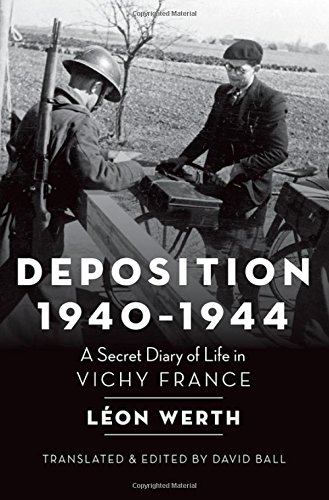
  • Deposition 1940-1944: A Secret Diary of Life in Vichy France

    Historians agree: the diary of Léon Werth (1878-1955) is one of the most precious–and readable–pieces of testimony ever written about life in France under Nazi occupation and the Vichy regime. Werth was a free-spirited and unclassifiable writer. He is the author of eleven novels, art and dance criticism, acerbic political reporting, and memorable personal essays. He was Jewish, and left Paris in June 1940 to hide out in his wife’s country house in Saint-Amour, a small village in the Jura Mountains. His short memoir 33 Days recounts his struggle to get there. Deposition tells of daily life in the village, on nearby farms and towns, and finally back in Paris, where he draws the portrait of a Resistance network in his apartment and writes an eyewitness report of the insurrection that freed the city in August, 1944.

    From Saint-Amour, we see both the Resistance in the countryside, derailing troop trains, punishing notorious collaborators–and growing repression: arrests, torture, deportation, and executions. Above all, we see how Vichy and the Occupation affect the lives of farmers and villagers and how their often contradictory attitudes evolve from 1940-1944. Werth’s ear for dialogue and novelist’s gift for creating characters animate the diary: in the markets and in town, we meet real French peasants and shopkeepers, railroad men and the patronne of the café at the station, schoolteachers and gendarmes. They come off the page alive, and the countryside and villages come alive with them.

    With biting irony, Werth records, almost daily, what Vichy-German propaganda was saying on the radio and in the press. We follow the progress of the war as people did then, day by day. These entries make interesting, often amusing reading, a stark contrast with his gripping entries on the persecution and deportation of the Jews. Deposition is a varied and complex piece of living history, and a pleasure to read.

  • HITLER SEEKS BASES IN SPANISH CANARY ISLANDS

    Berlin, Germany · September 15, 1940 On this date in 1940 Adolf Hitler wrote a letter to Gen. Fran­cisco Franco, the Cau­dillo of Spain, asking for naval bases for Ger­many in the Spanish Canary Islands and other places. Franco replied one week later, demanding enor­mous stock­piles of wea­pons, supplies, and part of French North Africa…

  • HEYDRICH’S DEATH UNLEASHES HORRIFIC REPRISALS

    Berlin, Germany · June 9, 1942 On this date in 1942, with the full leadership of the Third Reich in atten­dance, Nazi “martyr” Rein­hard Hey­drich was eulo­gized in one of the most elab­o­rate fune­rals ever staged in Berlin. (Hey­drich had been added by Adolf Hitler to the “honor­ary list of the Fallen of the Nazi…