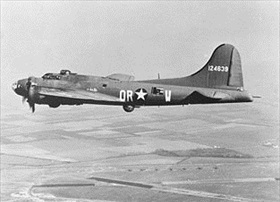
B-17 BOMBER MAKES COMBAT DEBUT
London, England · July 8, 1941
On this date in 1941, five months before the United States was drawn into World War II, the Boeing B‑17 Flying Fortress was flown in combat for the first time, this by the Royal Air Force in an attack on the North German port of Wilhelmshaven. The first production model, the Boeing B‑17B, was flown on June 27, 1939, and by year’s end 25 of these high-performance, four-engine heavy bombers were in America’s air fleet. By the end of World War II, nearly 13,000 “Forts” would see service in the RAF and U.S. Eighth, Ninth, Twelfth, and Fifteenth Army Air Forces. The later-model B‑17s—there were six in all—had a top speed of just under 300 mph, a range of 2,000 miles, and carried a 10- or 11-man crew. Like the twin-tailed Consolidated B‑24 Liberator and the British-built Avro Lancaster, the B-17 was at the heart of the Anglo-American strategic bombing campaign in Europe. According to a statement by the U.S.-British Combined Chiefs of Staff in January 1943, the objective of the bombing campaign was to destroy and dislocate the Axis “military, industrial, and economic system, and [undermine] the morale of the people to a point where their capacity for armed resistance is fatally weakened.” In carrying out its role, the heavy defensive armaments of the B-17 limited bomb loads to 2‑1/2 tons per plane, which meant that raids over Axis-occupied Europe consisted, on any single mission, of hundreds and later several thousand of these warbirds, accompanied by a thousand-fighter escort. The bombers carried a deadly mix of high-explosive bombs and incendiary bombs that devastated not just population centers like Hamburg (mid-1943) and Berlin (a turnabout on the London Blitz of 1940–1941) but also key economic and military chokepoints; for example, marshaling yards, rail lines, highways, and bridges; aircraft and armament factories; ball bearing plants; and oil and artificial fuel refineries and tank farms. The theory that round-the-clock bombing by the RAF (by night) and the USAAF (by day) would devastate the German economy and workforce and force Germany’s military leaders to the negotiation table like it did Italy (more or less)—all without a bloody ground invasion—did not materialize. But applied to Japan’s Home Islands, the theory worked, nudged in the end by two nuclear bombs.
[fblike]
[amazon_carousel widget_type=”ASINList” width=”600″ height=”200″ title=”Recommended Reading” market_place=”US” shuffle_products=”False” show_border=”False” asin=”1848327412,0451228715,0440226481,1574889990,0451232275,1848847602,0743235452,0811733882,0425252868,0071341455″ /]
Allied Heavy Bombers Over Germany and Their Escorts
 |
 |
Left: A B-17 Flying Fortress of the U.S. Eighth Air Force stationed at Bassingbourn, England. Unable to conduct ground operations on the European continent until Allied strength was sufficient for a full-scale invasion, British and American war planners based their grand strategy on a protracted campaign of aerial bombardment of Germany’s industrial sites and civilian areas in order to bring the Third Reich to its knees. Allied heavy bombers, combined with night-navigation and precision-bombing techniques, proved devastatingly effective. Of Germany’s 25 largest population centers (500,000 or more residents) Leipzig suffered the least (at 20 percent) and Bochum the most (83 percent). Hamburg was 75 percent destroyed; Mainz, Duesseldorf, Cologne, Hannover, and Mannheim suffered 60 percent or better; and a third of the Nazi capital, Berlin, lay in ruins at war’s end.
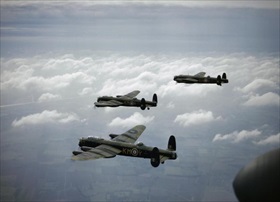
Right: Three RAF Avro Lancaster B.Is based at Waddington, Lincolnshire, fly above the clouds, September 29, 1942. Introduced into service in February 1942, 7,377 of these four-engine “Lancs” were built. They became the main heavy bomber used by the RAF as well as the most famous and successful of the war’s night bombers in contrast to the USAAF heavy bombers that were used mostly in daylight raids over Europe.
 |
 |
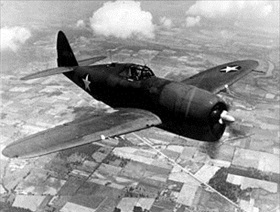
Left: First flown on May 6, 1941, 15,660 of these Republic P‑47 Thunderbolt air combat, ground attack, and bomber escorts were built. Rugged and armed with eight .50 caliber machine guns, these jug-shaped fighters were powered by a Pratt & Whitney R-2800 radial engine for a maximum speed of 433 mph at 30,000 ft. They were a good match for the Luftwaffe’s Messerschmitt Bf 109s and Focke-Wulf Fw 190s. But even outfitted with extra fuel in belly tanks, P‑47s in their escort role could only accompany Allied heavy bombers from England to the German border before they were forced to turn back for home.
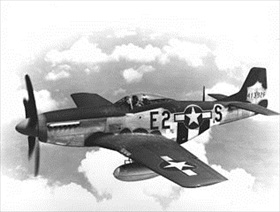
Right: North American P‑51 Mustangs were used in air combat, ground attacks, precision bombing, and long-range bomber escort service. Over 15,000 P‑51s in 12 major production variants were built. The P‑51 entered service at the end of 1943. Equipped with a Rolls-Royce Merlin V engine that could propel it at 441 mph at 29,000 ft, the P‑51 and the Lockheed P‑38 Lightning virtually swept the Luftwaffe from the sky in time for June 1944’s Normandy landings. In this photo the P‑51 is wearing its Normandy invasion stripes. P‑51s destroyed 4,950 enemy aircraft in the air, more than any other fighter in Europe.
U.S. Air Force’s Presentation of the Schweinfurt and Regensburg Raids, August 17, 1943
httpv://youtu.be/dB8C-CagZeU