
RAF DAMAGES NAZI ROCKET SITE
London, England · August 17, 1943
In mid-June 1943 a Royal Air Force reconnaissance mission flew over the top-secret Peenemuende Army Research Center and V‑2 rocket launch site on the German Baltic coast. Images confirmed the presence of long-range ballistic missiles at the site. A month later British Prime Minister Winston Churchill ordered an attack at the earliest opportunity based on moon and meteorological conditions. The attack on Peenemuende began Operation Crossbow, the strategic bombing campaign against Germany’s V‑2 (Vergeltungswaffe 2, or Vengeance Weapon 2) program. Among the German rocket scientists affected by the RAF campaign was Dr. Wernher von Braun (1912–1977). Beginning at midnight on this date in 1943 three waves of RAF heavy bombers (596 mostly Lancasters and Halifaxes) damaged test rigs and laboratories (leaving other important installations untouched) at a cost of 215 British aircrew members, 40 bombers, and hundreds of civilians in a nearby concentration camp. Joseph Goebbels, Nazi Minister of Public Enlightenment and Propaganda, claimed that the RAF attack set the rocket program back six to eight weeks. V‑2 development and test firing shifted from Peenemuende to an SS training base near Blizna in southeastern Poland, which was less vulnerable to Allied air raids, while the nearly operational V‑2 production plant for the most part shifted to salt mines in the Harz Mountains in eastern Germany. In underground tunnels slave laborers from the Dora-Mittelbau concentration camp (initially a subcamp of Buchenwald) constructed, by war’s end, 5,200 V-2 rockets. An estimated 20,000 prisoners died at the German camp, 9,000 from exhaustion. The majority, however, died from disease, starvation, or execution, including 200 accused of sabotage. (Von Braun admitted visiting the subterranean facilities on many occasions.) Bodies of V-2 production workers were returned to Buchenwald for burning at the rate of about 1,000 a month. On September 8, 1944, the first successful launch of the supersonic V‑2 missile targeted newly liberated Paris, then England. From September to the following March, Germans launched over 3,000 V‑2s against Allied targets on the continent and the British Isles. The deadly rockets, falling without warning, killed fewer people than those who died manufacturing them.
[fblike]
[amazon_carousel widget_type=”ASINList” width=”600″ height=”200″ title=”Recommended Reading” market_place=”US” shuffle_products=”False” show_border=”False” asin=”156663511X,0306812924,0252077881,1594160120,0393059103,0811733874,0307389375,1841765414,1591149274,1602397058″ /]
Dr. Wernher von Braun and the German V-2 Rocket Program
 |
 |
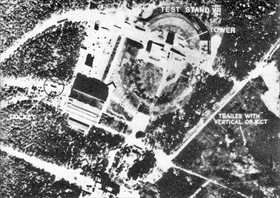
Left: Royal Air Force reconnaissance photograph of V‑2 rockets at Peenemuende Test Stands I and VII, June 12, 1943. The August 17–18, 1943, air raid dropped roughly 1,800 tons of mostly high-explosive bombs, which killed two V‑2 rocket scientists. Bombs with delay fuses hampered salvage efforts. The island of Usedom, where Peenemuende is located, is a tourist destination today.
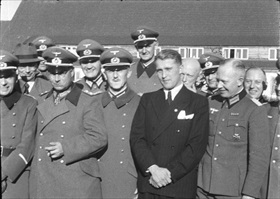
Right: Dr. Wernher von Braun, Technical Director at the Army Rocket Center at Peenemuende, March 21, 1941. The brilliant pioneer of modern rocketry (and the father of the American space program), von Braun and his team of engineers postponed their initial dreams of space travel to create weapons of terror and mass destruction for Hitler’s Germany. Not only were they ambitious members of the Nazi movement (von Braun was issued Nazi Party membership number 5,738,692), but they collaborated with the SS in exploiting slave labor to build V-2 rockets.
 |
 |
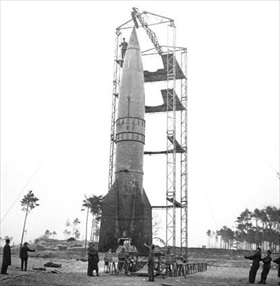
Left: Peenemuende launch pad with V‑2, March 1942. The ancestor of modern-day ballistic missiles, the V‑2 (technical name Aggregat‑4, or A4) could not win the war for Germany—it was too expensive, too complicated, too inaccurate, and its warhead too small.
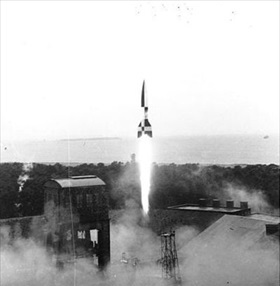
Right: Seconds after a V-2 rocket launch at Peenemuende, March 1942.
 |
 |
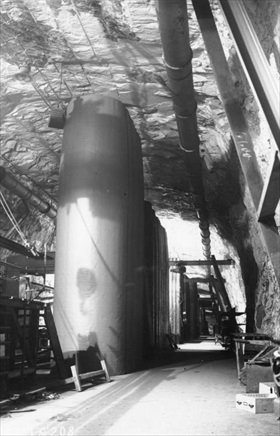
Left: Underground tunnel in the Harz Mountains at Kohnstein where the V‑2 rockets were manufactured. Photo taken after the Allies had captured the area.
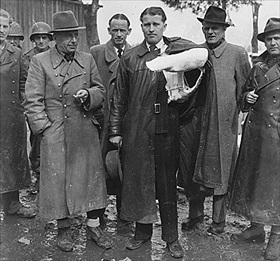
Right: The unprecedented invulnerability and influence on Allied planning made the V‑2 and the advancements it represented the ultimate war prize, and American, British, and Soviet forces scrambled to seize German rocket technology along with its scientists and engineers. This photo from May 3, 1945, shows von Braun in an arm cast with several of his scientists shortly after their surrender to U.S. soldiers.
German V-2 Rocket Program
httpv://youtu.be/VDmaFj2dJ8A