
HITLER STEPS BACK FROM EDGE RE: POLISH WAR
Berlin, Germany · August 29, 1939
Adolf Hitler ordered the German invasion of Poland to begin on August 26, 1939. Troops, panzers, and aircraft had been lining up near Poland’s western border since mid-August. Though planned since late March 1939, the invasion was bound to rile Poland’s eastern neighbor, the Soviet Union. That concern was laid to rest when, at the invitation of Joseph Stalin, Soviet Foreign Minister Vyacheslav Molotov and German Foreign Minister Joachim von Ribbentrop inked a bilateral non-aggression pact (Molotov-Ribbentrop Pact) in Moscow on August 24. The next day Hitler’s smirk of triumph was shredded by the “bombshell” that the British and Polish governments had concluded a mutual assistance pact that afternoon. On the evening of the 25th, when things looked dangerously out of control, an irritable Hitler issued a stop order and huddled with his advisers to concoct a ploy to divert attention away from their real objective. Late on this date in 1939 Hitler and Ribbentrop handed the British ambassador, Sir Nevile Henderson, terms that would allegedly ensure peace, not war. The Danzig enclave and the Polish Corridor were to be annexed by Germany, terms modified the next day to holding a plebiscite in the Polish Corridor. Both territories were viewed as the illegitimate offspring of the 1919 Versailles peace settlement. Poles who had been born or had settled in those places after 1919 could not vote, while all Germans born but not living there could. Safeguards for German minorities living in Poland would have to be put in place. If Poland accepted these terms, Germany would agree to the British demand to involve the Soviet Union in any settlement. A Polish plenipotentiary with full powers to accept the terms was to arrive in Berlin by noon, August 30. The Poles, however, would have nothing to do with a meeting in Berlin, suggesting instead a town near the Polish-German border. When the Polish ambassador, Józef Lipski, visited Ribbentrop’s office on August 30, he too was presented with Hitler’s demands. Because the ambassador lacked authority to endorse the Germany’s terms, Ribbentrop ended the meeting. Soon German radios blared reports that Poland had rejected Germany’s offer. The diplomatic do-si-do was a hoax on everyone. Hitler had no intention of acting on his own offer. Troops, armor, and airplanes were in place, set to launch on September 1.
[fblike]
[amazon_carousel widget_type=”ASINList” width=”600″ height=”200″ title=”Recommended Reading” market_place=”US” shuffle_products=”False” show_border=”False” asin=”0521618576,034911515X,1781592276,0813118034,0143120069,0714651982,0393322521,0415862558,1929631278,1405840285″ /]
Hitler Protects His Eastern Flank with Soviet Pact and Offers Western Democracies “Options” for Settling German-Polish Crisis
 |
 |
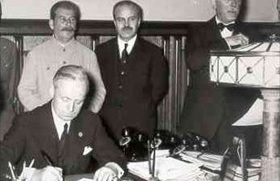
Left: German Foreign Minister Joachim von Ribbentrop signs the German-Soviet Non-Aggression Pact, Moscow, August 1939. Behind him is Soviet leader Joseph Stalin and, to his left, Soviet Foreign Minister Vyacheslav Molotov. The pact had a secret protocol that parceled out half of Poland, sandwiched between the two states, to each signatory in the event of a German invasion of Poland. Hitler believed that the pact protected his eastern flank when the inevitable war with Poland came. But in truth the near simultaneous invasions of Poland by Germany (on September 1, 1939) and the Soviet Union (on September 17, 1939) brought Hitler face to face with a rapidly arming colossus whose leader had no intention of giving Germany a free hand on his western frontier. Operation Barbarossa, Hitler’s invasion of the Soviet Union in June 1941, offered the prospect of nipping in the bud the threat Stalin’s machinations might have in Germany’s Polish conquests.
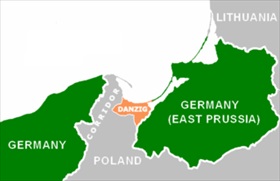
Right: Areas on Germany’s eastern frontier where Hitler proposed territorial “readjustments”; namely, the Polish Corridor and the Danzig enclave (“Free City of Danzig,” today’s Gdańsk), two of Germany’s so-called “lost territories.” During the last week of August 1939, Poland’s Western allies—Great Britain and France—made it clear that German-Polish relations were key to European war or peace. An argument can be made that Great Britain and France propelled themselves into the deadliest war in history by guaranteeing the Poles (who had their own national agenda) their independence earlier in the year (March 31, 1939) and then formalizing that guarantee on August 25, 1939, in a mutual military alliance directed against Germany. Turning their back on that August guarantee to Poland would have brought national dishonor to both Western democracies.
The Nazi Invasion of Poland: U.S. War Department Documentary Using Captured German Films
httpv://youtu.be/uNOqSSP1o94