HITLER PUTS INVASION OF ENGLAND ON HOLD
Berlin, Germany · September 17, 1940
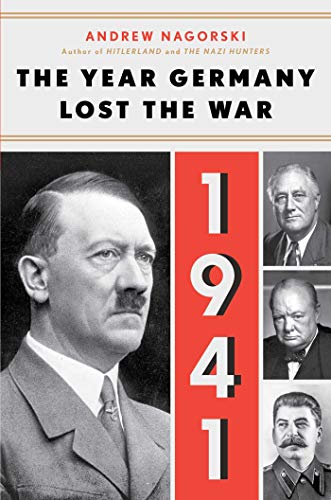
In November 1939, some two months after Germany had invaded Poland, Grand Admiral Erich Raeder, head of the Kriegsmarine, instructed a subordinate to draw up a paper on “the possibility of troop landings in England.” The study paper set out four prerequisites. The next month the Wehrmacht (German armed forces) issued its own paper, also laying out four prerequisites. Following Germany’s swift occupation of France and the Low Countries in May and June 1940, and Adolf Hitler’s growing impatience with British indifference toward his recent peace feelers, the German leader formally set in motion preparations for Operation Sea Lion (Seeloewe), the cross-Channel invasion of England. Sadly for Germany, the failure of Hermann Goering’s Luftwaffe in August–September 1940 to defeat the Royal Air Force, despite inflicting punishing losses, convinced the Kriegsmarine’s high command that the invasion was too risky. Not being certain of the approaching winter weather, Hitler wisely decided on this date in 1940 to postpone the invasion until a new date could be set. The Luftwaffe still had orders to continue its attacks on Britain. Instead of airfields and other military installations, the Luftwaffe now targeted industrial centers and, finally, on September 7, 1940, the city of London. This phase of the air war over Britain was called the Blitz (September 7, 1940, to May 10, 1941), and was Hitler’s way of punishing the British for refusing to surrender. Assisting the Luftwaffe in punishing English cities was a small contingent of Italian fighters and bombers, the Italian Air Corps (Corpo Aereo Italiano, or CAI), which over a 100-day period had little to show for its effort, earning the mocking nickname “The Chianti Raiders” whenever RAF pilots acted to intercept the Italian enemy. The Battle of Britain (July–October 1940)—the air war that was Operation Sea Lion’s prelanding phase—cost the Luftwaffe 1,733 planes against 915 British fighters and took all the wind out of Sea Lion’s sails. Hitler’s ambitions for dominating Europe now turned toward the Soviet Union, which was in a 10‑year non-aggression pact (Molotov-Ribbentrop Pact) with an incorrigible aggressor. Operation Barbarossa, launched June 22, 1941, proved a fatal mistake. In just short of four years the capital of Hitler’s Thousand-Year Reich, menaced on every side by Soviet armies and shrunk to a few hundred square yards, became the Nazi leader’s tomb on April 30, 1945.
[fblike]
[amazon_carousel widget_type=”ASINList” width=”600″ height=”200″ title=”Recommended Reading” market_place=”US” shuffle_products=”False” show_border=”False” asin=”1468301497,058277294X,125000215X,0760339368,0786716185,1593761163,1853673617,0061125369,0393322971,1848856997″ /]
The Battle of Britain Halts Operation Sea Lion, the 1940 German Invasion of England
 |
 |
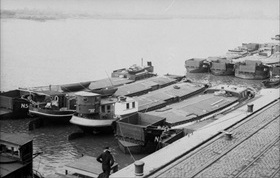
Left: Lacking purpose-built landing craft, the Kriegsmarine improvised with inland freight barges in the lead-up to Operation Sea Lion, as shown here at Wilhelmshaven, August 1940. Approximately 2,400 were collected from all over Nazi Europe (half from the Netherlands). Of these only about 800 were powered (some poorly); the rest had to be towed by tugs. Converting the assembled river barges into landing craft for troops, tanks, and vehicles was complicated. Some barges could accommodate three or four tanks. After Sea Lion was cancelled, the Kriegsmarine used some of the motorized barges for landing on Soviet-held Baltic islands but most were returned to their former service.
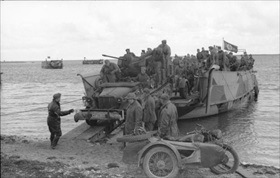
Right: In the late 1930s the Kriegsmarine ordered the development of purpose-built landing craft, which were tested in the Baltic Sea beginning in March 1941. Not until September 1941, a year after Sea Lion was cancelled, was the first in a series of landing craft, the Pionierlandungsboot 39 shown here, available. Excepting the last in the series, the landing craft were assembled from two mirrored pieces, which could be transported by rail to the coast or river entry. The Pionierlandungsboot 39 was nearly 50 ft long and 15 ft wide and capable of carrying 20 tons. This landing craft was first used during Operation Barbarossa, Hitler’s invasion of the Soviet Union. The largest and last in the series, Pionierlandungsboot 43, was 116 ft long, 28 ft wide, and could carry 95 tons of cargo.
 |
 |
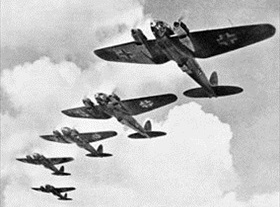
Left: German bombers (He 111s) over Britain. From the perspective of Germany, the fifteen weeks of aerial combat known as the Battle of Britain (July–October 1940) was an attempt to whittle away at the Royal Air Force, thereby giving the Luftwaffe air superiority during Operation Sea Lion. Stymied by the RAF on the one side and by their own lack of combined operational command on the other, the Germans switched from bombing military complexes to bombing centers of industry and population, inadvertently permitting the RAF to regroup and replace its lost aircraft and installations.
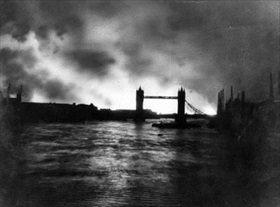
Right: The first heavy bombing of London’s docks came on the night of September 7, 1940 (“Black Saturday”), the start date for the London Blitz. The huge pall of smoke billowing from riverside warehouses and docks could be seen for miles. Fires raged right up to Tower Bridge. Like the Battle of Britain, the Blitz never achieved its intended goals of either demoralizing British political and military leaders into capitulation or significantly damaging the country’s economy to continue the war. (Over its nine months, the Blitz killed more than 43,000 civilians.) By the time the last bombs had fallen on London on May 10, 1941, in a particularly murderous climax to the Blitz, the invasion threat had passed, and Hitler’s attention was directed eastwards to the Soviet Union.
Alternate History: Operation Sea Lion, the Successful German Invasion and Occupation of England
httpv://youtu.be/-HFnrBPXddM