ANGLO-FRENCH-NORWEGIAN OFFENSIVE LAUNCHED
Narvik, Norway · April 29, 1940
Copenhagen, Denmark’s capital, and Oslo, Norway’s capital, succumbed to German invaders on April 9, 1940, the first day of Operation Weseruebung. Though planning for Weseruebung had begun the previous December, Adolf Hitler did not order full speed ahead until British warships entered the territorial waters of neutral Norway in February 1940 and freed some 300 sailors who had been captured by the German pocket battleship Admiral Graf Spee several weeks earlier. Hitler’s invasion of Norway ostensibly was to forestall the planned Anglo-French occupation of that country. Indeed, German envoys to Copenhagen and Oslo made the case that the Wehrmacht’s move was to protect the neutrality of both Scandinavian countries. (The occupation of Denmark was based on geographical considerations: its location facilitated greater air and naval control of the North and Baltic seas.)
In truth, the goal of the Germans in Norway was to secure Narvik, the ice-free port and rail terminus for Swedish iron ore exports to Germany, at the moment vital to the German war effort. (In 1939, Germany imported 60 percent of its iron ore.) Great Britain and France, the latter nation a month shy of being invaded herself, responded to Operation Weseruebung with their own landings in Central Norway five days later. The initial engagement of British and German forces on April 21 was the first ground action between the two nations since World War I and it did not bode well for the Allies. A week later London, without warning its Norwegian comrades-in-arms in advance, ordered British forces to evacuate Central and Southern Norway.
On this date, April 29, 1940, Norwegian and French forces took the offensive on the northern front near Narvik. Though holding a strong numerical advantage over the Germans in Norway, the Allies were nonetheless prompted to withdraw everywhere from the country after Allied defeats in France in May and June 1940 and the herculean cross-Channel rescue of most of the main British fighting force—the trapped British Expeditionary Force—from the Dunkirk pocket, which made it impossible to send reinforcements. King Haakon VII and his government, having established themselves temporarily in Tromsø in Northern Norway, reluctantly went into exile in England hours before the last Allied troops embarked for home, leaving Norwegian forces to capitulate to the invaders on June 10, 1940. (Other European monarchs in English exile were Queen Wilhelmina of the Netherlands, Grand Duchess Charlotte of Luxembourg, King George II of Greece, and King Peter II of Yugoslavia.) After 62 days of fighting, Norway was consigned to share the fate of Czechoslovakia and Poland in 1938–1939 and now in 1940 with France as well as neutral Belgium, neutral Netherlands, and neutral Luxembourg.
Allied Campaign in Norway, April–June 1940
 |
 |
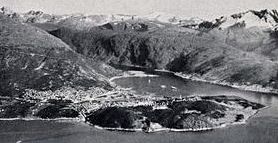
Left: Narvik provided an ice-free harbor in the Northeast Atlantic for iron ore transported by rail from Sweden’s Kiruna ore mine. The unique geography of this part of Northern Scandinavia is primarily east–west, whereas the countries of Norway and Sweden are primarily laid out longitudinally, north–south. Thus, the iron ore mined in Northern Sweden was more easily shipped from the Norwegian port of Narvik immediately to the west rather than traversing the long length of Sweden by rail, then ferry to Germany. Both Britain and Germany realized how important this ore was to the German war effort. Both combatant nations had an interest in denying this iron supply to the other, setting the stage now for a resumption of land battles following the German and Soviet invasions and annexations of Poland eight months earlier in 1939.
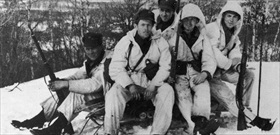
Right: The total number of Norwegian defenders during the Battles of Narvik (April 9 to June 8, 1940) was 8,000–10,000. French, British, and Polish forces in and around Narvik brought the total Allied force to 24,500 men. Facing them were 5,600 German soldiers, paratroopers, and shipwreck sailors, the latter survivors of a major naval battle off Narvik in April, when the Royal Navy sank 10 German destroyers.
 |
 |
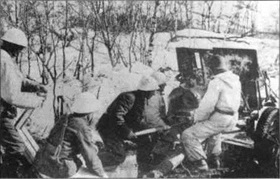
Left: The Battles of Narvik, which started with the German capture of the vital rail terminus and harbor in Norway’s north at the start of Operation Weseruebung, provided the Allies with their first major land victory in World War II on May 29, 1940.
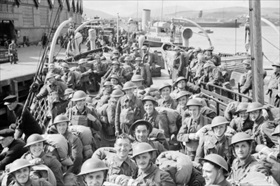
Right: However, the successful German attack on France in May and June 1940 forced the Allied expeditionary force to evacuate Norway, which these British soldiers (minus the 6,000 who had been killed) did between June 4 and 8. Without Allied air and naval support, Norwegians at Narvik were forced to lay down their arms, which they did on June 10, 1940, the last Norwegian forces to surrender their country to the invaders.
Allied Siege of Narvik, Norway, Mid-April to Early June 1940
httpv://youtu.be/jfo8Zdld1Zo