DUTCH PAY PRICE, BECOME NAZI VASSALS
The Hague, Netherlands · May 15, 1940
Following the Dutch surrender on this date in 1940, Adolf Hitler appointed fellow Austrian Arthur Seyss-Inquart to be Reichskommissar for the Occupied Netherlands. Previously, long-time Nazi Party member Seyss-Inquart had served as Reichsstatthalter (governor) of the new German province of Ostmark, which had once been the independent country of Austria before the March 1938 Anschluss (union). Later he was posted to Kraków in Southern Poland. As deputy governor to the notorious Governor General Hans Frank of the General Government (the Nazis’ administrative name for Central and Southern Poland), Seyss-Inquart was involved in “pacifying” the region and forcing Polish Jews into ghettos, from which they were sent to extermination camps such as Auschwitz-Birkenau and the concentration camp at Płaszów, where fellow Austrian Amon Goeth, depicted in Steven Spielberg’s movie Schindler’s List, served as camp superintendent.
In his new position in the Netherlands, Seyss-Inquart directed the civil administration, took measures to thwart resistance groups, and in May 1943 created special summary court-martial procedures for striking Dutch workers who were collectively fined a breathtaking 18 million guilders (close to 24 million wartime dollars).
Obnoxious and cynical, Seyss-Inquart was also an unwavering anti-Semite. Within months of his arrival from Poland, he took measures to expel Jews from the Dutch government, the press, and leading positions in industry. He intensified anti-Jewish measures in 1941 when he forced approximately 140,000 Jews to register and ordered the creation of a ghetto in Amsterdam, the only attempt by Nazi Germany to establish a Jewish ghetto west of Poland.
At Westerbork in Northeastern Netherlands Seyss-Inquart opened a deportation camp for Jews and Roma. Beginning that February Jews were deported to concentration camps at Buchenwald, Mauthausen (Austria), and Bergen-Belsen, where 15‑year-old German-born Anne Frank, deported from Holland with her family, died. Later Dutch Jews were sent to Auschwitz and Theresienstadt (today Terezín in the Czech Republic). Of the 140,000 Dutch Jews who were forced to register by Seyss-Inquart, only 30,000 survived the war. During the five years of Nazi occupation, over 300,000 Dutch died and between 800 and 1,500 were executed by order of Seyss-Inquart.
On May 7, 1945, Seyss-Inquart was arrested in Hamburg, Northern Germany. At the four-power International Military Tribunal at Nuremberg (1945–1946), both he and Hans Frank were convicted of war crimes and crimes against humanity. Both men expressed repentance and both were executed by hanging on October 16, 1946.
Arthur Seyss-Inquart, 1892–1946: Leading Nazi Figure in Austria, Poland, and the Netherlands
 |
 |
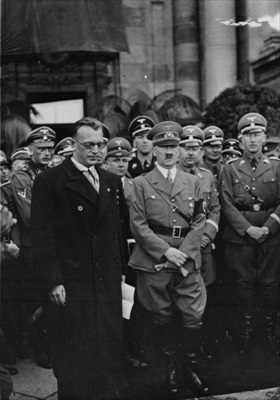
Left: Austrian governor Arthur Seyss-Inquart in Vienna 1938 with German Chancellor Adolf Hitler. Behind Hitler and to his left are Heinrich Himmler, Chief of German Police in the Reich Ministry of the Interior, and Reinhard Heydrich, head of both the Sicherheitspolizei (SiPo), consisting of the Gestapo and Kripo (Kriminalpolizei, or criminal police), and the Sicherheitsdienst (SD), the intelligence agency of the Schutzstaffel (SS) and the Nazi Party. In his stint as Reichsstatthalter of Austria (March 1938 to October 1939), Seyss-Inquart embarked on a campaign of repression and terror, ably aided by evil twins Himmler and Heydrich. Tens of thousands of Austrians, among them Catholics, Social Democrats, Socialists, Communists, and Jews, were arrested and sent to concentration camps or, in the case of Jews, forced to leave the country, their property confiscated.
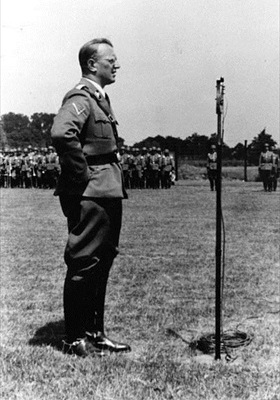
Right: Reich Commissioner for Occupied Netherlands Seyss-Inquart addressing German police battalions (Ordnungspolizei) at The Hague, Netherlands, 1940. The headquarters of the Ordnungspolizei was in Gestapo central headquarters on Prinz-Albrecht-Strasse in Berlin. Incidentally, Prinz-Albrecht-Strasse has been renamed Niederkirchnerstrasse, and the site of the Nazis’ terror apparatuses between 1933 and 1945 is now part of the “Topography of Terror” exhibition in the heart of modern-day Berlin.
 |
 |
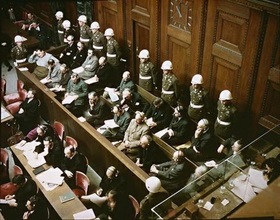
Left: View of the defendants, including Arthur Seyss-Inquart, in the dock at the International Military Tribunal trial of war criminals at Nuremberg, November 1945. The trial of Nazi war criminals was a trial without precedent in history.
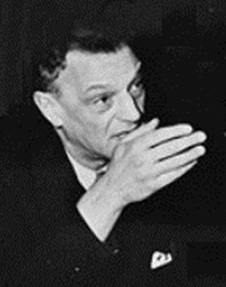
Right: Defendant Seyss-Inquart, former Reich Commissioner for Occupied Netherlands, at the Nuremberg Trials, 1946.
DW Documentary “Nazis on Trial”: Nuremberg War Crime Trials, 1945–1946
httpv://youtu.be/qMbaY8dCfUM