
JAPAN INVITES U.S. TO JOIN AXIS
Tokyo, Japan · October 13, 1940
On this date in 1940 Japan’s foreign minister Yōsuke Matsuoka, who had grown up in Oregon and California (1893–1902), invited the United States and other nonaligned nations to join the Tripartite Pact, which Axis powers Germany, Italy, and Japan had initialed in Berlin the previous month (September 27). The Pact was an outgrowth of the “Rome-Berlin Axis” celebrated by the Italo-German “Pact of Steel,” which Adolf Hitler’s foreign minister Joachim von Ribbentrop and Benito Mussolini’s foreign minister (and son-in-law) Count Galeazzo Ciano had signed in Berlin in late May 1939.
The “new world order” envisioned by Tripartite founding members, said Matsuoka, was one in which economic barriers would be broken down and the natural geographic divisions of the world established in complementary fashion to bring prosperity to all peoples. Leading the nations into the new nirvana were the signatories themselves: Article 1 of the Tripartite Pact stipulated that Japan “recognizes and respects the leadership of Germany and Italy in the establishment of a new order in Europe.” Article 2 stipulated that Germany and Italy “recognize and respect the leadership of Japan in the establishment of a new order in Greater East Asia.” Ten days after Foreign Minister Matsuoka had floated his invitation to the U.S. and other nonaligned nations, the leader of the Pact, Hitler himself, on a whirlwind tour of vanquished-foe France, appealed in person to Spanish dictator Francisco Franco and Vichy president Marshal Philippe Pétain to join the 3 signatories. Neither did.
Starting in late November 1940, however, the Tripartite Pact swiftly expanded: Hungary, to which Hitler had generously given half of Romania’s Transylvania in late August, signed up on November 20; Romania, threatened by Joseph Stalin’s Soviet Union on its northeastern border, joined on the 23rd; and the Slovak Republic, formed from a portion of dismembered Czechoslovakia, came aboard the next day. By the time Bulgaria, recipient of Romania’s southern Dobruja, joined the Tripartite Pact in March 1941, the entire Balkans and Eastern Europe were either in treaty relationship with the Axis powers or, like Yugoslavia was soon to be, under Axis occupation. Urged on by Japan, Japanese-occupied Thailand and the Chinese puppet state of Manchukuo and the collaborationist “Republic of China” (led by Wang Jingwei) became unofficial signatories of the Tripartite Pact on February 15, 1942.
Germany and Japan During Axis Heyday, 1940–1941
 |
 |
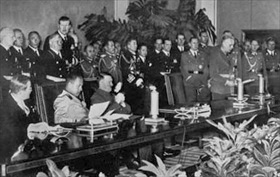
Left: On September 27, 1940, the Axis Powers (Germany and Italy) grew by one when Japan’s ambassador Saburō Kurusu (left in picture), Italy’s foreign minister Galeazzo Ciano (to Kurusu’s left), and Germany’s foreign minister Joachim von Ribbentrop (standing at podium at right) signed the three-way Tripartite Pact. Adolf Hitler (slumping in chair) witnessed the gala proceedings. Despite signing a 10‑year military and commercial convention in 1940, Germany, Italy, and Japan for the most part fought separately during World War II and surrendered separately less than 5 years into the pact: Italy in September 1943, Germany in May 1945, and Japan in September 1945. Americans remember Kurusu as 1 of 2 Japanese envoys Japanese envoys who tried to negotiate peace and understanding with the Roosevelt administration in November and December 1941 while their country was secretly preparing the attack on U.S. military installations at Pearl Harbor, Hawaii.
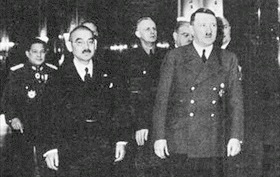
Right: Japanese foreign minister Yōsuke Matsuoka paid a visit to Hitler in Berlin in March 1941. In the background between Matsuoka and Hitler is German foreign minister Ribbentrop. Matsuoka, who in 1933 led Japan’s walkout of the League of Nations, was a major advocate of Japan’s alliance with Germany and Italy, whose assistance he saw as a perfect balancing force against U.S. interests in the Asia Pacific region. Following Japan’s defeat in 1945, Matsuoka was arrested by Gen. Douglas MacArthur, Supreme Commander of the Allied Powers, and held at Sugamo Prison (near Tokyo), where he died in 1946 prior to his trial on war crimes charges before the International Military Tribunal for the Far East (Tokyo Trials).
Japan Joins Germany and Italy in Tripartite Pact, September 27, 1940 (Skip first 20 seconds)
httpv://youtu.be/B6GzLKj5VhA