SOVIET INITIATIVE OUTSIDE MOSCOW SHOCKS GERMANS
Moscow, Soviet Union · December 6, 1941
Three weeks after launching Operation Barbarossa on June 22, 1941, the Germans and their Axis partners had reached close enough to Moscow to fly sorties and bomb the Soviet capital. Tactically, the Wehrmacht (German armed forces) won resounding victories, taking over 3 million Soviet prisoners in 1941 and seizing some of the most important economic resources of the Soviet Union, among them the heavily populated and rich agricultural heartland of the Ukraine. But the Eastern Front sucked Germany and its Axis allies in and refused to spit them out until they’d been mauled by Mother Nature, or been bloodied in fierce combat, or been victims of both actions. By November 1 the advancing German Army and Luftwaffe were paralyzed in their tracks by the worst winter weather in 140 years. The Wehrmacht in 1941 was simply not equipped for this kind of winter warfare; the Red Army was.
On this date in 1941 outside Moscow, Soviet forces attacked Axis lines to begin their successful offensive on their western front, the Battle of Moscow. A few German units had reached close enough to the Soviet capital 4 days earlier to glimpse the fabled golden spires of the Kremlin, just over a dozen miles away, but the army itself got no further in a white Russian hell where ill-clad soldiers died from severe frostbite, fuel froze, and machine guns ceased firing. (The day before the temperature stood at 36 below zero.) Gen. Ludwig Bock, commander of Army Group Center, and Gen. Heinz Guderian, who held command of the Second Panzer Army, knew their men were at the end of their abilities and resources. In one 3‑week period, German dead and wounded totaled 155,000. Some divisions were a fraction of their original strength.
General Field Marshal Walther von Brauchitsch responded to the disaster with coronary failure and resigned his post. Bock was replaced and Guderian summarily dismissed. Brauchitsch’s replacement as commander in chief of the armies was none other than Adolf Hitler, but even he could not stem the Soviet offensive, which ended on January 7, 1942, after Axis armies had been pushed back 60 to 150 miles/96 to 241 km. For the duration of the war Hitler, whose highest rank as a German soldier in World War I had been corporal, would oversee all military operations right up to the day of his suicide on April 30, 1945, as Red Army soldiers closed in on his underground headquarters beneath the shattered capital of his Thousand Year Reich.
Operation Barbarossa: Germany’s Invasion of the Soviet Union, 1941
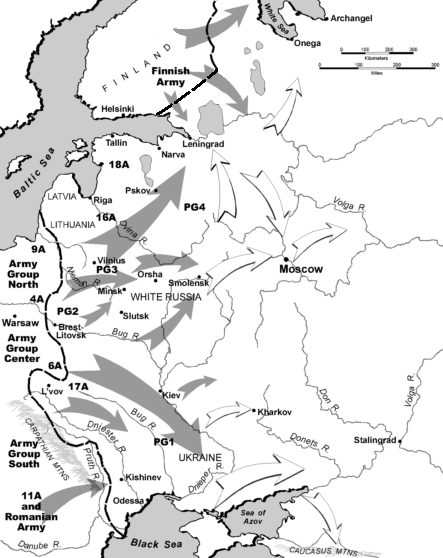 |
Above: Map of Axis and Finnish operations against the Soviet Union, June 22 to December 5, 1941. Operation Barbarossa was the largest military operation in history in both manpower and casualties. It eventually cost the German Army (Heer) over 210,000 killed and missing and 620,000 wounded in 1941, a third of whom became casualties after October 1. Unknown is the number of casualties among Romanian, Hungarian, and German Waffen‑SS units, as well as co-belligerent Finns.
 |
 |
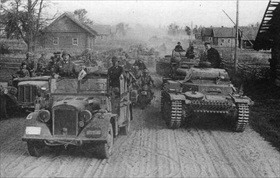
Left: Panzer units from Army Group Center speed into Western Belarus on an unpaved road, June 1941. By the end of the first week of Operation Barbarossa, all three German Army Groups—North, Center, and South—had achieved major campaign objectives. Chief of the Army Franz Halder trumpeted in his diary: “It is thus probably no overstatement to say that the Russian Campaign has been won in the space of 2 weeks.”
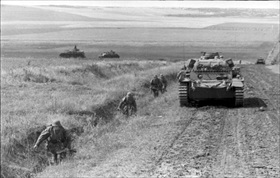
Right: A German tank and crouching infantry make good time crossing the steppes in July 1941. But 4 months into the campaign, temperatures fell and there was continual rain, which by mid-October would have turned this unpaved road into a muddy bog. The changed road conditions slowed the German advance on Moscow (Operation Typhoon) to as little as 2 miles/3.2 km a day.
 |
 |
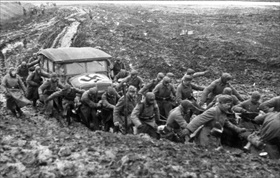
Left: German soldiers pull a staff car through heavy mud on a Russian road, November 1941. Hitler, arrogant and ruinously overconfident owing to his blitz of successes in Western Europe, expected a victory in the East within a few months, and therefore he did not prepare his Wehrmacht for a campaign that might last into a wet late fall, much less a bitterly cold winter. The assumption that the Soviet Union would quickly capitulate proved to be his, and Nazi Germany’s, tragic undoing.
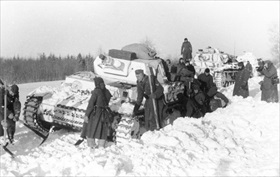
Right: On December 2, 1941, the first blizzards of the Russian winter began just as one unit of the Wehrmacht caught a glimpse of the spires of Moscow’s Kremlin 14 miles/22 km away. Sometime later a reconnaissance battalion crept to within 5 miles/8 km of Moscow, but that was as close to the military prize as any Wehrmacht unit managed. In this photo a Panzer IV tank in white camouflage is stranded in deep Russian snow as its crew attempts to free it. At the right edge of the photo is a war correspondent (admittedly hard to see), who filmed the scene for audiences back in Germany.
 |
 |
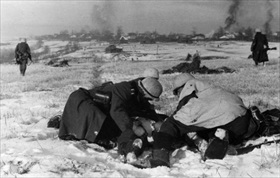
Left: Against the backdrop of burning houses near Moscow in November or December 1941 Germans attend to one of their own.
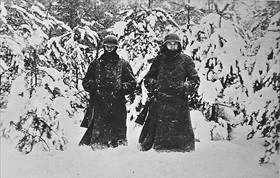
Right: Two German soldiers in heavy snow on guard duty west of Moscow, December 1941. December’s low temperature reached ‑40°F/‑40°C. More than 130,000 cases of frostbite were reported among German soldiers. The same weather hit Soviet troops, but they were better prepared for the cold.
Battle of Moscow (Operation Typhoon), September 30 to December 8, 1941
httpv://youtu.be/yJj6qBC3h5w