BRITAIN, FRANCE STAND FIRM ON POLAND
London, England and Paris, France • September 2, 1939
Shortly after British Prime Minister Neville Chamberlain and French Premier Édouard Daladier confirmed for themselves the German invasion of Poland on September 1, the 2 leaders gave the order for general mobilization and evacuation of hundreds of thousands of children and mothers, tens of thousands of hospital patients, and huge stores of food from their main cities to safe zones in rural areas. Both leaders also prepared to coordinate the delivery in Berlin of notes demanding German aggression against Poland be stopped and German troops promptly withdrawn. If the Germans could not provide assurance of that happening (there was no deadline), the British note concluded that the British government would fulfill its obligation under the terms of the Anglo-Polish military pact concluded the month before. In that pact, the Agreement of Mutual Assistance between Great Britain and Poland signed on August 25, 1939, each nation promised the other military support in the event either was attacked by some “European country.” In a secret protocol to the pact, the signatories specifically identified Nazi Germany as their common threat.
The British and French notes were handed late on the 1st to German Foreign Minister Joachim von Ribbentrop, who passed them on to his boss. Reading the notes Adolf Hitler could not determine if they were formal ultimatums or not. But on this date, September 2, 1939, Hitler decided that if the notes were ultimatums, then he would have nothing to do with an idea hastily floated in several European capitals, but mainly in Rome, Italy, of attending some sort of peace summit. (The British and French cabinets thought the idea was worth exploring.) Hitler said as much to the Italian leader Benito Mussolini the next day, adding that no conference was possible that devalued the “blood sacrifice” already made by German soldiers. Mediation? Armistice? Pullback? German concessions? all dealt a quick, diplomatic death. (Dealt also in less than a half-dozen years, German national suicide.)
Near 8 o’clock on the hot, humid evening of September 2, Chamberlain found the British House of Commons—its windows blacked out like all in London—in an anxious and truculent mood due in part to the absence of a deadline that might compel German forces to leave Poland. The prime minister sensed that his government would collapse the next day unless the Allies imposed an early deadline for Germany’s withdrawal. Across the Channel Daladier, meeting with a friendlier audience in the French Chamber of Deputies in Paris, received a standing ovation when he ticked off French efforts to preserve the peace and underscored the necessity of honoring the West’s pledges to Poland. (Actually, Chamberlain could have boasted to Members of Parliament of his own efforts to negotiate a settlement satisfactory to all parties, along with repeatedly pledging Britain’s support to Poland, but his speech was ill-prepared, uninspiring—not a word of British honor or Polish valor—very short (4 minutes), and very late (the speech had been postponed twice) in a very long day; hence, the angry mood of many MPs forced to wait the afternoon and evening out in the Commons smoking room bar.) Near midnight ministers in London and Paris finessed parallel ultimatums, to be delivered in Berlin at 9 a.m. on September 3, to expire later that day: Germany was to withdraw its troops from Poland immediately or a state of war would exist between the 3 nations.
French Ambassador Delivers Ultimatum to German Foreign Minister
 |
 |
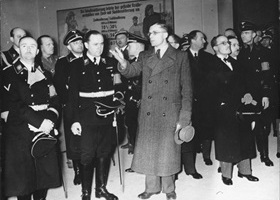
Left: Between 1938 and 1939 Robert Coulondre was France’s dapper ambassador to Berlin (and before that to Moscow for 2 years), shown here in 1939 holding his hat in his left hand. (Reichsfuehrer-SS Heinrich Himmler is at left in the photograph.) It was Coulondre who, on the morning of September 3, handed German Foreign Minister Joachim von Ribbentrop his government’s ultimatum, worked out the night before with London, demanding Germany “suspend all aggressive action against Poland and to declare themselves ready promptly to withdraw their forces from Polish territory” or face the consequences. France gave the Germans till 5 p.m. to comply. Ribbentrop said icily, “Very well, France will be the aggressor,” to which the seasoned Coulondre coolly replied: “History will be the judge of that.”
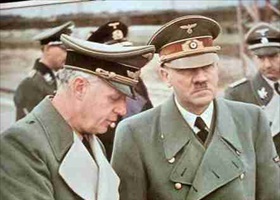
Right: Berlin’s diplomatic community thought Ribbentrop a “bumptious” (Coulondre’s description) person, conceited and arrogant. Even among his fellow Nazis, Ribbontrop was deeply unpopular, viewed as incompetent and bellicose in equal measure. (Ribbentrop had married into money and added a bogus aristocratic “von” to his name.) Coulondre (1885–1959) and Sir Nevile Henderson (1882–1942), Britain’s ambassador to Berlin, remarked on Ribbentrop’s snubbing them in their dealings with the German Foreign Office. Both diplomats much preferred working with Ribbentrop’s deputy, State Secretary Ernst Baron von Weizsaecker, an ex-naval officer and the father of future German President Richard von Weizsaecker (in office 1984–1994). In 1949 Baron von Weizsaecker was found guilty of crimes against humanity and sentenced to 7 years in prison in the Ministries Trials, 1 of 12 trials at Nuremberg that followed the International Military Tribunal in 1945–1946.
Hitler’s Blitzkrieg Targets Poland, Then Western Europe the Next Year
httpv://youtu.be/Ugc0b30IC9Q