Author: Norm Haskett

  • EIGHTH AIR FORCE BLASTS U-BOAT PENS IN FRANCE

    London, England · January 3, 1943 By the end of 1942 U-boats operating from ports in Germany and occupied Europe had sunk just over 1,160 ships (see Battle of the Atlantic). U‑boats claimed nearly 70 per­cent of all Allied and neu­tral shipping losses (about 7.8 million tons), and the Kriegs­marine appeared to be winning the ton­nage race, sinking…

  • JAPAN CAPTURES ISLAND CAPITAL

    Manila, Philippines · January 2, 1942 Japan intended to occupy the Philippine Islands as part of its plan for a “Greater East Asia War.” The nation’s Southern Expeditionary Army Group was tasked with seizing the islands, British Malaya (today’s Malaysia), and the Netherlands East Indies (now Indonesia) simul­taneously with the Japanese Navy’s assault on the…

  • 26 REPS IN CAPITAL AFFIRM “UNITED NATIONS”

    Washington, D.C. · January 1, 1942 On August 14, 1941, President Franklin D. Roose­velt and British Prime Minister Winston Chur­chill signed the Atlantic Charter on a war­ship off the Cana­dian coast. The two leaders hoped that, fol­lowing the defeat of Adolf Hitler’s Ger­many, coun­tries around the world would re­nounce the use of force in inter­national…

  • |

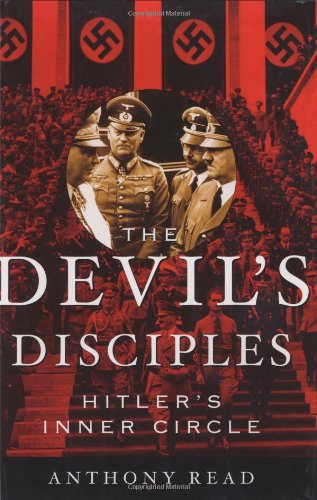
    The Devil’s Disciples: Hitler’s Inner Circle

    The Nazi regime was essentially a religious cult relying on the hypnotic personality of Adolf Hitler, and it was fated to die with him. But while it lasted, his closest lieutenants competed feriously for power and position as his chosen successor. This peculiar leadership dynamic resulted in millions of deaths and some of the worst excesses of World War II. This book examines these lieutenants, both as individuals and as a group. It focuses on the three most important Nazi paladins – Goring, Goebbels and Himmler – with their nearest rivals – Bormann, Speer and Ribbentrop – in close attendance. It shows how these personalities developed, and how their constant jealousies and intrigues affected the regime, the war and Hitler himself.

  • | |

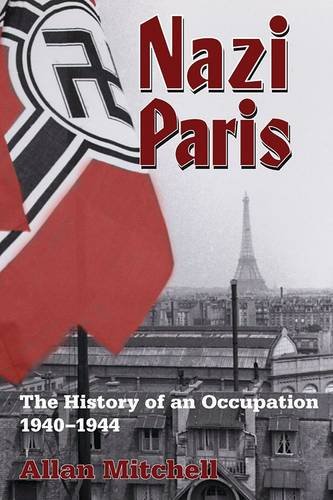
    Nazi Paris: The History of an Occupation, 1940-1944

    CHOICE OUTSTANDING ACADEMIC TITLE 2009

    “…an essential book. It provides precise facts and figures for many issues that have heretofore been presented in impressionistic terms.” · The International History Review

    Basing his extensive research into hitherto unexploited archival documentation on both sides of the Rhine, Allan Mitchell has uncovered the inner workings of the German military regime from the Wehrmacht’s triumphal entry into Paris in June 1940 to its ignominious withdrawal in August 1944. Although mindful of the French experience and the fundamental issue of collaboration, the author concentrates on the complex problems of occupying a foreign territory after a surprisingly swift conquest. By exploring in detail such topics as the regulation of public comportment, economic policy, forced labor, culture and propaganda, police activity, persecution and deportation of Jews, assassinations, executions, and torture, this study supersedes earlier attempts to investigate the German domination and exploitation of wartime France. In doing so, these findings provide an invaluable complement to the work of scholars who have viewed those dark years exclusively or mainly from the French perspective.

  • Rising Sun Victorious: An Alternate History of the Pacific War

    “Everyone with an interest in the Pacific War will find something stimulating in this thought-provoking study of what might have been.”
    –British Army Review

    In war, victory can be held hostage to seemingly insignificant incidents–chance events, opportunities seized or cast aside–that can derail the most brilliant military strategies and change the course of history. What if the Japanese had conquered India and driven out the British? What if the strategic link between the United States and Australia had been severed? What if Vice Admiral Nagumo had launched a third attack on Pearl Harbor? What if the U.S. Navy’s gamble at Midway had backfired?

    Ten leading military historians ask these and other questions in this fascinating book. The war with Japan was rife with difficult choices and battles that could have gone either way. These fact-based alternate scenarios offer intriguing insights into what might have happened in the Pacific during World War II, and what the consequences would have been for America.

    “A compelling read . . . bound to generate a good deal of debate.”
    –The Defense Information Bulletin

    “Rising Sun Victorious is must reading.”
    –Almanac of Seapower

  • The Winter War: Russia’s Invasion of Finland, 1939-1940

    “Edwards recounts events, both shameful and heroic, with insight, conviction and considerable wit.”—Publishers Weekly

    On November 30, 1939, the Soviet Union’s Red Army invaded the young nation-state of Finland, in the full expectation of routing the small, ill-equipped Finnish army and annexing the former Russian territory by the end of the year. But Finland held out for 105 bitterly cold, fiercely combative days, until March 15, 1940, when a peace agreement ended the short, savage Winter War.

    At the stirring center of the story lie the resourcefulness and resolve of the Finnish people, who against all military odds—in want of ammunition, food, sleep, and troops—fought a blundering, ineptly commanded Red Army to a standstill. On March 15, they ceded to the Soviet 11 percent of their territory and 30 percent of their economic assets, but none of their national pride.

    The Russians meanwhile had markedly damaged their international standing and effectively ruined their military reputation-to such an extent, as this probing chapter in World War II history demonstrates, that Germany, with proud-blooded Finland as an ally, dared to launch its 1940 invasion of Russia. At the same time, though, the fiasco of the Winter War forced Stalin to acknowledge the shortcomings of the Red Army and to reform it: Germany would fall at Stalingrad in 1941.

    With authority, this skillfully narrated military history unfolds its story of the four-month Soviet-Finnish war and explores its consequences from London to Moscow, from Helsinki to Paris, to Washington, DC. 20 black-and-white illustrations


  • The Winter War: Russia’s Invasion of Finland, 1939-1940

    “Edwards recounts events, both shameful and heroic, with insight, conviction and considerable wit.”—Publishers Weekly

    On November 30, 1939, the Soviet Union’s Red Army invaded the young nation-state of Finland, in the full expectation of routing the small, ill-equipped Finnish army and annexing the former Russian territory by the end of the year. But Finland held out for 105 bitterly cold, fiercely combative days, until March 15, 1940, when a peace agreement ended the short, savage Winter War.

    At the stirring center of the story lie the resourcefulness and resolve of the Finnish people, who against all military odds—in want of ammunition, food, sleep, and troops—fought a blundering, ineptly commanded Red Army to a standstill. On March 15, they ceded to the Soviet 11 percent of their territory and 30 percent of their economic assets, but none of their national pride.

    The Russians meanwhile had markedly damaged their international standing and effectively ruined their military reputation-to such an extent, as this probing chapter in World War II history demonstrates, that Germany, with proud-blooded Finland as an ally, dared to launch its 1940 invasion of Russia. At the same time, though, the fiasco of the Winter War forced Stalin to acknowledge the shortcomings of the Red Army and to reform it: Germany would fall at Stalingrad in 1941.

    With authority, this skillfully narrated military history unfolds its story of the four-month Soviet-Finnish war and explores its consequences from London to Moscow, from Helsinki to Paris, to Washington, DC. 20 black-and-white illustrations
  • Tojo

    General, minister of war, prime minister, and unrepentant ultranationalist, Hideki Tojo (1884–1948) was the most powerful leader in the Japanese government during World War II. From October 1941 to July 1944 he held unquestioned control, advocating and setting in motion the attack on Pearl Harbor as well as pushing forward the Japanese offensives in China, Southeast Asia, and the Pacific. The author examines Tojo’s life against the backdrop of increasing Japanese militarism—Civil war, political assassinations, and coup d’états—and uses exclusive interviews with Tojo’s wife to illuminate the spartan, single-minded, incorruptible personality of the man who chose war rather than succumb to U.S.–induced economic strangulation. From the initial victories, through the later severe defeats and Tojo’s resignation, to his thwarted suicide attempt, trial as a war criminal, and execution, no other book offers such a clear and compelling portrait.