AXIS FORTUNES RECOVER IN BALKANS

Belgrade, Yugoslavia · April 6, 1941

At the tail end of February 1941 British Commonwealth forces from Nigeria captured Moga­dishu, capital of Ital­ian Somali­land (part of today’s Somalia), after Benito Mussolini’s armies had aban­doned any pre­tense of defending their East Afri­can colony. The Ital­ian colony in the Horn of Africa had threa­tened the south­ern en­trance to the Suez Canal in Egypt, the Middle Eastern oil fields, and the Brit­ish sea route to India. On this date in 1941, two days after it was aban­doned by the Ital­ians, Addis Ababa, the Ethio­pian capi­tal, was occu­pied by Com­mon­wealth troops from South Africa—the first nation­al capi­tal lib­er­ated from the Axis. Ital­ian forces capitu­lated in Eri­trea on the Red Sea in a sep­a­rate cam­paign later that month. Mopping up oper­a­tions con­tinued until Novem­ber 1941, when all of Ital­ian East Africa fell under Allied control. Mean­while in Europe, the Bal­kans weighed heav­ily on the minds of Mus­so­li­ni and his Axis part­ner, Adolf Hitler. Il Duce’s armies, having in­vaded Greece from Ital­ian-held Alba­nia in late Octo­ber 1940, were faring poorly against Greek forces. Should Italy fail after Hitler had rushed 50,000 Ger­man troops to bol­ster Italy’s posi­tion in the Bal­kans, the Greeks might per­mit Great Brit­ain to base troops on their soil—already 60,000 Brit­ish and Com­mon­wealth troops had rushed to Greece’s aid—there­by poten­tially com­pli­cating Opera­tion Barba­rossa, Hitler’s colos­sal sum­mer cam­paign against the Soviet Union. So against the back­drop of Axis losses in East Africa, Axis armies from Hun­gary, Roma­nia, and Bul­garia, spear­headed by 33 Ger­man divisions and supported by 1,200 planes of the Luft­waffe, swept across the frontier into Yugo­sla­via and Greece on April 6, 1941, bringing both nations into the Axis orbit and forcing Allied troops into a painful Dunkirk-like evacu­ation of the Greek main­land. By April 29, 1941, the Allied pre­sence was gone. North of Greece, por­tions of Yugo­sla­via were placed under Axis occu­pa­tion, an­nexed by Italy (cen­tral Dal­ma­tia and part of Slo­ve­nia), or formed into a new Fascist state, Croatia. Three and a half years later, in Octo­ber 1944, the Ger­mans were forced to aban­don Greece, the same month they aban­doned Yugo­sla­via. Hun­dreds of thou­sands of Greeks died during the Nazi years along with a mil­lion Yugo­slavs, although most of the latter died at the hands of rival partisan groups.
[fblike]


[amazon_carousel widget_type=”ASINList” width=”600″ height=”200″ title=”Recommended Reading” market_place=”US” shuffle_products=”False” show_border=”False” asin=”098165259X,1781592489,1781591814,193627406X,1932455191,1855324733,1889247014,0300089236,0231700504,0982373430″ /]

Scenes from the German Balkans Campaign, April 1941
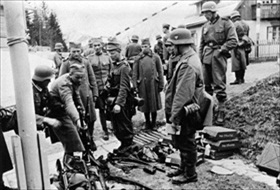
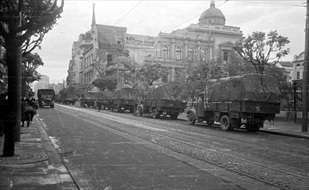
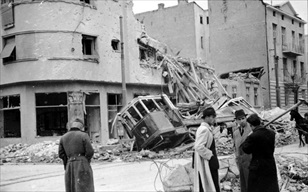
Yugoslav infantry unit surrenders, 1941 Damage to Yugoslavia's royal palace

Left: Starting on April 6, 1941, Axis armies invaded Yugo­sla­via from all sides. This photo shows a Yugo­slav infan­try unit sur­ren­dering on the first day of war.

Right: Operation Punishment was the code name for the Ger­man bombing of Bel­grade, Yugo­sla­via’s capital, which began on April 6, 1941 (Palm Sun­day), and con­tinued through April 10. Among the main tar­gets of the Luft­waffe was the Yugo­slav royal palace of King Peter II in down­town Belgrade.

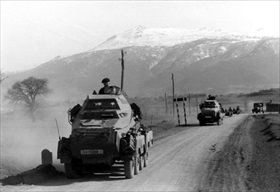
Damaged Belgrade street, 1941 German armored cars enter Greece, 1941

Left: A street damaged by the Luftwaffe’s bombing of Bel­grade, April 1941. Ger­man Field Marshal Paul von Kleist said during the post­war Nurem­berg Trials: “The air raid on Bel­grade in 1941 had a pri­marily poli­tical-ter­rorist char­acter and had nothing to do with the war. That air bombing was a matter of Hitler’s vanity, his per­son­al re­venge,” on the Yugo­slav offi­cers who over­threw Yugo­slavia’s pro-Axis regent, Prince Paul.

Right: Armored cars of the 1st SS Division Leib­standarte SS Adolf Hitler advance into Greece, April 1941.
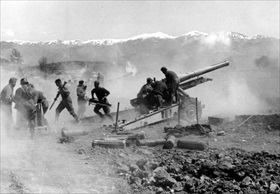
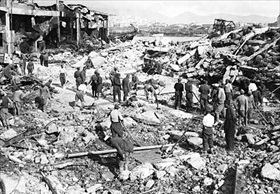
German artillery in Greece, 1941 Bomb damage to Piraeus, April 6, 1941

Left: German artillery firing during the advance into Greece, April 1941.

Right: Damage from the German bombing of Piraeus, Athens’ har­bor, on April 6, 1941. During the bombing, a ship carrying nitro­gly­cerin was hit, causing a huge explosion.

Yugoslavia During and After World War II

httpv://youtu.be/3d2JjJ_Zm1U
Similar Posts

  • HIROHITO BRIEFED ON HIROSHIMA CATASTROPHE

    Tokyo, Japan • August 8, 1945 On this date in 1945, Japan’s Foreign Minister Shige­nori Tōgō, the govern­ment’s leading civil­ian propo­nent of a peace settle­ment with the Allies, visited Emperor Hiro­hito (post­humously referred to as Em­peror Shōwa) at his palace to brief him on Hiro­shima’s ruin by (as Hiro­hito later char­ac­terized it) “a new and…

  • LEADING JAPANESE POLLED ON HOW TO END WAR

    Tokyo, Japan • August 29, 1944 From the summer of 1944 to the spring of 1945, Japanese forces con­tinued their retreat from mili­tary out­posts in South­east Asia and the Pacific. Japanese losses in person­nel, war­ships, and air­planes were mini­mized by front­line com­manders, who exag­gerated Japa­nese mili­tary successes against the Allied enemy in reports to Imperial…

  • U.S. SUCCESSFULLY DETONATES WORLD’S FIRST ATOMIC BOMB

    Trinity Test Site near Alamogordo, New Mexico • July 16, 1945 On this date in 1945 the first detonation of an atomic bomb directly led to greater un­imag­in­able destruc­tion when “Little Boy” and “Fat Man” immo­lated Hiro­shima and Naga­saki on August 6 and 9, 1945, respec­tively. Up until July 16, 1945, mili­tary brass and mili­tary and civil­ian scien­tists…

  • Jouer à Lucky8 Casino sur mobile : astuces et fonctionnalités clés

    Introduction au casino Lucky8 mobile Jouer au casino lucky8 sur mobile offre une expérience pratique et immersive pour les amateurs de jeux d’argent. Cette plateforme innovante a su adapter son interface pour les smartphones et tablettes, garantissant une navigation fluide et des performances optimales. Que vous soyez un joueur novice ou expérimenté, comprendre les fonctionnalités…

  • | | |

    Red Wind over the Balkans: The Soviet offensive south of the Danube, September-October 1944

    This book describes two Soviet offensive operations carried out during September and October 1944. The first was the operation for the occupation of Bulgaria – known as the ‘Bulgarian operation’; the second was the Belgrade offensive operation, which was carried out immediately after the Bulgarian operation. Although separate, the two operations were closely linked to each other: the first was conducted in an almost peaceful manner, which saved resources. This necessitated that the Soviet Command carried out the second operation promptly, which seriously endangered the encirclement of German Army Group position in the Southern Balkans. Pressed by the advancing Red Army, the German troops withdrew from the territories of Greece and Albania. They also relocated fresh forces from the Western Balkans to the Bulgarian-Yugoslav Border in order to build up a defense line.

    The book describes in detail the heavy battles during the Belgrade offensive operation. Both combatants suffered from the same problems: heavy mountainous terrain; poor roads and infrastructure; and severe weather conditions. This is one of the few Soviet offensives which started without a large superiority of their forces over those of the enemy. The German soldiers were trained to fight in mountainous conditions, and the Soviets were not. The Soviet armament was more modern, but heavier. Additionally, it was not designed to move on the narrow and steep mountain roads. Therefore, the success of this offensive operation was unclear for a long time. The German Command was but a step away from turning Belgrade into a fortress, and slowing down the war in the region for months. The Soviet troops won, but as a result of very tough fighting. After Bulgaria joined the Allied forces, its military forces were subject to the command of the 3rd Ukrainian Front. The commander of the Front used this new ally to the max – thus conserving Soviet forces. There is also a short description of the activities of the Bulgarian troops, who undertook a secondary offensive from the Aegean Sea to the town of Nis in Southern Serbia.

    The book describes the operations of both ground and air forces. Special attention is paid to the Soviet tank and mechanized units which participated in both operations, and the book benefits from a detailed set of daily statistics and accompanying analysis which has not been attempted before. As well as a detailed narrative, the author also provides information covering camouflage, markings and unit insignia. The authoritative text is supported by more than 400 photographs (the majority of them previously unpublished); full-color profiles showing the aforementioned camouflage, markings and unit insignia; and also full-color battle maps. This book is a result of the author’s years spent studying documents from the Russian Federation’s Central Archives of the Ministry of Defense and the Bulgarian State Military Historical Archives. Such a detailed study on this topic has not appeared before – and the author’s work is unlikely to be superseded.

  • Gérer votre compte Fatpirate Casino en toute simplicité

    Gérer un compte sur une plateforme de jeu en ligne comme fatpirate doit être une expérience fluide et sécurisée. Que vous soyez un joueur débutant ou expérimenté, comprendre comment naviguer dans votre compte Fatpirate Casino vous permettra de profiter pleinement de ses nombreuses fonctionnalités sans tracas. Dans cet article, nous vous guidons pas à pas…