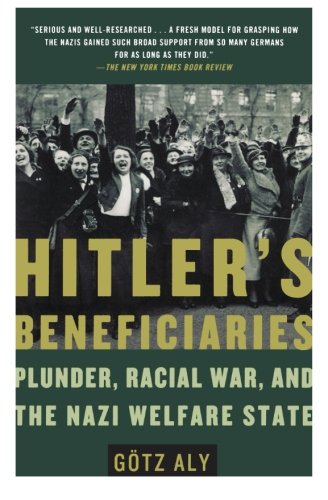
BIG NAZI PARTY RALLY IN NUREMBERG
Nuremberg, Germany · September 10, 1935
On this date in 1935 the Nazis convened their annual Party congress in Nuremberg completely fixated on the charismatic savior-figure Adolf Hitler, Germany’s chancellor since January 1933. The 1935 “Rally of Freedom” (Reichsparteitag der Freiheit) touted Hitler’s wildly popular reintegration of the Saar region into the German Reich (from 1920 to 1935 the Territory of the Saar Basin was a League of Nations mandate sandwiched between Germany and France), as well as the partial lifting of the hated Versailles Treaty of 1919 that constrained Germany’s room to maneuver militarily.
The real news, however, was made by Reichstag members whose strings, in Hitler’s deft hands, drew them to Nuremberg, the second-largest city in Bavaria after Munich. On September 15 the puppet German parliament passed the Nuremberg Laws (Nuernberger Gesetze) based on recommendations of top-level anti-Semitic Nazi ministers and officials meeting the month before, on August 20, 1935. Previous laws had allowed some Jews to avoid the Nazis’ discrimination aimed at them. But with passage of the Nuremberg Laws, there was no more wiggle room, no escape. A German Jew was classified as Jude based on the person’s descent from 3 or 4 Jewish grandparents, a Mischling (crossbreed) if descended from 1 or 2. Evading discrimination by converting to Christianity was now rendered impossible. Thus, one Nuremberg law forbade marriage or extramarital relations between Jews and “nationals of German or kindred blood,” and the employment of “German” females under 45 in Jewish households. A second law stripped German citizenship from persons not considered of German blood and introduced a new distinction between “Reich citizens” (Reichsbuerger)—pureblooded Germans—and “Reich nationals” (Staatsangehoerige).
The effect of these discriminatory statutory measures led straight to Kristallnacht (“Night of Broken Glass”), when carefully orchestrated anti-Jewish violence “erupted” throughout the Reich. Starting late on November 9, 1938, and for the next 48 hours, Nazi rioters, which included pre-teens and teenagers from the Hitler Youth and the League of German Girls, burned or damaged nearly every synagogue in Germany and ransacked and smashed the windows of more than 7,500 businesses, community centers, schools, and homes. Jewish cemeteries were desecrated. (Some Jews thought Kristallnacht called shame on the German people; hence, they referred to the night as Schamnacht, “Night of Shame.”) An estimated 400 Jews were murdered and 20,000 to 30,000 Jews between the ages of 10 and 80 were imprisoned or taken away to German concentration camps in the November pogrom. Over the next 10 months more than 115,000 Jews would flee their homeland in Germany and Austria, the latter now part of the Greater German Reich. Heaping insult on injury, the Nazi government demanded that Jews sweep up the mess and pay 1 billion Reichsmarks ($401.6 million) into government coffers for property damage caused during Kristallnacht.
Kristallnacht, November 9–10, 1938: Violent Turning Point in Nazi Germany’s Assault on Jews
 |
 |
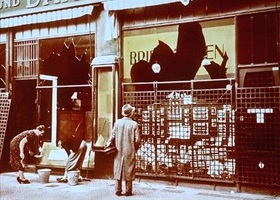
Left: Example of damage directed at Jewish businesses during Kristallnacht (literally “crystal night”). The German term alluded to the enormous number of windows shattered into tiny shards of glass during the night of vandalism that targeted mostly synagogues and Jewish-owned shops. With Kristallnacht the Nazis achieved three of their goals: confiscation of Jewish property by local branches of the Nazi Party to help finance the military buildup to war; increased separation, marginalization, and isolation of German Jews (in certain neighborhoods Jews were required to sell their homes at huge losses and move to other neighborhoods); and most importantly, the move from the anti-Semitic policy of discrimination to one of ethnic cleansing, which continued in the Third Reich and conquered territories until the end of World War II.
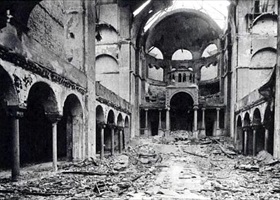
Right: Interior of Berlin’s Fasenenstrasse Synagogue, constructed between 1910 and 1912 in the affluent neighborhood of Charlottenburg off Kurfuerstendamm, after it was set on fire during Kristallnacht on the morning of November 10, 1938 (perhaps not ironically, Martin Luther’s birthday). In Berlin 9 out of 17 synagogues were torched; in Vienna, the Austrian capital, 95. In all, over 1,000 synagogues were vandalized or destroyed.
 |
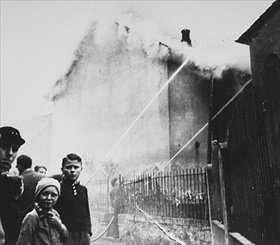 |
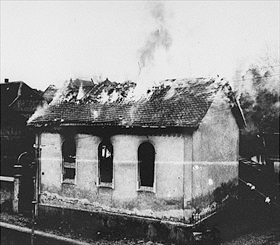
Left: Not even the smallest towns in Germany escaped the Nazis’ anti-Jewish pogrom. In this photo, a small synagogue in Ober Ramstadt (Hessen, Germany), roughly 18 miles/29 km south of Frankfurt am Main, burns on Kristallnacht.
Right: As the Ober Ramstadt synagogue burned, local residents watched firefighters instead save a nearby house. In some German cities, such as Cologne, police handed out axes and other tools of destruction to troublemakers in the mob, supplying them with a list of names and addresses of Jewish properties for them to destroy. The mobs cut fire hoses when firefighters directed water onto Jewish properties.
 |
 |
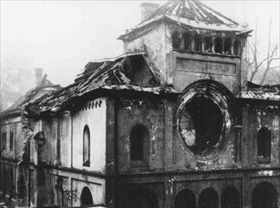
Left: Munich’s Herzog Rudolfstrasse synagogue off Maximillianstrasse, one of the city’s main boulevards. By midnight, November 9, 1938, attacks on Jewish businesses, schools, homes, and synagogues were occurring all over Germany and Austria prompted by a telex to regional and local police commanders with orders from Hitler and telephone calls from Nazi Party leaders to their underlings. Mobs roamed the streets shouting, “Beat the Jews to death!” or sang “When Jewish blood spurts from the knife, then things will go twice as nice.” In Munich, the first synagogues started burning at midnight. In Berlin, Kristallnacht was delayed until 2 a.m. on November 10 so that the police would have time to prepare the rampage. They identified Jewish properties that would be destroyed and set up roadblocks to keep traffic away from those areas. Police were instructed not to interfere with the rioters unless they resorted to looting or “other special excesses.” Looting happened anyway. Private homes were broken into, contents stolen or smashed, and books dumped in streets to be burned in piles with other Jewish books.
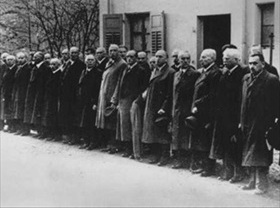
Right: As the looting and destruction wound down on November 10, 1938, the arrests began. Jewish males of all ages were rounded up and marched through the streets as some of their Aryan (non-Jewish) neighbors hurled insults at them. In this photograph, Jews arrested after Kristallnacht await deportation to Dachau concentration camp north of Munich. Others were sent to Buchenwald and Sachsenhausen concentration camps. The treatment of camp inmates was brutal, but most were released and returned to their families within 3 months on the condition they leave Germany.
Kristallnacht, November 9–10, 1938: Holocaust Start Date
httpv://youtu.be/-y0uwd9QAYE