Hitler & Third Reich

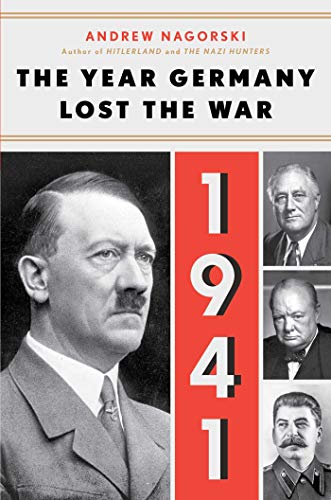
  • 1941: The Year Germany Lost the War

    Bestselling historian Andrew Nagorski takes a fresh look at the decisive year 1941, when Hitler’s miscalculations and policy of terror propelled Churchill, FDR, and Stalin into a powerful new alliance that defeated Nazi Germany.

    In early 1941, Hitler’s armies ruled most of Europe. Churchill’s Britain was an isolated holdout against the Nazi tide, but German bombers were attacking its cities and German U-boats were attacking its ships. Stalin was observing the terms of the Nazi-Soviet Pact, and Roosevelt was vowing to keep the United States out of the war. Hitler was confident that his aim of total victory was within reach.

    \By the end of 1941, all that changed. Hitler had repeatedly gambled on escalation and lost: by invading the Soviet Union and committing a series of disastrous military blunders; by making mass murder and terror his weapons of choice, and by rushing to declare war on the United States after Japan’s attack on Pearl Harbor. Britain emerged with two powerful new allies—Russia and the United States. By then, Germany was doomed to defeat.

    Nagorski illuminates the actions of the major characters of this pivotal year as never before. 1941: The Year Germany Lost the War is a stunning examination of unbridled megalomania versus determined leadership. It also reveals how 1941 set the Holocaust in motion, and presaged the postwar division of Europe, triggering the Cold War. 1941 was a year that forever defined our world.
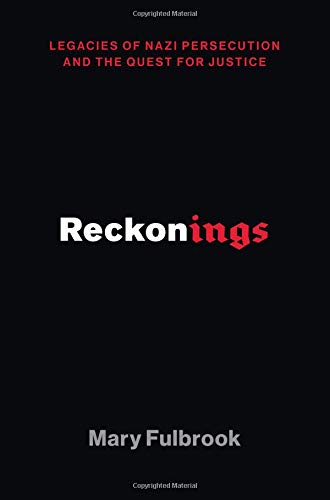
  • Reckonings: Legacies of Nazi Persecution and the Quest for Justice

    A single word–“Auschwitz”–is sometimes used to encapsulate the totality of persecution and suffering involved in what we call the Holocaust. Yet focusing on a single concentration camp, however horrific the scale of crimes committed there, leaves an incomplete story, truncates a complex history and obscures the continuing legacies of Nazi crimes.

    Mary Fulbrook’s encompassing book explores the lives of individuals across a full spectrum of suffering and guilt, each one capturing one small part of the greater story. Using “reckoning” in the widest possible sense to evoke how the consequences of violence have expanded almost infinitely through time, from early brutality through programs to euthanize the sick and infirm in the 1930s to the full functioning of the death camps in the early 1940s, and across the post-war decades of selective confrontation with perpetrators and ever-expanding commemoration of victims, Fulbrook exposes the disjuncture between official myths about “dealing with the past” and the extent to which the vast majority of Nazi perpetrators evaded responsibility. In the successor states to the Third Reich — East Germany, West Germany, and Austria — prosecution varied widely. Communist East Germany pursued Nazi criminals and handed down severe sentences; West Germany, caught between facing up to the past and seeking to draw a line under it, tended toward selective justice and reintegration of former Nazis; and Austria made nearly no reckoning at all until the mid-1980s, when news broke about Austrian presidential candidate Kurt Waldheim’s past. The continuing battle with the legacies of Nazism in the private sphere was often at odds with public remembrance and memorials.

    Following the various phases of trials and testimonies, from those immediately after the war to those that stretched into the decades following, Reckonings illuminates shifting public attitudes toward both perpetrators and survivors, and recalibrates anew the scales of justice.

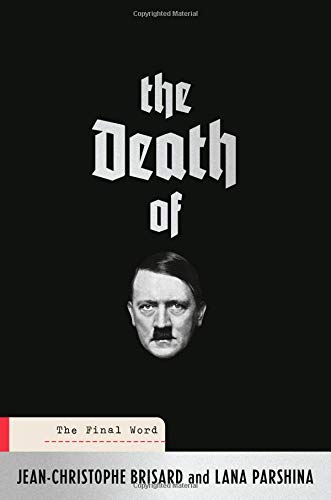
  • The Death of Hitler: The Final Word

    On April 30, 1945, Hitler committed suicide in his bunker as the Red Army closed in on Berlin. Within four days the Soviets had recovered his body. But the truth about what the Russian secret services found was hidden from history, when, three months later, Stalin officially declared to Truman and Churchill that Hitler was still alive and had escaped abroad. Reckless rumors about what really happened to Hitler began to spread like wildfire and, even today, they have not been put to rest. Until now.

    In 2017, after two years of painstaking negotiations with the Russian authorities, award-winning investigative journalists Jean-Christophe Brisard and Lana Parshina gained access to confidential Soviet files that finally revealed the truth behind the incredible hunt for Hitler’s body.

    Their investigation includes new eyewitness accounts of Hitler’s final days, exclusive photographic evidence and interrogation records, and exhaustive research into the power struggle that ensued between Soviet, British, and American intelligence services. And for the first time since the end of World War II, official, cutting-edge forensic tests have been completed on the human remains recovered from the bunker graves–a piece of skull with traces of a lethal bullet, a fragment of bone, and teeth.

    In The Death of Hitler–written as thrillingly as any spy novel–Brisard and Parshina debunk all previous conspiracy theories about the death of the Führer. With breathtaking precision and immediacy they penetrate one of the most powerful and controversial secret services to take readers inside Hitler’s bunker in its last hours–and solve the most notorious cold case in history.

  • Hitler in Los Angeles: How Jews Foiled Nazi Plots Against Hollywood and America

    A 2018 FINALIST FOR THE PULITZER PRIZE

    The chilling, little-known story of the rise of Nazism in Los Angeles, and the Jewish leaders and spies they recruited who stopped it.

    No American city was more important to the Nazis than Los Angeles, home to Hollywood, the greatest propaganda machine in the world. The Nazis plotted to kill the city’s Jews and to sabotage the nation’s military installations: plans existed for hanging twenty prominent Hollywood figures such as Al Jolson, Charlie Chaplin, and Samuel Goldwyn; for driving through Boyle Heights and machine-gunning as many Jews as possible; and for blowing up defense installations and seizing munitions from National Guard armories along the Pacific Coast.

    U.S. law enforcement agencies were not paying close attention–preferring to monitor Reds rather than Nazis–and only Leon Lewis and his daring ring of spies stood in the way. From 1933 until the end of World War II, attorney Leon Lewis, the man Nazis would come to call “the most dangerous Jew in Los Angeles,” ran a spy operation comprised of military veterans and their wives who infiltrated every Nazi and fascist group in Los Angeles. Often rising to leadership positions, this daring ring of spies uncovered and foiled the Nazi’s disturbing plans for death and destruction.

    Featuring a large cast of Nazis, undercover agents, and colorful supporting players, Hitler in Los Angeles, by acclaimed historian Steven J. Ross, tells the story of Lewis’s daring spy network in a time when hate groups had moved from the margins to the mainstream.

  • Stormtroopers: A New History of Hitler’s Brownshirts

    The first full history of the Nazi Stormtroopers whose muscle brought Hitler to power, with revelations concerning their longevity and their contributions to the Holocaust

    Germany’s Stormtroopers engaged in a vicious siege of violence that propelled the National Socialists to power in the 1930s. Known also as the SA or Brownshirts, these “ordinary” men waged a loosely structured campaign of intimidation and savagery across the nation from the 1920s to the “Night of the Long Knives” in 1934, when Chief of Staff Ernst Röhm and many other SA leaders were assassinated on Hitler’s orders.
     
    In this deeply researched history, Daniel Siemens explores not only the roots of the SA and its swift decapitation but also its previously unrecognized transformation into a million-member Nazi organization, its activities in German-occupied territories during World War II, and its particular contributions to the Holocaust. The author provides portraits of individual members and their victims and examines their milieu, culture, and ideology. His book tells the long-overdue story of the SA and its devastating impact on German citizens and the fate of their country.

  • The Winter Fortress: The Epic Mission to Sabotage Hitler’s Atomic Bomb

    From the internationally acclaimed, best-selling author of Hunting Eichmann and The Perfect Mile, an epic adventure and spy story about the greatest act of sabotage in all of World War II.
     
    It’s 1942 and the Nazis are racing to be the first to build a weapon unlike any known before. They have the physicists, they have the uranium, and now all their plans depend on amassing a single ingredient: heavy water, which is produced in Norway’s Vemork, the lone plant in all the world that makes this rare substance. Under threat of death, Vemork’s engineers push production into overdrive.
     
    For the Allies, the plant must be destroyed. But how would they reach the castle fortress set on a precipitous gorge in one of the coldest, most inhospitable places on Earth?
     
    Based on a trove of top secret documents and never-before-seen diaries and letters of the saboteurs, The Winter Fortress is an arresting chronicle of a brilliant scientist, a band of spies on skies, perilous survival in the wild, sacrifice for one’s country, Gestapo manhunts, soul-crushing setbacks, and a last-minute operation that would end any chance Hitler could obtain the atomic bomb—and alter the course of the war.
     

  • With Hitler and Mussolini: Memoirs of a Nazi Interpreter

    An insider’s view of Hitler, Himmler, Heydrich, and Mussolini.

    In the years before World War II, Eugen Dollmann arrived in Rome on a scholarship, intending to write a history of the Catholic Church. Instead he joined the Nazi Party and became an interpreter to various members of the German and Italian Fascist hierarchy.

    In this capacity Dollmann attended the Munich Conference of 1938 and was present at most of the important meetings between Hitler and Mussolini, also witnessing many of the endless squabbles between Mussolini’s son-in-law Galeazzo Ciano and Hitler’s foreign secretary, Joachim von Ribbentrop. He interpreted for Heinrich Himmler during his visits to Rome and was, curiously for one of his temperament, appointed Obersturmführer in the Allgemeine SS. He played a considerable role in the surrender of the German Army in Italy, helping to prevent the execution of Hitler’s scorched-earth orders.

    The book is full of piquant anecdotes—Himmler’s excavations for the legendary treasure of King Alaric; the visit of Reinhard Heydrich to the House of the Provinces, a brothel frequented by officers and men of means; Hitler’s dread and annoyance at being piloted into his newly conquered Ukraine by Mussolini—to mention only a few.

    Throughout, Dollmann makes no attempt to conceal or exonerate his association with the Nazis. With Hitler and Mussolini is a fascinating memoir filled with political intrigue, undercover activity, and insights into the biggest personalities connected to the Second World War.
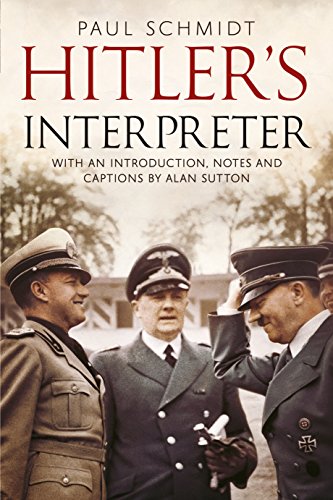
  • Hitler’s Interpreter

    As the main interpreter for Adolf Hitler during the key prewar moments, such as the Munich Agreement, the British Declaration of War and the surrender of France, Paul-Otto Schmidt was well placed to record his impressions of events from 1935 up to 1945.

    He was an interpreter working in the German foreign ministry where he served from 1923 to 1945, and being fluent in English and French he gained respect and was Hitler’s usual first choice for the important meetings. During the war years he served as Hitler’s interpreter during his meetings with Marshal Philippe Pétain and Francisco Franco.

    After the 1942 Dieppe Raid resulted in thousands of Canadian soldiers captured, Schmidt was in charge of their interrogations. Schmidt’s book is helpful in gaining an insight into the minutiae of Third Reich thinking and planning―as much as planning went beyond Hitler’s will. One classic nugget is from the early morning of 3 September 1939 when Britain issued its ultimatum to Germany, for it was Schmidt who had to hand the translation to Hitler: ‘After an interval which seemed an age, he turned to Ribbentrop, who had remained standing by the window. “What now?” asked Hitler with a savage look, as though implying that his Foreign Minister had misled him about England’s probable reaction.’

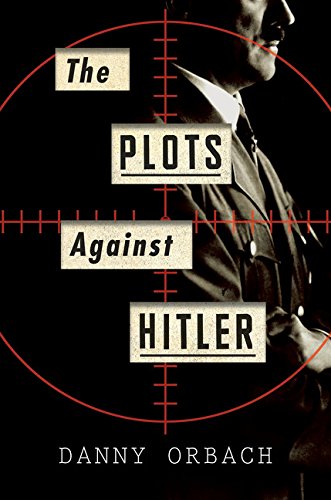
  • The Plots Against Hitler

    A new and definitive account of the anti-Nazi underground in Germany and its numerous efforts to assassinate Adolf Hitler

    In 1933, Adolf Hitler became Chancellor of Germany. A year later, all parties but the Nazis had been outlawed, freedom of the press was but a memory, and Hitler’s dominance seemed complete. Yet over the next few years, an unlikely clutch of conspirators emerged – soldiers, schoolteachers, politicians, diplomats, theologians, even a carpenter – who would try repeatedly to end the Fuhrer’s genocidal reign. This dramatic and deeply researched book tells the full story of those noble, ingenious, and doomed efforts. This is history at its most suspenseful, as we witness secret midnight meetings, crises of conscience, fierce debates among old friends about whether and how to dismantle Nazism, and the various plots themselves being devised and executed.
     
    Orbach’s fresh research takes advantage of his singular skills as linguist and historian to offer profound insight into the conspirators’ methods, motivations, fears, and hopes. Though we know how this story ends, we’ve had no idea until now how close it came – several times – to ending very differently. The Plots Against Hitler fundamentally alters our view of World War II and sheds bright – even redemptive – light on its darkest days.

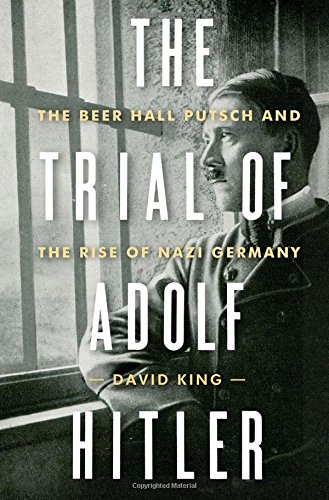
  • The Trial of Adolf Hitler: The Beer Hall Putsch and the Rise of Nazi Germany

    The never-before-told story of the scandalous courtroom drama that paved the way for the rise of Adolf Hitler and the Nazi Party.

    On the evening of November 8, 1923, the thirty-four-year-old Adolf Hitler stormed into a beer hall in Munich, fired his pistol in the air, and proclaimed a revolution. Seventeen hours later, all that remained of his bold move was a trail of destruction. Hitler was on the run from the police. His career seemed to be over.

    The Trial of Adolf Hitler tells the true story of the monumental criminal proceeding that followed when Hitler and nine other suspects were charged with high treason. Reporters from as far away as Argentina and Australia flocked to Munich for the sensational four-week spectacle. By its end, Hitler would transform the fiasco of the beer hall putsch into a stunning victory for the fledgling Nazi Party. It was this trial that thrust Hitler into the limelight, provided him with an unprecedented stage for his demagoguery, and set him on his improbable path to power.

    Based on trial transcripts, police files, and many other new sources, including some five hundred documents recently discovered from the Landsberg Prison record office, The Trial of Adolf Hitler is a gripping true story of crime and punishment―and a haunting failure of justice with catastrophic consequences.

    8 pages of illustrations