Hitler & Third Reich

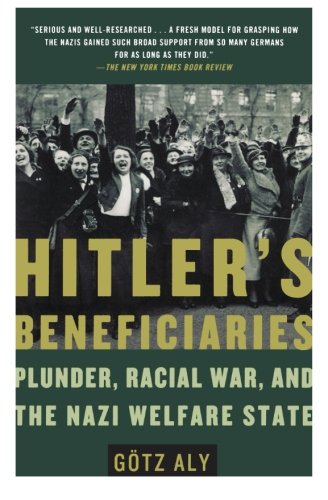
  • Hitler’s Beneficiaries: Plunder, Racial War, and the Nazi Welfare State

    A “provocative” account of great “intellectual significance,” illuminating the economic workings of the Third Reich―and the reasons ordinary Germans supported the Nazi state (The New York Times Book Review)

    In this groundbreaking book, historian Götz Aly addresses one of modern history’s greatest conundrums: How did Hitler win the allegiance of ordinary Germans? The answer is as shocking as it is persuasive: by engaging in a campaign of theft on an almost unimaginable scale―and by channeling the proceeds into generous social programs―Hitler literally “bought” his people’s consent.

    Drawing on secret files and financial records, Aly shows that while Jews and citizens of occupied lands suffered crippling taxation, mass looting, enslavement, and destruction, most Germans enjoyed an improved standard of living. Buoyed by millions of packages soldiers sent from the front, Germans also benefited from the systematic plunder of Jewish possessions. Any qualms were swept away by waves of tax breaks and government handouts.

    Hitler’s Beneficiaries has been hailed as “startling” by Richard Evans, and as “fascinating and important” by Christopher Browning. Above all, as Omer Bartov testifies, this remarkable book “irreversibly transforms our understanding of the Third Reich.”

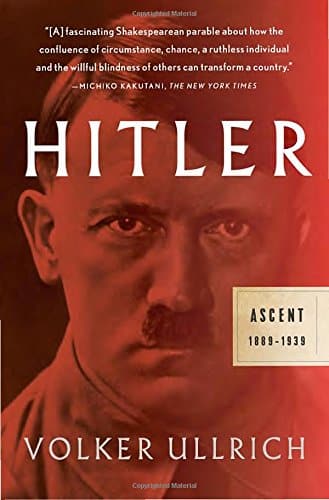
  • Hitler: Ascent, 1889-1939

    Winner of the Los Angeles Times Book Prize for Biography

    A New York Times bestseller, this major new biography of Hitler puts an emphasis on the man himself: his personality, his temperament, and his beliefs.

    Volker Ullrich’s Hitler, the first in a two-volume biography, has changed the way scholars and laypeople alike understand the man who has become the personification of evil. Drawing on previously unseen papers and new scholarly research, Ullrich charts Hitler’s life from his childhood through his experiences in the First World War and his subsequent rise as a far-right leader. Focusing on the personality behind the policies, Ullrich creates a vivid portrait of a man and his megalomania, political skill, and horrifying worldview. Hitler is a landmark biography with unsettling resonance in these times.

  • | | |

    Red Wind over the Balkans: The Soviet offensive south of the Danube, September-October 1944

    This book describes two Soviet offensive operations carried out during September and October 1944. The first was the operation for the occupation of Bulgaria – known as the ‘Bulgarian operation’; the second was the Belgrade offensive operation, which was carried out immediately after the Bulgarian operation. Although separate, the two operations were closely linked to each other: the first was conducted in an almost peaceful manner, which saved resources. This necessitated that the Soviet Command carried out the second operation promptly, which seriously endangered the encirclement of German Army Group position in the Southern Balkans. Pressed by the advancing Red Army, the German troops withdrew from the territories of Greece and Albania. They also relocated fresh forces from the Western Balkans to the Bulgarian-Yugoslav Border in order to build up a defense line.

    The book describes in detail the heavy battles during the Belgrade offensive operation. Both combatants suffered from the same problems: heavy mountainous terrain; poor roads and infrastructure; and severe weather conditions. This is one of the few Soviet offensives which started without a large superiority of their forces over those of the enemy. The German soldiers were trained to fight in mountainous conditions, and the Soviets were not. The Soviet armament was more modern, but heavier. Additionally, it was not designed to move on the narrow and steep mountain roads. Therefore, the success of this offensive operation was unclear for a long time. The German Command was but a step away from turning Belgrade into a fortress, and slowing down the war in the region for months. The Soviet troops won, but as a result of very tough fighting. After Bulgaria joined the Allied forces, its military forces were subject to the command of the 3rd Ukrainian Front. The commander of the Front used this new ally to the max – thus conserving Soviet forces. There is also a short description of the activities of the Bulgarian troops, who undertook a secondary offensive from the Aegean Sea to the town of Nis in Southern Serbia.

    The book describes the operations of both ground and air forces. Special attention is paid to the Soviet tank and mechanized units which participated in both operations, and the book benefits from a detailed set of daily statistics and accompanying analysis which has not been attempted before. As well as a detailed narrative, the author also provides information covering camouflage, markings and unit insignia. The authoritative text is supported by more than 400 photographs (the majority of them previously unpublished); full-color profiles showing the aforementioned camouflage, markings and unit insignia; and also full-color battle maps. This book is a result of the author’s years spent studying documents from the Russian Federation’s Central Archives of the Ministry of Defense and the Bulgarian State Military Historical Archives. Such a detailed study on this topic has not appeared before – and the author’s work is unlikely to be superseded.


  • |

    The Devil’s Disciples: Hitler’s Inner Circle

    The Nazi regime was essentially a religious cult relying on the hypnotic personality of Adolf Hitler, and it was fated to die with him. But while it lasted, his closest lieutenants competed feriously for power and position as his chosen successor. This peculiar leadership dynamic resulted in millions of deaths and some of the worst excesses of World War II. This book examines these lieutenants, both as individuals and as a group. It focuses on the three most important Nazi paladins – Goring, Goebbels and Himmler – with their nearest rivals – Bormann, Speer and Ribbentrop – in close attendance. It shows how these personalities developed, and how their constant jealousies and intrigues affected the regime, the war and Hitler himself.

  • | |

    Nazi Paris: The History of an Occupation, 1940-1944

    CHOICE OUTSTANDING ACADEMIC TITLE 2009

    “…an essential book. It provides precise facts and figures for many issues that have heretofore been presented in impressionistic terms.” · The International History Review

    Basing his extensive research into hitherto unexploited archival documentation on both sides of the Rhine, Allan Mitchell has uncovered the inner workings of the German military regime from the Wehrmacht’s triumphal entry into Paris in June 1940 to its ignominious withdrawal in August 1944. Although mindful of the French experience and the fundamental issue of collaboration, the author concentrates on the complex problems of occupying a foreign territory after a surprisingly swift conquest. By exploring in detail such topics as the regulation of public comportment, economic policy, forced labor, culture and propaganda, police activity, persecution and deportation of Jews, assassinations, executions, and torture, this study supersedes earlier attempts to investigate the German domination and exploitation of wartime France. In doing so, these findings provide an invaluable complement to the work of scholars who have viewed those dark years exclusively or mainly from the French perspective.