

FRANCE BEGINS TO EMPTY ITSELF OF JEWS
Paris, Occupied France · May 27, 1942
On May 10, 1940, Adolf Hitler, having ended Poland’s existence in September 1939, turned his wrath on the democracies in the West. The Netherlands and Belgium capitulated to his war machine in May. Representatives of Marshal Philippe Pétain, who had recently been named premier of the French Third Republic, signed a ceasefire with Hitler on June 22, 1940. Hitler could not have made the armistice ceremony any more humiliating for the French, occurring as it did in the same railway car at Compiègne in northern France where Kaiser Wilhelm II’s delegates had signed the World War I armistice. Early in October 1940 Marshal Pétain’s collaborationist Vichy government—named after the resort community in which his administration had settled—approved the first French anti-Semitic law, Statut des Juifs. Similar anti-Semitic laws were quickly approved in the Vichy possessions of Algeria, Morocco, and Tunisia. Passed largely unopposed and without coercion from German authorities, the French defined Jewishness in more encompassing terms than did the Nazis’ infamous Nuremberg Laws of the 1930s, and like the Nuremberg Laws the Statut des Juifs deprived French Jews of the right to hold public office and deprived them of normal French citizenship. Naturalized French citizens had their papers revoked. Arrests of Jews in Paris began in May 1941, not long after the establishment of a General Commissariat for Jewish Questions. In the summer of 1941 the chasse aux Juifs, the hunt for Jews, began in earnest, so zealously pursued by French collaborators and anti-Semites that even the Nazis were said to be impressed. The Milice (French Gestapo, nominally headed by Vichy Prime Minister and Minister of the Interior, Pierre Laval) and the French Self-Defense Corps, both largely manned by native Fascist thugs and released jailbirds, helped the Germans round up thousands of Jews for deportation. The victims were taken to the newly opened internment camp of Drancy on the outskirts of Paris, others to a camp at Compiègne. (In all, there were over 200 internment camps in France and its overseas possessions.) On this date in 1942 more than a thousand French Jews, the first of over 75,000, were herded into cattle cars destined for Nazi camps in the east—chiefly Auschwitz—where they would be systematically exterminated.
[fblike]
[amazon_carousel widget_type=”ASINList” width=”600″ height=”200″ title=”Recommended Reading” market_place=”US” shuffle_products=”False” show_border=”False” asin=”1936274310,0300126018,0199254575,0199970866,0804724997,0803299141,0810118432,1845457862,0385497059,0195090527″ /]
The French “Hunt for Jews” (Chasse aux Juifs), Paris, Summer 1941
 |
 |
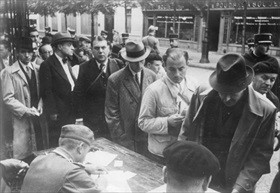
Left: Shortly after the German occupation of France in June 1940, the reactionary, collaborationist Vichy administration of Marshal Philippe Pétain, encouraged by occupation authorities, began a program of registering all 330,000 Jews in France; only half were French nationals. This photo shows officials examining the identity cards of Parisians stopped at a sidewalk table.
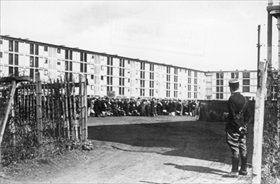
Right: The Drancy internment camp northeast of Paris was an interrogation, detention, and assembly camp, mainly for Jews, but also for communists, Freemasons, human smugglers (passeurs), and other enemies of the Vichy government. In May 1941, when the arrest of Jews in Paris began, French police brought the first 13,000 of their victims to the Velodrome d’Hiver, or Winter Velodrome, a Paris cycling stadium, a stone’s throw from the Eiffel tower, before busing them to Drancy.
 |
 |
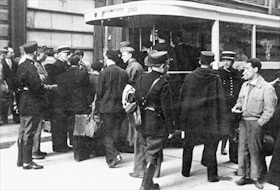
Left: French police arrest Jews in Paris and place them on a bus for transport to one of Vichy’s internment camps for registration and interrogation. The largest camp, Drancy, together with its five subcamps, first fell under French police administration. In 1943 the camps became the responsibility of the Gestapo Office of Jewish Affairs in France.
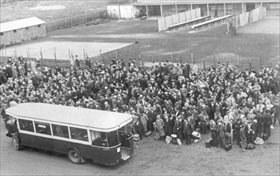
Right: Busloads of Jews arrive at Drancy internment camp in this August 1941 photograph.
 |
 |
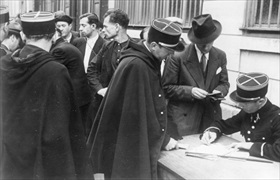
Left: French police process their Jewish hostages. The German Army set up internment camps to hold Allied civilians captured in areas it occupied in France. Civilians included U.S. citizens caught in Europe by surprise when Hitler declared war on America in December 1941, as well as British Commonwealth citizens caught in areas engulfed by the Blitzkrieg in the West.
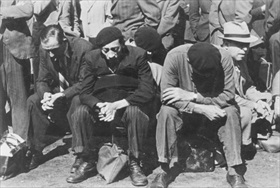
Right: Traumatized Jews await an unknown fate. (Could any of them have predicted what Hitler had in store for them?) Between June 22, 1942, and the end of July 1944, 67,400 French, Polish, and German Jews were deported from France in 64 rail transports, mainly to Auschwitz but some to Sobibór, both extermination camps in Nazi-occupied Poland. Among them were 11,000 children, some less than two years old, including infants only days old. People over 60 numbered 9,000. The oldest was a 95-year-old woman. At the Drancy internment camp just 1,542 internees remained alive when Allied forces liberated it on August 17, 1944.
Vichy French Newsreels from the Early 1940s. Includes Marshal Pétain Addressing Nation
httpv://youtu.be/dU61J_xXBAE