HITLER INVADES CZECHOSLOVAKIA
Prague, Czechoslovakia · March 15, 1939
From the ruins of the Austro-Hungarian Empire in November 1918 a half-dozen new states emerged. Among them were Austria and Czechoslovakia. When Austria was incorporated into Adolf Hitler’s Greater German Reich in March 1938, Czechoslovakia found itself inside a German pincer. On October 1, 1938, following the Munich Agreement signed by Hitler, his Axis partner Benito Mussolini, Neville Chamberlain, and Édouard Daladier—the leaders of Germany, Italy, Great Britain, and France, respectively—Czech Sudetenland was offered up to Germany on a platter of appeasement after Hitler loudly complained that Czechs discriminated against its German-speaking citizens. Ever the master of intrigue and deceit, Hitler set out to encourage internal unrest in the rest of Czechoslovakia. He focused on the eastern provinces of Slovakia and Ruthenia, which enjoyed a fair degree of autonomy from the central government in Prague, encouraging them to demand even greater independence. After Slovakia declared its independence on March 14, 1939, putting an end to the Czechoslovak state, Hitler sent mechanized German troops splashing their way into Prague on this blustery, rainy morning in 1939. The invaders were greeted with hisses and catcalls and people singing the Czech national anthem. Slovakia became a German puppet state, and the western Czech lands of Bohemia and Moravia (see map) were incorporated into Germany as a “Reich Protectorate.” Czechoslovakia was erased from the map. Within six months other creations of the post-World War I era also disappeared. The “Free City of Danzig” and the “Polish Corridor”—the narrow strip of land that separated East Prussia from the rest of Germany—were consumed in a blitzkrieg Hitler unleashed on September 1, 1939, to the utter dismay, revulsion, and sense of betrayal felt by Chamberlain and Daladier. (Chamberlain, having met Hitler on a half-dozen occasions, described him as “the blackest devil he had ever met.”) Adopting the same strategy he had used in 1938 Czechoslovakia, Hitler told a reverent Reichstag on that fateful September day in 1939 that Germans in Poland were being persecuted “with bloody terror” and driven from their homes. No great power could tolerate that, he declared. Discarding his customary brown party jacket for a field-grey officer’s uniform, Hitler told his audience: “From now on I am just the first soldier of the German Reich.” He vowed not to take off his new uniform until he had achieved victory or he died trying.
[fblike]
[amazon_carousel widget_type=”ASINList” width=”600″ height=”200″ title=”Recommended Reading” market_place=”US” shuffle_products=”False” show_border=”False” asin=”0880335351,0062030345,0199843465,0195102673,0226286967,1891227416,0714680567,0674034597,0764305891,0374531560″ /]
The Partition of Czechoslovakia in 1938–1939
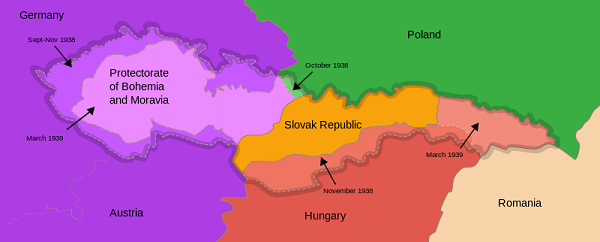 |
Above: In the map, German-speaking Sudetenland (light purple) surrounds Bohemia and Moravia (western Czechoslovakia). Slovakia and Ruthenia (eastern Czechoslovakia) are indicated in goldenrod and pink. Arrows with dates indicate territories that were gobbled up by Czechoslovakia’s hungry neighbors.
 |
 |
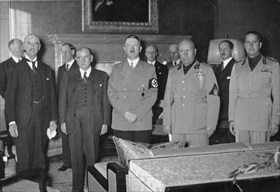
Left: British Prime Minister Chamberlain (left), French Prime Minister Daladier, Hitler, Italian Prime Minister Mussolini, and Italy’s Foreign Minister Galeazzo Ciano pose stiffly for the camera before signing the Munich Agreement shortly after 1 a.m., September 30, 1938.
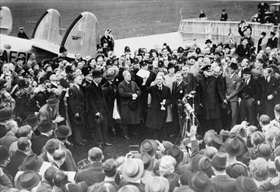
Right: On his triumphal return from Munich on September 30, 1938, Chamberlain (right of center) waves the paper containing the Anglo-German commitment to resolve differences between their two countries peacefully, which he and Hitler had signed a few hours earlier. He boasted: “The settlement of the Czechoslovakian problem,” resolved by the European Great Powers detaching Czechoslovakia’s mostly German-speaking Sudetenland and handing it over to Germany, “has now been achieved [and] is, in my view, only the prelude to a larger settlement in which all Europe may find peace.”
 |
 |
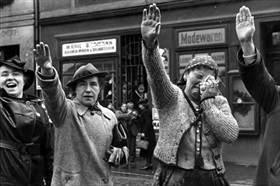
Left: People in the Sudeten town of Eger (Czech, Cheb) line the street as German troops enter the town in early October 1938 following the Munich Agreement.
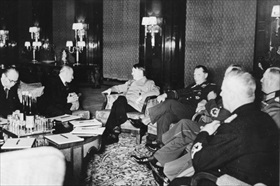
Right: Hitler facing Czech President Emil Hácha in discussions in Berlin on March 14–15, 1939, hours before the German invasion of Bohemia and Moravia. Hácha suffered a heart attack during the meeting but eventually acquiesced to Hitler’s demand that the Czechoslovak army capitulate.
German Newsreel Clips Showing German Wehrmacht and Hitler’s Entry into Czechoslovakia, March 1939
httpv://youtu.be/CSe1Yuk0jsc