JEWISH GHETTO RESIDENTS STAGE REVOLT
Warsaw, Occupied Poland · April 19, 1943
In October 1940, a little over a year after Nazi Germany’s conquest of its eastern neighbor Poland, German Governor-General Hans Frank established a Jewish ghetto in Poland’s capital, Warsaw, moving some 90,000 Jews from all over Poland into the ghetto. The largest of the ghettos in Poland, the Warsaw Ghetto occupied a tiny section of the city, just 3.5 sq. miles (two percent of the city’s area), but it contained 30 percent of the city’s population. Initially gates allowing entry and exit were guarded by a mixed force of Germans, Poles, and Jews. Then on November 16, 1940, the Germans permanently sealed off the ghetto from the rest of the capital, first with barbed wire and wooden fences, then with 11-ft-high brick walls topped with broken glass. No longer were residents allowed to leave the ghetto even for work. Hunger, disease, and overcrowding were endemic: each apartment building in the ghetto housed on average 400 people, and each room six to seven people. No fresh fruits, vegetables, meat, fish, or milk were delivered from the outside. Food allocations, distributed through the ghetto’s Judenrat (Jewish Council) were roughly 200 calories per day per person. Over the months some 300,000 people from the ghetto were sent 60 miles to the northeast of the capital, to the Treblinka death camp, one of six death camps established on Polish soil. (The six were Treblinka, Auschwitz-Birkenau, Chelmno (Kulmhof), Bełżec, Sobibór, and Majdanek). In January 1943 Jewish resistance groups repulsed German troops sent to deport more ghetto residents. When the Germans entered the ghetto again on this date in 1943, resistance flowered into a full-scale rebellion—the Warsaw Ghetto Uprising. Poorly armed Jews fought 2,000 tank-supported SS troops, who were stunned by the ferocity of the Jewish fighters. The Germans initially withdrew from the ghetto after suffering 200 casualties. Despite impossible odds, residents held out against the Germans for more than a month. Jews who survived the uprising were sent to either forced-labor camps or the Treblinka death camp. Treblinka is second only to Auschwitz-Birkenau in Jews murdered in Nazi death camps (900,000 vs. 1.5 million). Between deaths in camps and the uprising, at least 300,000 Warsaw Jews lost their lives during the Nazi period.
[fblike]
[amazon_carousel widget_type=”ASINList” width=”600″ height=”200″ title=”Recommended Reading” market_place=”US” shuffle_products=”False” show_border=”False” asin=”1844083195,0253355990,0395901308,1598453475,0809030721,1904859054,9652295272,0300093764,0300097425,0300095465″ /]
Warsaw Ghetto Uprising, April 19 to May 16, 1943
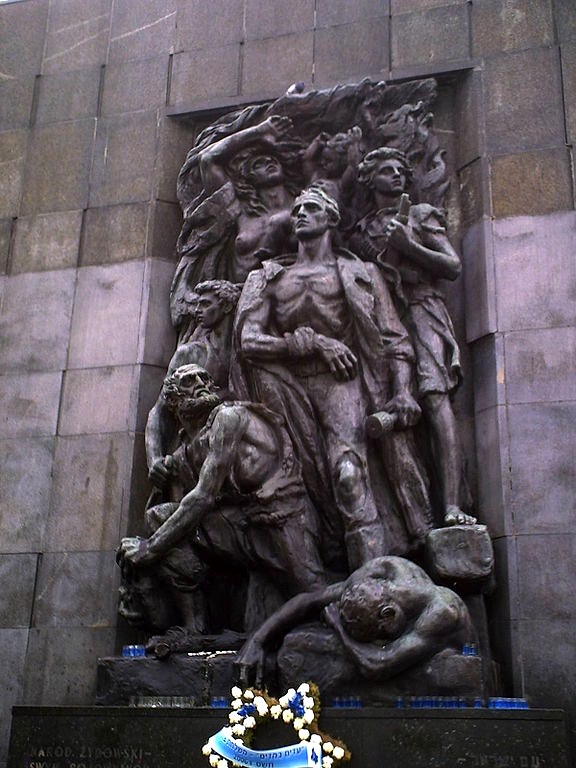 |
Above: Unveiled in Warsaw in 1948, the monument to the heroes of the Warsaw ghetto uprising commemorates the largest single revolt by Jews in World War II.
 |
 |
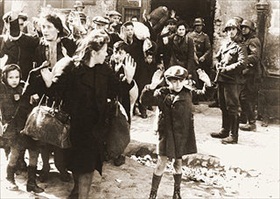
Left: Captioned “Forcibly pulled out of dugouts” (“Mit Gewalt aus Bunkern hervorgeholt”), this photograph, submitted in an SS report (Stroop-Bericht) to Reichsfuehrer-SS Heinrich Himmler, is one of the best known of World War II. It was taken between April 19 and May 16, 1943.
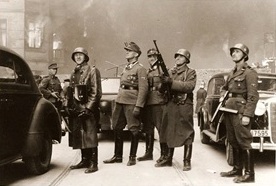
Right: Guarded by troops armed with submachine guns, high-ranking SS officers watch ghetto apartments burn. The intention of the blazes was to “smoke out the Jews and bandits,” as the author of the report to Himmler put it.
 |
 |
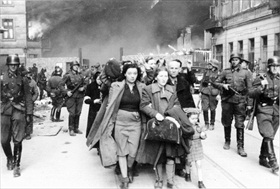
Left: This photo in the SS report shows ghetto residents being led from a bunker where they had been hiding and marched to a transfer point (Umschlagplatz). There they would be sealed in freight cars with little water and poor ventilation and deported to death or labor camps.
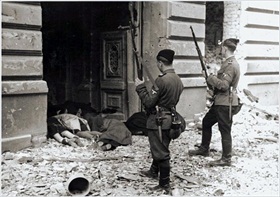
Right: Two ex-Soviet POWs in Hilfseinheiten (auxiliary units) used by the SS in suppressing the Warsaw uprising stare past the bodies of Jews killed in the uprising. Jews who resisted forcible deportation by hiding were often killed on the spot when discovered.
Warsaw Ghetto Uprising, 1943
httpv://youtu.be/8bjY6L_MUkY