MASSIVE ESCAPE OF GERMAN POWs

Bridgend, South Wales · March 10, 1945

Twenty-two miles west of the Welch capital, Cardiff, was a British prisoner-of-war camp built to house mainly Ger­man but also some Ital­ian pri­soners. Cap­able of accom­mo­dating 2,000 in­mates, the camp was called Island Farm. On this date in 1945, 67 POWs (one source says as many as 84 POWs) escaped from Island Farm through a 70‑ft‑long tun­nel that breached the camp peri­meter. The break­out was the largest escape attempt from any Euro­pean POW camp. (The largest escape took place in 1944 in Cowra, New South Wales, Aus­tra­lia, at a Japa­nese POW camp, when at least 545 prisoners attempted an escape.)

Some of the tech­niques used by the fugi­tives in Wales were in­genious and not too dis­similar from those de­picted in the film and book of the same name, The Great Escape, which focused on the March 24–25, 1944, escape of 76 British air­men (out of 200 who tried) from “escape-proof” Sta­lag Luft III in what is now Żagań, West­ern Poland, but then part of Ger­man Lower Silesia. To dig the Welch tun­nel camp in­mates used cans and knives from the mess hall; soil was hauled out in a make­shift box and put into knap­sacks. The tun­nel roof was held up by wood retrieved from benches and beds. A hand-cranked fan forced air through a venti­la­tion pipe made from con­densed milk cans. The men were divided into groups and each had iden­tity papers forged in the camp. They also had rough sketches of Welch rail­roads and road­ways. When the POWs made their escape late on March 10, one set used a stolen car to reach Bir­ming­ham in the Eng­lish West Mid­lands, 120 miles away. Another set reached South­amp­ton, the major port on the south coast of Eng­land. The fugi­tives were even­tually cap­tured; none was offi­cially pun­ished, unlike the 50 recaptured Brit­ish air­men from Stalag Luft III whom Adolf Hitler ordered exe­cuted.

The nearest equi­valent to a mass break­out in the U.S. was attempted by 25 Ger­man detainees at Pa­pa­go Park east of Phoenix, Ari­zona. After crawling through a 178‑ft tun­nel just before Christ­mas 1944, they headed for the near­by Salt River, their in­tended escape route to Mexico, 150 miles to the south. The fugi­tives, some carrying wooden boards to fashion into a raft, were hugely dis­appointed to find that the Salt River was a dry river­bed, even in the dead of winter. By Janu­ary 28, 1945, the last fugitive had been captured.
[fblike]

Years ago, when I first came across the startling infor­ma­tion that German prisoners of war—more than 370,000—were held in the United States during World War II, I knew I had to write about it, particularly when I learned a POW camp had been located about two hours from my home that housed more than 1,700 naval and U‑boat officers and crew­men. My research became a histor­ical novel, The Swastika Tattoo, a story set at Camp Papago Park in east Phoenix, Arizona. Luckily for me, John Ham­mond Moore did a lot of the ground­work I needed with his book, The Faust­ball Tunnel: German POWs in America and Their Great Escape. Another well-researched book, Nazi Prisoners of War in America by Arnold Kram­mer filled more gaps, touching a bit on the re-edu­ca­tion program 20,000 hand-selected POWs were put through before being shipped back to Germany. How­ever, Ron Robin’s research for The Barbed-Wire College: Reeducating German POWs in the United States During World War II describes the program in-depth where camp offi­cials tried to mold the daily lives and minds of their cap­tives. To round out my research, I wanted to find out what happened to German POWs still held in Europe after the war. Giles Macdonogh, author of After the Reich: The Brutal History of the Allied Occu­pa­tion, paints a dis­paraging view of the Amer­i­can occu­pa­tion of Germany, one entirely different than the treat­ment of German POWs held in the States.—Geraldine Birch


[amazon_carousel widget_type=”ASINList” width=”600″ height=”200″ title=”Recommended Reading” market_place=”US” shuffle_products=”False” show_border=”False” asin=”0425252736,0812885619,1591145260,0393325792,1585445452,1416505318,0465091237,1572337281,0755310381,0786424044″ /]

Scenes of Three Stalags (Prisoner-of-War Camps) in Germany
Stalag IV-B street scene Oflag XIII-B liberation

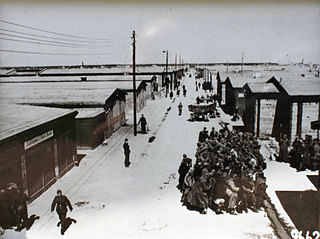
Left: Stalag, a contraction of “Stammlager” (“Main Camp”), was a Ger­man term used for pri­soner-of-war camps, of which there were 54. (By con­trast, the U.S. had 511 POW camps.) Stalag IV‑B (shown here), about 30 miles north of Dres­den, was one of the largest POW camps in Ger­many. At the end of Decem­ber 1944, some 7,500 Amer­i­cans arrived, pri­soners taken in the Battle of the Bulge. When the Soviet Army arrived at Stalag IV‑B on April 23, 1945, there were roughly 30,000 POWs crowded into the faci­li­ties. About 3,000 of them died, mainly from tuber­culosis and typhus.

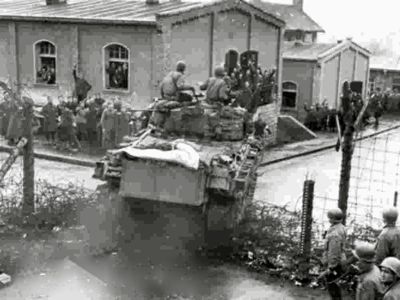
Right: An M4 Sherman tank of Gen. George S. Patton’s 14th Armored Divi­sion crashes into the pri­son com­pound at Oflag XIII‑B, an officers POW camp (“Offizier-lager”) two miles south of Hammel­burg, Bavaria, on April 6, 1945. A raid sanc­tioned by Patton, whose son-in-law was a pri­soner at the camp, failed 11 days earlier. All of the 57 tanks, jeeps, and other vehicles were lost in that first raid. Of the roughly 300 men in the March raiding party (Task Force Baum), 32 were killed and only 35 made it back to Allied-con­trolled terri­tory, with the rest taken prisoner.

Liberation of Stalag XIII-C Freed POWs at Stalag XIII-C

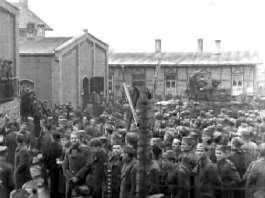
Left: Just after the liberation of Stalag XIII-C. The Amer­i­can tele­vision sit­com Hogan’s Heroes, which aired from 1965 to 1971, was sit­u­ated in a ficti­tious POW camp called “Stalag 13” said to be near Hammel­burg. There was no resem­blance between the fic­tional camp and the actual Stalags XIII‑A, -B, and -C other than name and location.

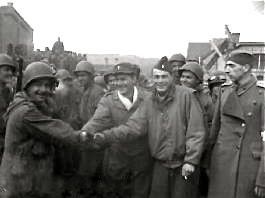
Right: Freed POWs at Stalag XIII‑C. Following Germany’s sur­render, the north­ern part of the Stalag XIII was used to intern former Nazi Party mem­bers. The camp also housed large numbers of Ger­man refugees who had fled the ad­vancing Red Army in East­ern Germany as well as eth­nic Ger­mans who had been ex­pelled from areas of Poland and Czechoslovakia.

Various Scenes of Allied POWs Following Liberation; Germans Entering Captivity; Gen. Eisenhower Touring Ohrdruf, a Subcamp of Buchenwald Death Camp

httpv://youtu.be/X2Usm_gbnxc
Similar Posts

  • HITLER DIRECTS WAR FROM UNDERGROUND

    Berlin, Germany · January 16, 1945 On this date in 1945 Adolf Hitler moved his entourage into the “Fuehrer Bunker” under the Old Reich Chan­cel­lery in Berlin, where he lived and directed the last months of the war in Europe. The bunker—a maze of living quar­ters, con­fer­ence rooms, offices, and utili­ties spreading two stories deep…

  • NAZI ATROCITY IN RUMBULA FOREST

    Riga, Occupied Latvia · November 30, 1941 On November 25 and 29, 1941, Einsatz­gruppe 3 (Special Task Group 3), one of many SS (Schutz­staffel) mobile death squads oper­ating behind the front lines, mur­dered 5,000 “Reich Jews,” that is, Ger­man- and Austrian-born Jews. These men, women, and chil­dren had arrived in the Baltic ghetto at Kau­nas, Lithu­ania’s second largest…

  • U.S. LAUNCHES NEW GEORGIA CAMPAIGN IN SOUTH PACIFIC

    New Georgia Islands, Solomon Islands • June 21, 1943 On this date in 1943, the U.S. kicked off Operation Toenails, as the New Georgia cam­paign was called, with unopposed landings by the elite 4th Marine Raider Bat­talion followed the next day by the Army’s 43rd Infan­try Divi­sion. The year before, in Octo­ber, the Japa­nese had recon­noitered…

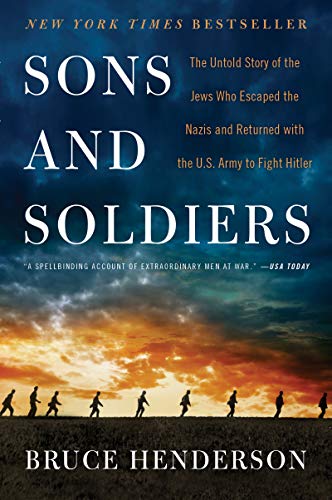
  • Sons and Soldiers: The Untold Story of the Jews Who Escaped the Nazis and Returned with the U.S. Army to Fight Hitler

    NEW YORK TIMES BESTSELLER • “An irresistible history of the WWII Jewish refugees who returned to Europe to fight the Nazis.” —Newsday

    They were young Jewish boys who escaped from Nazi-occupied Europe and resettled in America. After the United States entered the war, they returned to fight for their adopted homeland and for the families they had left behind. Their stories tell the tale of one of the U.S. Army’s greatest secret weapons.

    Sons and Soldiers begins during the menacing rise of Hitler’s Nazi party, as Jewish families were trying des-perately to get out of Europe. Bestselling author Bruce Henderson captures the heartbreaking stories of parents choosing to send their young sons away to uncertain futures in America, perhaps never to see them again. As these boys became young men, they were determined to join the fight in Europe. Henderson describes how they were recruited into the U.S. Army and how their unique mastery of the German language and psychology was put to use to interrogate German prisoners of war.

    These young men—known as the Ritchie Boys, after the Maryland camp where they trained—knew what the Nazis would do to them if they were captured. Yet they leapt at the opportunity to be sent in small, elite teams to join every major combat unit in Europe, where they collected key tactical intelligence on enemy strength, troop and armored movements, and defensive positions that saved American lives and helped win the war. A postwar army report found that nearly 60 percent of the credible intelligence gathered in Europe came from the Ritchie Boys.

    Sons and Soldiers draws on original interviews and extensive archival research to vividly re-create the stories of six of these men, tracing their journeys from childhood through their escapes from Europe, their feats and sacri-fices during the war, and finally their desperate attempts to find their missing loved ones. Sons and Soldiers is an epic story of heroism, courage, and patriotism that will not soon be forgotten.

  • SAIPAN BANZAI CHARGE FAILS TO EVICT GIs

    Saipan, Marianas, Central Pacific · July 6, 1944 The Battle of the Philippine Sea (June 19–20, 1944) was a pivotal U.S. naval victory, effec­tively elim­i­nating Japan’s ability to both con­duct large-scale carrier actions and rein­force its gar­ri­sons to the east in the Mari­anas. The most impor­tant islands in the Mari­ana chain were Guam (an Amer­i­can…

  • FAILED OPERATION WINTER STORM DOOMS GERMANS IN STALINGRAD

    Southwest of Stalingrad, Soviet Union • December 23, 1941 On this date in 1942 the German Wehrmacht (armed forces) ended Oper­a­tion Winter Storm (German, Unter­nehmen Winter­gewitter), the 11‑day attempt by German Army Group Don, a new forma­tion commanded by Field Marshal Erich von Man­stein, to break the Soviet envelop­ment of Gen. Friedrich Paulus’ German Sixth…