MILITIA FORMED TO DEFEND HOMELAND
Tokyo, Japan · March 24, 1945
On this date in 1945 the Japanese Deputy Minister of War, Lt. Gen. Kaneshiro Shibayama, informed the Japanese Diet (Parliament) of the formation of a militia for the defense of the Home Islands. A home militia was critical to the nation’s survival because 60 percent of the roughly 4.6 million Japanese combat troops were still stationed aboard. The next month, on April 8, the operational plan to defend the homeland, called Ketsu‑Go (“Decisive Operation”), was issued. As a result of lessons learned in the South Pacific, the intent of Ketsu‑Go was to inflict enormous casualties on the invaders. In fact, this strategy had been tested most recently on the island of Iwo Jima in February and March 1945, where one in three U.S. Marines had been killed or wounded. Japanese tenacity in combat would, it was believed, undermine the American public’s will to continue the fight for Japan’s unconditional surrender; instead, the American public would insist on a peace more advantageous to Japan than otherwise. Preparations for Ketsu‑Go were to be conducted in three phases. The first phase, during which defensive preparations and combat unit organization were completed, continued through July 1945. (Combat unit organization involved activating the First and Second General Armies as well as an Air General Army.) The second and third phases were to have ended in October, when Japanese military officials forecast an American invasion of the islands might begin. The latter two phases were never completed because the Americans had their own plan for undermining the enemy’s will to continue fighting—all this without any further high-cost air, sea, and ground operations envisioned in Operation Downfall (see map and description below) and without any direct or behind-the-scenes diplomatic negotiations that might end with less than unconditional Japanese surrender. The American plan was awesome and dramatic and centered on using a new weapon, the atomic bomb, two of which blasted, seared, and irradiated tens of thousands of combatants and noncombatants alike residing in Hiroshima and Nagasaki on August 6 and 9, respectively. The way America decisively ended the war against Japan remains one of the great controversies in U.S. and Japanese history.
[fblike]
[amazon_carousel widget_type=”ASINList” width=”600″ height=”200″ title=”Recommended Reading” market_place=”US” shuffle_products=”False” show_border=”False” asin=”0141001461,0812968581,0760339759,0929398904,1570033544,1591143160,1846032849,0804754276,052173536X,0674022416″ /]
Defending the Japanese Homeland Against the Planned U.S. Invasion, 1945–1946
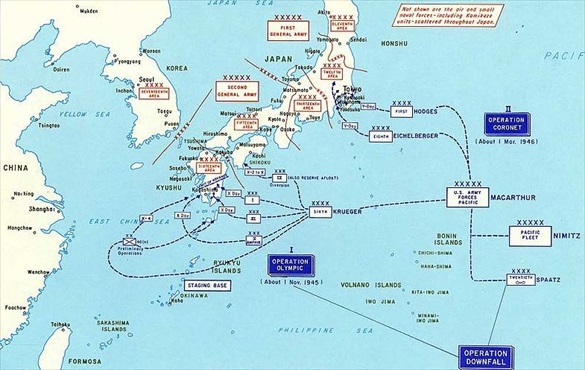 |
Above: This map outlines the Japanese and U.S. ground forces scheduled to take part in Operation Downfall, the battle for Japan. Two landings were planned: Operation Olympic, on the southern island, Kyūshū, set to begin in August 1945, and Operation Coronet, on the main island, Honshū, set to begin the following spring. The War Department staff in Washington estimated there would be 250,000–500,000 American casualties in an invasion of Japan. Operation Downfall was abandoned when Japan formally surrendered on September 2, 1945, after the U.S. dropped atomic bombs on Hiroshima and Nagasaki the previous month.
 |
 |
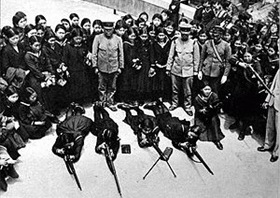
Left: Female students receive training in gun handling as members of a volunteer fighting corps, or Kokumin Giyū Sentōtai, in Tokorozawa, now considered a suburb of Tokyo. Governors of prefectures (states) could conscript all male civilians between the ages of 15 and 60 years, and unmarried females between 17 and 40. Commanders were appointed from retired military personnel and civilians with weapons experience. The Kokumin Giyū Sentōtai was intended as the main reserve, along with a “second defense line,” for Japanese forces to sustain a war of attrition against invading forces. After the Allied invasion, these forces were intended to form resistance or guerrilla warfare cells in cities, towns, and mountains. At this stage of the war, most militia members were armed with swords or even bamboo spears due to the lack of modern weaponry and ammunition.
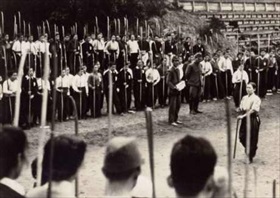
Right: Student militia at Kujukurihama, Chiba, a prefecture situated east of Tokyo across Tokyo Bay. Some 28 million men and women were considered “combat capable” by the end of June 1945; yet only about 2 million were recruited when the war ended, and most of these never experienced combat owing to Japan’s surrender before the Allied invasion of the Japanese home islands could proceed.
Newsreel Documenting Japan’s Unconditional Surrender on Board the USS Missouri, September 2, 1945
httpv://youtu.be/vcnH_kF1zXc