
NAZIS JAIL OUTSPOKEN PASTOR MARTIN NIEMOELLER
Berlin, Germany • July 1, 1937
On this date in 1937 the Gestapo (German secret police) arrested outspoken Lutheran theologian and pastor Martin Niemoeller. The next year Niemoeller, still incarcerated, was tried by a three-judge “special court” (a Nazi Sondergericht) for activities against the State. Niemoeller’s court-appointed defense counsel defended the cleric, insisting Niemoeller had raised only religious complaints. Acquitted of charges, fined a hefty 2,000 Reichmarks anyway, and released, Niemoeller was immediately rearrested by the Gestapo, presumably because Deputy Fuehrer Rudolf Hess decided to take “merciless action” against Niemoeller when the court wouldn’t. Niemoeller spent the next eight years in solitary confinement in Oranienburg’s Sachsenhausen concentration camp, 22 miles north of the Nazi capital, and in Dachau, 10 miles north of Munich, as a “personal prisoner” of Adolf Hitler.
An early supporter of Hitler (he had voted for Hitler in 1933), Niemoeller became (like his colleague-in-faith, theologian Dietrich Bonhoeffer) one of the founders of Germany’s Confessing (or Confessional) Church (German, Bekennende Kirche). The breakaway Protestant church arose in the 1930s in opposition to state-sponsored efforts to both Nazify German churches (some pastors took to wearing SS uniforms in the pulpit) and “dejudaize” Jesus and the New Testament in an effort to promote a “racially pure” form of Christianity. Niemoeller opposed the Nazis’ Aryan Paragraph, which first appeared in the April 1933 Reich Civil Service Law but found its way into all sorts of public and ecclesiastical statutes that stigmatized and marginalized non-German Volk and Germans of Jewish descent. For instance, the Aryan Paragraph removed “non-Aryan” clergy from official church positions and rosters lest their theology undermine the nation’s Christian faith and family life.
The 1930s “Deutsche Christen” movement of clergy and lay people propagated anti-Semitic, voelkisch (chauvinist) ideas in German schools, on church councils, and in other social arenas. Few clerical or lay leaders departed from the Nazi Party line that a Jewish “problem” existed and that it required restrictions on the “excessive” influence of German Jews. In this way the German church both reflected and contributed to the political, social, and racial milieu that made the Holocaust possible.
Niemoeller is best known for penning the provocative poem “First they came …” (see below), an indictment of German intellectuals like himself for not doing enough to stop Hitler and the Nazis from liquidating their opponents from German society. (The substance and order of the groups mentioned in the poem vary from version to version, as Niemoeller formulated them differently depending on his audience.) Released from imprisonment in 1945 by the Allies (he narrowly escaped execution), Niemoeller continued his career in Germany as a clergyman and as a leading voice of penance and reconciliation for the German people after World War II.
“First They Came . . . ” by Martin Niemoeller
First they came for the socialists
And I didn’t speak out because I wasn’t a socialist.
Then they came for the trade unionists
And I didn’t speak out because I wasn’t a trade unionist.
Then they came for the Jews
And I didn’t speak out because I wasn’t a Jew.
Then they came for me
And there was no one left to speak for me.
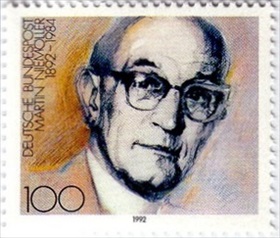
German Stamps Commemorating Anti-Nazi Theologians Martin Niemoeller and Dietrich Bonhoeffer
 |
 |
Left: Martin Niemoeller, 1892–1984. After his imprisonment Niemoeller often spoke of his deep regret about not having done enough to help the victims of the Nazis. In the 1950s he became a vocal pacifist and antiwar activist and a committed campaigner for nuclear disarmament. From 1961–1968 he served as President of the World Council of Churches. In 1966 he was awarded the Soviet Union’s Lenin Peace Prize.
Right: Dietrich Bonhoeffer, 1906–1945. Unlike Niemoeller, who was imprisoned from 1937 to 1945, Bonhoeffer was free to engage in antistate activities while serving in the German Abwehr (Military Intelligence) under the protection of its chief, Adm. Wilhelm Canaris, right up to his imprisonment in April 1943. Both Canaris and Bonhoeffer were implicated in the July 20, 1944, bomb plot to kill Hitler and both were executed at Flossenbuerg Prison on April 9, 1945, two weeks before the Allies arrived in the area.
Biography of Martin Niemoeller. (Amateur production but worth watching.)
httpv://youtu.be/y6QPzjuqf8E