ROOSEVELT NAMES WEDEMEYER TO REPLACE STILWELL
Chungking, China • October 31, 1944
The war against the Japanese in China was desultory at best, and service in that theater was viewed as a graveyard by U.S. military and diplomatic officials. On this date, October 31, 1944, Maj. Gen. Albert Wedemeyer arrived to replace dismissed Gen. Joseph (“Vinegar Joe”) Stilwell as commander of the China Theater and to serve as Chief-of-Staff to Nationalist Chinese leader Generalissimo Chiang Kai-shek. Wedemeyer’s instructions were to advise Chiang on issues of training, equipping, and supporting Chinese forces in the war against the Japanese, which had been going full-throttle since 1937. Chiang, however, was distracted by rival Communist Chinese forces operating in Northern China and tended to hold his best units back in this domestic contest. To his credit, Wedemeyer did his best to motivate Chiang to take a more aggressive role against the Japanese in the war.
Wedemeyer had more success in arranging logistical support for American air forces in China. These included support for the P‑51 Mustangs and the newly arrived B‑24 Liberators of the Fourteenth Air Force under Gen. Claire Chennault. Chennault was a long-time China hand, having created the American Volunteer Group (AVG) of “Flying Tigers” fame for Chiang Kai-shek prior to the entry of the U.S. into World War II. On December 20, 1941, 12 days after the surprise Japanese attack on the U.S. Pacific Fleet anchored at Pearl Harbor, Hawaii, Chennault’s pilots engaged a fleet of 10 Japanese Kawasaki bombers, shooting down 3 or 4 of them at the cost of 1 U.S. plane. It was the first Allied victory of the Pacific War.
Wedemeyer also moved to support basing long-range B‑29 Superfortresses of the XX Bomber Command in China under its newly appointed commander, 36-year-old Maj. Gen. Curtis LeMay. LeMay had gained a reputation developing highly effective techniques and tactics (e.g., the 12‑plane combat box formation of B‑17 Flying Fortresses) for use by the U.S. Eighth Air Force in its strategic bombing campaign over Nazi-occupied Europe. Placing B‑29 “Superforts” on Chinese soil had been pushed by President Franklin D. Roosevelt, who wished to bolster the Chinese war effort and was impatient to bomb mainland Japan. However, basing B‑29s in China was a temporary measure until forward bases became available in the Pacific Mariana Islands, much closer to the Japanese Home Islands. Once bases became operational in the Marianas for LeMay’s newest command, the XXI Bomber Command (late November 1944), the brutal aerial campaign that incinerated 67 Japanese cities (most famously Tokyo on the night of March 9/10, 1945, the single most destructive bombing raid in history), coupled with a no-holds-barred campaign to starve the islands’ population by aerial mining Japan’s coastal waters (Operation Starvation), began in earnest.
Gen. Claire Lee Chennault and His Flying Tigers, 1941–1945
 |
 |
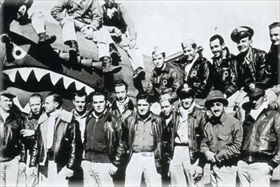
Left: The American Volunteer Group initially trained at an RAF base in Burma with the mission of defending beleaguered China against invading Japanese forces. AVG pilots like these shown in this photo were recruited under presidential authority from the U.S. armed services. Ground crew and headquarters staff were likewise mostly recruited from the U.S. military, along with some civilians.
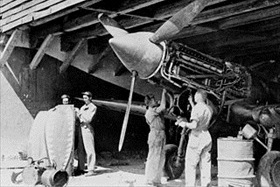
Right: A ground crew services a P‑40 Warhawk of the 23rd Fighter Group at an airfield in China, 1942. P‑40 Warhawks came off a Curtiss-Wright assembly line in Buffalo, New York, which produced P‑40 Tomahawk IIB models for British Commonwealth squadrons in North Africa and the Middle East. A squadron of the RAF was the first Allied military aviation unit to feature the “shark mouth” logo, copying similar markings on some Luftwaffe Messerschmitt Bf 110 twin-engine fighters.
 |
 |
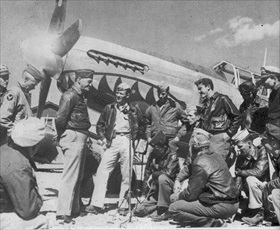
Left: In this 1942 photo Claire Chennault converses with pilots of the 23rd Fighter Group. In the background is a P‑40 Warhawk bearing the distinctive shark-mouth nose art from AVG days. The shark-mouth fighters remain among the most recognizable of any individual combat aircraft and combat unit of World War II. Incidentally, one of Chennault’s ace airmen, James H. Howard (6 Japanese kills), was the only fighter pilot over Europe to be awarded the Medal of Honor, the U.S. military’s highest decoration.
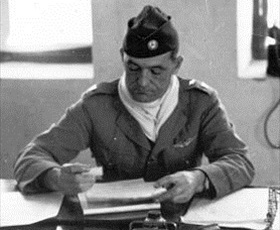
Right: Chennault (1893–1958) was a 44-year-old retired U.S. Army Air Corps officer when he arrived in China in 1937. He eventually became director of a Chinese Air Force flight school centered in Kunming, Southwest China, before being appointed commander of China Air Task Force. In this May 1942 photo, he wears a U.S. Army brigadier general’s star on his left shoulder but Chinese insignia otherwise.
 |
 |
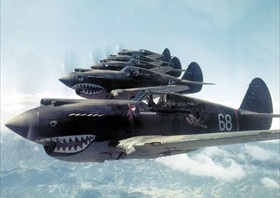
Left: Flying Tigers’ Third Pursuit Squadron, called “Hell’s Angels,” photographed near the Salween River Gorge on the Chinese-Burmese border, May 28, 1942. Ace squadron Flight Leader Robert “R.T.” Smith commented on the challenge of taking this photo while flying in formation and “scanning the surrounding sky every few seconds to make sure no Jap fighters were about to ambush us.”
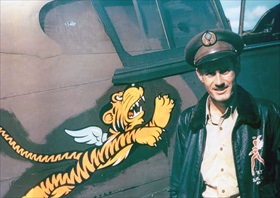
Right: Squadron Flight Leader Robert “R.T.” Smith standing next to his P‑40 Warhawk fighter, Kunming, China, May 23, 1942. Note Smith’s Nationalist Chinese emblem on his cap and the “Flying Tigers” insignia on his aircraft. The insignia was created by the Walt Disney Company, while the Chinese came up with the nickname for the pilots, who were said to be fighting like “flying tigers.” Smith was credited with downing 8.9 Japanese aircraft while fighting with the Flying Tigers. He was twice decorated by the Chinese government. After a brief State-side stint, Smith returned to the China Burma India Theater, flying 55 combat missions over Burma and earning 3 more service decorations.
Contemporary Documentary of the Flying Tigers, a Unit of the U.S. Fourteenth Air Force
httpv://youtu.be/FqJP-193pR0