
SAIPAN BANZAI CHARGE FAILS TO EVICT GIs
Saipan, Marianas, Central Pacific · July 6, 1944
The Battle of the Philippine Sea (June 19–20, 1944) was a pivotal U.S. naval victory, effectively eliminating Japan’s ability to both conduct large-scale carrier actions and reinforce its garrisons to the east in the Marianas. The most important islands in the Mariana chain were Guam (an American territory captured by Japan on December 8, 1941), Tinian, and Saipan (two Japanese World War I mandates).
Amphibious U.S. Marine and Army divisions had landed on Saipan beginning June 15. On this night in 1944 on Saipan, three thousand Japanese troops—realizing that they could not defeat the invaders—hurled themselves against American lines in the largest banzai charge of the war. Led by Japanese officers swinging swords overhead, the suicidal charge of able-bodied men in the front ranks, the lame and wounded in the rear, some armed only with rocks or knives mounted on sticks, left most Japanese attackers dead and battle-hardened Marines and soldiers shaken to the core.
The self-inflicted slaughter was not over. The next day brought another suicidal banzai charge and mass suicides, including that of Emperor Hirohito’s hero at Pearl Harbor and Midway, Vice Admiral Chūichi Nagumo. Two U.S. Army regiments were almost destroyed, losing 650 killed and wounded in this last-ditch charge on July 7. Hundreds of Japanese civilians jumped off cliffs, drowned themselves, or blew themselves up with grenades. All told, 29,000 Japanese military and 22,000 civilians (half the population of the island) died versus 3,426 American dead and 10,364 wounded, making Saipan the most costly victory to date in the Pacific War.
News that Saipan had been lost caused Japanese Premier Hideki Tōjō and his cabinet to resign later in the month. Until Saipan’s capture the Japanese populace continued to believe that success in the war remained possible. Now Japan’s leadership was forced to begin considering the reality of defeat. Marine General Holland M. “Howlin’ Mad” Smith, ground commander of the assault on Saipan, declared that the U.S. victory “opened the way to the home islands” by providing secure air bases for the new long-range heavy bombers that were now within striking distance of all Japanese cities. Four months later one hundred B‑29 Superfortresses departed Saipan’s new U.S. airstrips for their first massive air raid over Tokyo.
Saipan and Tinian, 1944–1945. U.S. Begins End Game for Pacific War
 |
 |
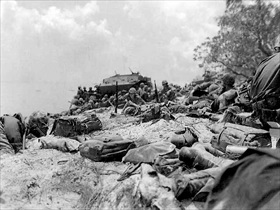
Left: U.S. Marines take cover on Red Beach, June 15, 1944. The invasion fleet of hundreds of ships carried more than 70,000 Marines and soldiers. Shelling the pistol-shaped island began on June 11, 1944, and lasted for more than three days. Landings began on the west side on June 15 when the 2nd Marine Division hit Red and Green beaches and the 4th Marine Division hit Blue and Yellow beaches.
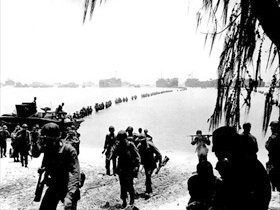
Right: Soldiers of the U.S. Army 27th Infantry Division, green reinforcements, disembark from LSTs and proceed across a coral reef on the extreme southwest coast of the Saipan. Photo from June 16 or 17, 1944.
 |
 |
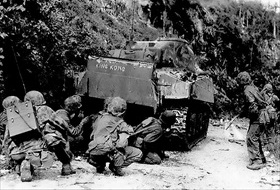
Left: Marines take cover behind an M4 Sherman tank while clearing out the northern end of Saipan Island, July 8, 1944.
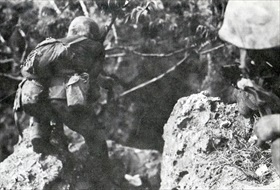
Right: Holding a Colt 45 pistol, a Marine moves cautiously through the Saipan jungle, July 1944, as he and his platoon ferret out the enemy. Out of a 30,000-strong garrison, less than 1,000 Japanese were taken prisoner. The suicides and banzai charges were called gyokusai, which can be roughly translated as “breaking the jewel,” a reference to the destruction of an entire Japanese unit. Gyokusai can only be made at the behest of Imperial General Headquarters.
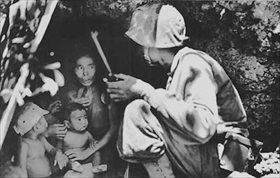 |
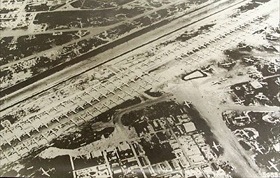 |
Left: Marine Lt. Robert B. Sheeks, an Intelligence and Japanese Language Officer, coaxes a terrified island native (a Chamorro woman) and her children into abandoning their hiding place, circa June 21, 1944. Using a combination of surrender leaflets and amplified voice appeals, Sheeks personally ended up saving the lives of hundreds of Japanese civilians and servicemen by being able to talk them out of the many caves in Saipan’s and Tinian’s volcanic landscape during combat in 1944.
Right: Isley Field on Saipan is filled with B‑29 Superfortresses in this mid‑1945 photo. The Marianas were desired by the U.S. as bomber bases to reach the Japanese mainland, with Saipan attacked for that reason even before the U.S. moved to recapture Guam. Once captured, Saipan and Tinian were used by the U.S. Twentieth Air Force because the islands finally put mainland Japan within round-trip range of B‑29s. In response, Japanese aircraft attacked the bases on Saipan and Tinian from November 1944 to January 1945. Both the Enola Gay and the Bockscar (which dropped atomic bombs on Hiroshima and Nagasaki, respectively) flew their missions from Tinian’s “North Field.”
The Invasion of Saipan, June 1944: Piercing Japan’s Pacific Defensive Perimeter
httpv://youtu.be/lHxL192Qxrs