STALIN SEIZES LATVIA, HITLER HALTS WAR IN FRANCE

Munich, Germany · June 17, 1940

On this date in 1940 Joseph Stalin of the Soviet Union, drawing on pro­vi­sions of the sec­ret pro­to­col in the August 1939 Molotov-Rib­ben­trop Non­aggression Pact with his Nazi ally, ordered an attack on the Baltic state of Lat­via. (The 1939 pro­to­col had already returned divi­dends to the two con­spira­tor nations, allowing them to divide Poland between them­selves within a month of the Soviet and Ger­man foreign minis­ters signing the pact named after them.) The next day, June 18, 1940, an offi­cial repre­sen­ta­tive of Stalin’s arrived in the Lat­vian capi­tal, Riga, to assume the reins of power. The in­cor­por­a­tion of Lat­via and the other two Baltic states, Lithu­a­nia and Esto­nia, into the Soviet Union was com­pleted in early August 1940.

On the other side of the European conti­nent, Adolf Hitler, Sta­lin’s co-con­spi­rator, ordered the sus­pen­sion of hos­tili­ties in France on this date, June 17, 1940, and the new French pre­mier, Marshal Philippe Pétain, took to the nation’s air­waves, in­forming his fellow coun­try­men that nego­ti­a­tions for an armis­tice were in pro­gress. The news was met with enthu­si­asm in the ranks of the Royal Ital­ian Army (Regio Esercito) and in Italy, which had declared war on France and Great Britain just the week before. The hos­til­ities were over; it was time to grab the “spoils” was how Italian strong­man Benito Mus­so­lini saw it. (An Ital­ian skir­mish with French defense forces on June 21 was designed to drive the point home.) Ever the oppor­tun­ist, Il Duce (Italian, “the leader”), on board a train to Munich to confer with Axis part­ner Hitler, gene­rated a shopping list of mate­riel and terri­tories he wanted for his country under the terms of the gen­er­al armis­tice; for example, ships, air­craft, the island of Cor­sica, Tuni­sia in North Africa, etc.

On June 18 Musso­lini and Hitler drew lines on a large mili­tary map of France that iden­ti­fied their future zones of occu­pa­tion. They also agreed to sepa­rate armis­tice com­mis­sions: Hitler did not want his junior partner’s pre­sence near the north­ern French city of Com­piègne to in­trude on the spec­tac­ular pro­gram he had choreo­graphed for the French sur­render—the armis­tice was to be signed in the same rail­way car in which the World War I Allied supreme com­mander, French Marshal Ferdi­nand Foch, had dic­tated peace terms to repre­sen­ta­tives of Kaiser Wil­helm II in 1918. Hitler and Germany had waited 22 years for this triumphant moment.
[fblike]

Acclaimed historian Roger Moorhouse recounts the events that not only led up the nefarious 1939 Nazi-Soviet Non­aggression Pact, which divided East Euro­pean states between two dictator­ships, but took on a curious after­life in The Devils’ Alliance: Hitler’s Pact with Stalin. Though it lasted less than two years, the pact from hell is rich in ironies, as Moor­house’s authori­ta­tive account explains. From being Stalin’s co-conspi­rator, Hitler did a classic con artist’s make­over. His stab-in-the-back inva­sion of the Soviet Union in June 1941 had the mis­for­tune of dooming his adven­turism in Central and Eastern Europe and has­tening the sorry end of his diabolical regime. And 50 years after their en­slave­ment by the Stalin’s Red Army, Esto­nians, Lithu­anians, Lat­vians, and Poles suc­ceeded in finally liber­ating them­selves by bringing down the Iron Curtain and accel­erating the demise of their tormentor’s Communist  regime.—Norm Haskett


[amazon_carousel widget_type=”ASINList” width=”600″ height=”200″ title=”Recommended Reading” market_place=”US” shuffle_products=”False” show_border=”False” asin=”0465030750,1591142954,0275979377,1848851456,0521338352,1936274299,0192805509,0679729941,0141030658,0393327973″ /]

German-Soviet Nonaggression Pact with Secret Protocol, Moscow, August 23–24, 1939
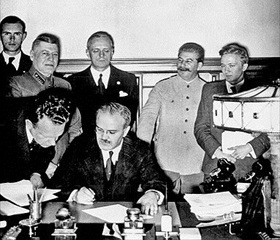
Molotov signing nonaggression pact, August 23–24, 1939 Stalin-Ribbentrop handshake, August 24, 1939

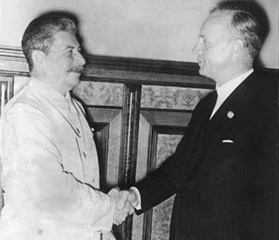
Left: Soviet Foreign Minister Vyacheslav Molotov signs the German-Soviet Non­aggression Pact. Imme­diately behind him is Ger­man Foreign Minis­ter Joachim von Ribben­trop and, to the Ger­man’s left, is Soviet leader Joseph Stalin. The Kremlin, Moscow, August 24, 1939.

Right: Stalin congratulates Ribbentrop with a warm handshake following the signing ceremony.

Below: The Molotov-Ribbentrop Non­aggression Pact con­tained a secret pro­to­col (Geheimes Zusatz­pro­tokoll) that was revealed only after Ger­many’s defeat in 1945. Under its terms Roma­nia, Poland, Lithu­a­nia, Lat­via, Esto­nia, and Fin­land were to be divided into Ger­man and Soviet “spheres of in­flu­ence.” Fin­land, Esto­nia, and Lat­via were assigned to the Soviet sphere. Poland was to be parti­tioned after Hitler’s in­va­sion of that coun­try, which came on Septem­ber 1, 1939. Thus, the western half of Poland was occu­pied by Germany and the east­ern half of Poland came under Soviet occu­pa­tion, appor­tioned after the war between Byelo­rus­sian Soviet Socialist Republic (today’s inde­pen­dent Belarus) and Ukrai­nian Soviet Socialist Republic (today’s inde­pen­dent Ukraine). A second se­cret pro­to­col assigned the major­ity of Lithuania, which bordered on Germany’s East Prussia, to the Soviet Union.
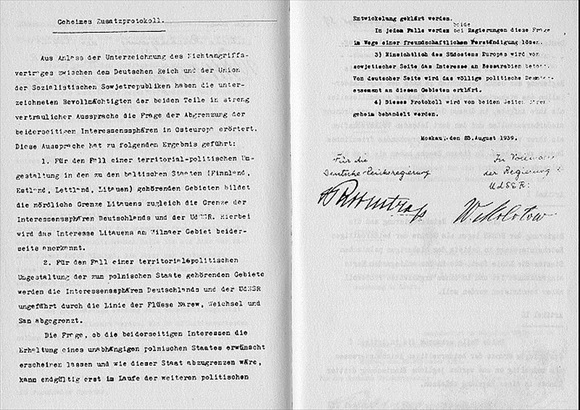
Two-page secret protocol


The 1939 Molotov-Ribbentrop Non­aggression Pact: A Reenactment

httpv://youtu.be/ukUw3RHIBrY

Similar Posts

  • JAPAN DELIVERS FINAL PEACE OFFER TO U.S.

    Washington, D.C. • November 20, 1941 On this date in 1941 in Washington, Japanese ambassador Kichisa­burō Nomura pre­sented his govern­ment’s final pro­posal for peace in the Asia Pacific region. Through much of 1941, Ambas­sador Nomura had nego­ti­ated with U.S. Secre­tary of State Cordell Hull to resolve fes­tering bi­lat­eral issues. Chief among the issues were the…

  • The Winter War: Russia’s Invasion of Finland, 1939-1940

    “Edwards recounts events, both shameful and heroic, with insight, conviction and considerable wit.”—Publishers Weekly

    On November 30, 1939, the Soviet Union’s Red Army invaded the young nation-state of Finland, in the full expectation of routing the small, ill-equipped Finnish army and annexing the former Russian territory by the end of the year. But Finland held out for 105 bitterly cold, fiercely combative days, until March 15, 1940, when a peace agreement ended the short, savage Winter War.

    At the stirring center of the story lie the resourcefulness and resolve of the Finnish people, who against all military odds—in want of ammunition, food, sleep, and troops—fought a blundering, ineptly commanded Red Army to a standstill. On March 15, they ceded to the Soviet 11 percent of their territory and 30 percent of their economic assets, but none of their national pride.

    The Russians meanwhile had markedly damaged their international standing and effectively ruined their military reputation-to such an extent, as this probing chapter in World War II history demonstrates, that Germany, with proud-blooded Finland as an ally, dared to launch its 1940 invasion of Russia. At the same time, though, the fiasco of the Winter War forced Stalin to acknowledge the shortcomings of the Red Army and to reform it: Germany would fall at Stalingrad in 1941.

    With authority, this skillfully narrated military history unfolds its story of the four-month Soviet-Finnish war and explores its consequences from London to Moscow, from Helsinki to Paris, to Washington, DC. 20 black-and-white illustrations

  • FRENCH INDOCHINA NOW OURS—JAPAN

    Saigon, French Indochina · July 25, 1941 On September 21, 1937, Japanese planes bombed the capi­tal of China, Nan­king, shortly after igniting the Second Sino-Japa­nese War. Presi­dent Franklin D. Roose­velt expressed the shock of “every civil­ized man and woman” over “the ruth­less bombing” of Chinese civil­ians. Gen­er­ally, how­ever, U.S. and Euro­pean reac­tion to Japa­nese aggres­sion…

  • DEATH CAMP SHOCKS DISCOVERERS

    Ohrdruf, Central Germany · April 4, 1945 Over the first three weeks of April 1945, during the brutal ter­mi­nal phase of the Third Reich, Allied armies dis­covered more than one hun­dred con­cen­tra­tion camps, including Buchen­wald, Nord­hausen, Flossen­buerg, and Bergen-Belsen. On this date in 1945 soldiers of Gen. George S. Patton’s U.S. Third Army un­ex­pectedly came…

  • ROOSEVELT, CHURCHILL ENDORSE NEW WAR AIMS

    Casablanca, French Morocco • January 14, 1943 On this date in 1943 U.S. President Frank­lin D. Roose­velt, Brit­ish Prime Minis­ter Win­ston Chur­chill, and their respective Chiefs of Staff opened a 10‑day strategy confer­ence in Casa­blanca, a sea­side resort half­way down the Moroccan coast in North­west Africa. (Casablanca was a signi­fi­cant venue, chosen to under­score the libera­tion…