101ST AIRBORNE

  • ARDENNES BULGE ELIMINATED, GERMANS RETREAT

    Bastogne, Belgium • January 25, 1945 On this date in 1945, in the thickly forested Belgian Ardennes, the Battle of the Bulge (referring to the German-induced bulge in Allied lines) effec­tively ended. The largest, most costly land battle fought by Ameri­can sol­diers in World War II marked in many ways the U.S. Army’s finest per­for­mance. Besides…

  • GERMANS SET TO SNUFF OUT BASTOGNE GARRISON

    Bastogne, Eastern Belgium • January 3, 1945 Beginning on this date and the next in January 1945 the German Wehr­macht (armed forces) began a risky, last-ditch attack on the U.S. garri­son at Bas­togne in East­ern Bel­gium. Adolf Hitler, in planning his mas­sive onslaught against Anglo-Amer­ican forces via the densely forested Ardennes region shared by Bel­gium,…

  • GERMANS UNABLE TO BREAK BASTOGNE ROADBLOCK

    101st Airborne Command Post, Bastogne, Belgium • December 25, 1944 On Christmas Eve 1944 in the German-besieged Eastern Bel­gian town of Bastogne (popu­la­tion 3,500), soldiers of the armor­less U.S. 101st Air­borne “Screaming Eagles” Divi­sion, ele­ments of the 9th and 10th Armored Divi­sions, and several com­bat engi­neer and field artil­lery bat­tal­ions received rations of brandy and listened…

  • GERMANS PREPARE SURPRISE OFFENSIVE IN ARDENNES FOREST

    Cologne, Germany • November 15, 1944 As the Allied offensive wore on west of the Rhine River, dozens of German tank and infan­try divi­sions gathered on this date in 1944 in assem­bly areas north­west of the city of Cologne and in the thick forest cover of the Eiffel moun­tains. Con­ceived by Adolf Hitler, the multi-stage…

  • GLIDER PHASE OF D-DAY BEGINS

    RAF Aldermaston and Ramsbury Airfields, England • June 3, 1944 On this date in 1944 in Aldermaston, England, men of the 434th Troop Carrier Group and the 101st Air­borne Divi­sion (“Screaming Eagles”) began moving 52 CG‑4A engine­less combat gliders and C‑47 Sky­train tug planes onto the air­field to lead the glider phase of Oper­a­tion Over­lord, the in­va­sion…

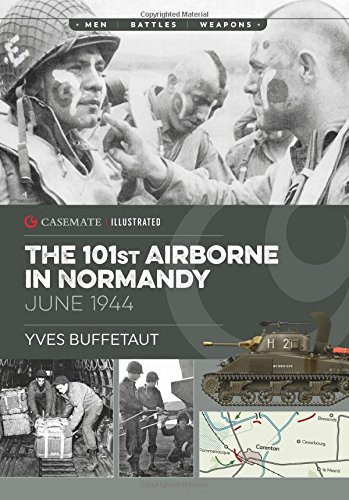
  • The 101st Airborne in Normandy: June 1944 (Casemate Illustrated)

    101st Airborne Division was activated in August 1942 in Louisiana, and its first combat mission was Operation Overlord. On D-Day—June 6, 1944—101st and 82nd Airborne dropped onto the Cotentin peninsula hours before the landings, tasked with capturing bridges and positions, taking out German strongpoints and batteries, and securing the exits from Utah and Omaha Beaches. Things did not initially go smoothly for 101st Airborne, with cloud and antiaircraft fire disrupting the drops, resulting in some units landing scattered over a large area outside their designated drop zones and having to waste time assembling—stymied by lost or damaged radio equipment—or trying to achieve their objectives with severely reduced numbers.

    Casualties were high in some areas due to heavy pre-registered German fire. Nevertheless, the paratroopers fought on and they did manage to secure the crucial beach exits, even if they only achieved a tenuous hold on some other positions. A few days later, 101st Airborne were tasked with attacking the German-held city of Carentan as part of the consolidation of the US beachheads and establishment of a defensive line against the anticipated German counteroffensive. The 101st forced their way into Carentan on 10 and 11 June. The Germans withdrew the following day, and a counteroffensive was put down by elements of the 2nd Armored Division.

    This fully illustrated book details the planning of the airborne element of D-Day, and the execution of the plans until the troops were withdrawn to prepare for the next big airborne operation, Market Garden.

    Table of Contents

    Planning and Preparation
    Airborne Invasion
    “E” is for Easy
    The 101st in Carentan

  • GLIDER PHASE OF D-DAY BEGINS

    RAF Aldermaston and Ramsbury Airfields, England · June 3, 1944 On this date in 1944 in Aldermaston, England, men of the 434th Troop Carrier Group and the 101st Air­borne Divi­sion began moving 52 CG‑4A gliders and C‑47 Sky­train tow planes onto the air­field to lead the glider phase of Oper­a­tion Over­lord, the in­va­sion of Nazi-occu­pied France….

  • BULGE ELIMINATED, GERMANS RETREAT

    Bastogne, Belgium · January 25, 1945 On this date in 1945, in the thickly forested Belgian Ardennes, the Battle of the Bulge (referring to the German-induced bulge in Allied lines) effec­tively ended. The largest, most costly land battle fought by Ameri­can sol­diers in World War II marked in many ways the U.S. Army’s finest per­for­mance. Besides…

  • EISENHOWER TAKES COMMAND OF LIBERATION ARMY

    London, England · January 15, 1944 On this date in 1944 Gen. Dwight D. Eisenhower assumed com­mand of the Allied Expe­di­tion­ary Force pre­paring to lib­er­ate France from the strangle­hold of Adolf Hitler’s Nazi Ger­many. A month earlier Presi­dent Franklin D. Roose­velt had desig­nated the 53‑year‑old army gen­e­ral Su­preme Allied Com­mand­er for Opera­tion Over­lord, the inva­sion…