BLITZ

  • ROOSEVELT DECLARES LIMITED NATIONAL EMERGENCY

    Washington, D.C. · September 8, 1939 On this date in 1939, eight days after Nazi Germany invaded neigh­boring Poland, triggering World War II in Europe, Presi­dent Franklin D. Roose­velt declared a state of “limited national emer­gency.” The under­funded and under­manned U.S. mili­tary forces were strength­ened, and the next year Con­gress pro­vided major mili­tary bud­get in­creases, which led…

  • BATTLE OF BRITAIN: RAIN OF TERROR BEGINS

    London, England · July 10, 1940 On this date in 1940, less than one month after France’s capit­ula­tion to Nazi Germany and just 10 days after the Ger­mans had seized the Chan­nel islands of Jersey and Guern­sey off the Brit­tany coast, Luft­waffe air­craft based in France began a relent­less aerial cam­paign tar­geting the lone Euro­pean…

  • FIREBOMBING RAVAGES DRESDEN

    Dresden, Germany · February 13, 1945 On this night in 1945, Shrove (or Fat) Tuesday, and over the next day, Ash Wednesday, some 1,300 Brit­ish and Amer­i­can bombers appeared over largely un­touched Dres­den in east­ern Ger­many. A city of 642,000 (1939) swelled by 300,000 refugees fleeing from fighting on the East­ern Front, Dres­den was the ancient capital…

  • LUFTWAFFE BOMBS BRITISH CAPITAL

    London, England · January 12, 1940 On this date in 1940 the German Luftwaffe conducted its first bombing raid on London, the British cap­i­tal, four months after assaulting the Polish cap­i­tal, War­saw, at the start of World War II in Europe. Five months later, on May 10, the Royal Air Force retal­i­ated with its first stra­tegic bombing…

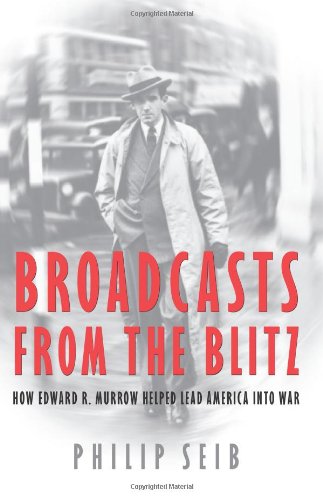
  • Broadcasts from the Blitz: How Edward R. Murrow Helped Lead America into War

    With the words “This is London,” Edward R. Murrow’s groundbreaking radio broadcasts from 1939 to 1941 brought the blitz into America’s living rooms. Countering the tide of U.S. isolationism, Murrow told his huge audience that the United States could not avoid a confrontation with Hitler and that the bombs it heard falling during his reports would eventually be targeted at American cities. But although often cited as the paragon of journalistic objectivity, Murrow had a clear agenda—to bring America into the war—and he slanted his broadcasts accordingly. And behind the scenes, he helped the British court U.S. public opinion and secure American funds for a British intelligence operation.

    Broadcasts from the Blitz examines Murrow’s work and life during this crucial time. It also profiles unsung heroes of those days, such as U.S. ambassador John Winant and Winston Churchill’s confidant Brendan Bracken, and villains as well—such defeatists as Joseph Kennedy and Charles Lindbergh, who believed England was doomed. Other compelling characters include Eric Sevareid, Mollie Painter-Downs, and Nancy Astor, whose “Cliveden set” was accused of being too cozy with the Germans. They and many others mixed in a London that remained vibrant even as it was being battered. Broadcasts from the Blitz is a story of courage—of a journalist broadcasting live from London rooftops as bombs fell around him—and of intrigue, as the machinery of two governments pulled America and Britain together in a common cause. Finally there is the drama of December 7, 1941, when Murrow was the sole journalist to meet with Roosevelt. Broadcasts from the Blitz is for all those interested in the influential career of an extraordinary man and in the relationship between journalism and politics.


  • BLITZ (SEPTEMBER 1940–MAY 1941)

    When September 7, 1940 to May 10, 1941 Where Great Britain and Northern Ireland Who German Luftwaffe under Air Marshal Hermann Goering (1893–1946) versus the Royal Air Force (RAF) Fighter Command under Air Chief Marshal Hugh Dowding (1882–1970) and after November 1940 Air Officer Commanding-in-Chief of Fighter Command William Sholto Douglas (1893–1969) Why The Luftwaffe’s…

  • BRITAIN, BATTLE OF (JULY–OCTOBER 1940)

    When July 10 to October 31, 1940 Where The skies over Britain and the English Channel Who Three German Luftwaffe Air Fleets (Luftflotten): Luftflotte 2 based in Belgium and northern France under Field Marshal Albert Kesselring (1885–1960), Luftflotte 3 based in Normandy under Field Marshal Hugo Sperrle (1885–1953), and Luftflotte 5 based in Norway and Denmark under Col-Gen….