CHURCHILL

  • RAF DAMAGES NAZI ROCKET SITE

    London, England • August 17, 1943 In mid-June 1943 a Royal Air Force reconnais­sance mission flew over the top-secret Peene­muende Army Research Center and V‑2 rocket launch site on the German Baltic coast. Images con­firmed the pre­sence of long-range bal­listic missiles at the site. A month later British Prime Minister Winston Chur­chill ordered an attack…

  • MATTERHORN WRAPS UP OPERATIONS

    58th Bombardment Wing HQ, Kharagpur, India • January 15, 1945 The final strategic bombing raid by American B‑29 Super­fortress heavy-bombers based in China occurred on this date in 1945. Targets of Opera­tion Matter­horn, as the bombing of Japa­nese assets by India- and China-based B‑29s was called, were on the Japanese-occupied island of Formosa (today’s Taiwan). Behind Operation…

  • U.S., BRITISH LEADERS FORMULATE WAR PLANS FOR 1942

    Washington, D.C • December 22, 1941 On this date in 1941 the Japanese public glimpsed their first photos in the news­paper Asahi Shimbun of their country’s devas­tating attack on the U.S. Pacific Fleet at Pearl Harbor, Hawaii, the worst mili­tary catas­trophe in Amer­i­can history. On the same date, Presi­dent Frank­lin D. Roose­velt, British Prime Minis­ter…

  • ROOSEVELT, CHURCHILL TO PLOT WAR ON AXIS ENEMY

    Aboard HMS Duke of York • December 12, 1941 On this date in 1941 British Prime Minister Winston Chur­chill, fearing that the im­medi­ate im­pact of Japan’s attack on the U.S. naval and air bases at Pearl Harbor in Hawaii would be a retreat into an “Amer­ica-comes-first” pos­ture, boarded the British battle­ship HMS Duke of York,…

  • ROOSEVELT, CHURCHILL IN SECRET DISCUSSIONS

    Quebec, Canada • August 18, 1943 On this date in 1943 in Quebec, Canada, President Franklin D. Roose­velt, British Prime Minis­ter Winston Chur­chill, and Cana­dian Prime Minis­ter Mac­kenzie King, along with their Com­bined Chiefs of Staff, set to work plan­ning Opera­tion Over­lord, the 1944 inva­sion of German-occupied France. At this first of two Quebec con­ferences,…

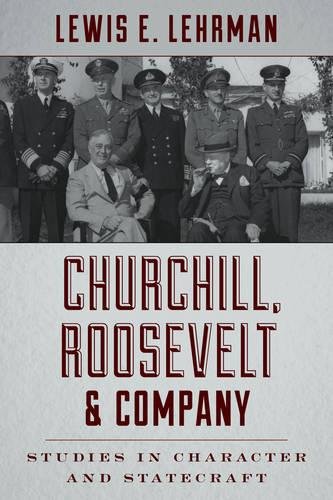
  • Churchill, Roosevelt & Company: Studies in Character and Statecraft

    During World War II the “special relationship” between the United States and Great Britain cemented the alliance that won the war in the West. But the ultimate victory of that partnership has obscured many of the conflicts behind Franklin Roosevelt’s charm and Winston Churchill’s victory signs—the clashes of principles and especially personalities between and within the leadership of the two nations.

    Synthesizing an impressive variety of sources from memoirs and letters to histories and biographies, Lewis E. Lehrman explains how the Anglo-American alliance worked—and occasionally did not work—by presenting portraits and case studies of the men who worked the back channels and back rooms, the generals and the admirals, the secretaries and under secretaries, ambassadors and ministers, responsible for carrying out Roosevelt’s and Churchill’s agendas while also pursuing their own. Such was the conduct of Joseph Kennedy, American ambassador to England often at odds with FDR; generals George C. Marshall and Dwight D. Eisenhower; spymasters William Donovan and William Stephenson; Secretary of State Cordell Hull, whom FDR frequently bypassed in favor of Under Secretary Sumner Welles; the Soviet spy in the leadership cadre of the US Treasury, Harry Dexter White, and his struggle with Lord Keynes; British ambassadors Lord Lothian and Lord Halifax; and, above them all, Roosevelt and Churchill. The President and the Prime Minister had the difficult task, not always well-performed, of managing their subordinates. Churchill and Roosevelt frequently chose to conduct foreign policy directly between themselves, and with Stalin.

    Scrupulous in its research and fair in its judgments, Lehrman’s book reveals the personal diplomacy, the character and statecraft, at the core of the leadership of the Anglo-American alliance.


  • CHURCHILL ADDRESSES CANADIAN LAWMAKERS

    Ottawa, Canada • December 30, 1941 On December 28, 1941, British Prime Minister Winston Chur­chill left Wash­ing­ton’s Union Station, the capital’s major train station, for Canada. Six days ear­lier Chur­chill and his mili­tary and civil­ian advisers had arrived in the United States aboard the Royal Navy’s newly com­mis­sioned battle­ship, the HMS Duke of York, to…

  • DE GAULLE LOYALISTS SEIZE VICHY FRENCH ISLANDS OFF CANADA

    Washington, D.C. • December 24, 1941 At dawn on this grim date, Christmas Eve 1941, a tiny piece of Vichy France—the Atlan­tic islets of Saint Pierre and Miquelon, whose 93 sq. miles­/242 sq. km of wind­blown gra­nite out­crop­pings lay just 12 miles/­19 km off the New­found­land coast adja­cent to Canada—fell to the forces of Free France with­out a drop of…

  • U.S. DECLARES WAR ON JAPAN

    Washington, D.C. • December 8, 1941 At 12:30 p.m. on this this rainy and blustery day in 1941, standing before a joint ses­sion of the U.S. Con­gress and a world listening by radio, the 32nd Presi­dent of the United States, Franklin D. Roose­velt, laid seve­ral type­written sheets on the speaker’s podium. The day before, the…

  • CHURCHILL ADDRESSES U.S. AND CANADIAN LAWMAKERS

    Ottawa, Canada · December 30, 1941 On December 28, 1941, British Prime Minister Winston Chur­chill left Wash­ing­ton’s Union Sta­tion for Canada. Six days ear­lier Chur­chill and his mili­tary and civil­ian advisers had arrived in the nation’s capi­tal to meet with their Amer­i­can and Cana­dian counter­parts. The visit by the two heads of state between Christ­mas…