HITLER

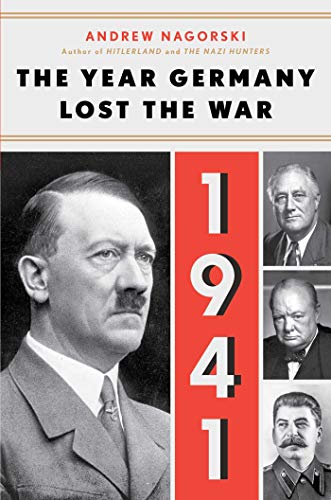
  • 1941: The Year Germany Lost the War

    Bestselling historian Andrew Nagorski takes a fresh look at the decisive year 1941, when Hitler’s miscalculations and policy of terror propelled Churchill, FDR, and Stalin into a powerful new alliance that defeated Nazi Germany.

    In early 1941, Hitler’s armies ruled most of Europe. Churchill’s Britain was an isolated holdout against the Nazi tide, but German bombers were attacking its cities and German U-boats were attacking its ships. Stalin was observing the terms of the Nazi-Soviet Pact, and Roosevelt was vowing to keep the United States out of the war. Hitler was confident that his aim of total victory was within reach.

    \By the end of 1941, all that changed. Hitler had repeatedly gambled on escalation and lost: by invading the Soviet Union and committing a series of disastrous military blunders; by making mass murder and terror his weapons of choice, and by rushing to declare war on the United States after Japan’s attack on Pearl Harbor. Britain emerged with two powerful new allies—Russia and the United States. By then, Germany was doomed to defeat.

    Nagorski illuminates the actions of the major characters of this pivotal year as never before. 1941: The Year Germany Lost the War is a stunning examination of unbridled megalomania versus determined leadership. It also reveals how 1941 set the Holocaust in motion, and presaged the postwar division of Europe, triggering the Cold War. 1941 was a year that forever defined our world.

  • LONDON’S ST. PAUL’S SURVIVES OVERNIGHT HIT

    London, England • April 16, 1941 This night and early the next morning in 1941, when London’s his­toric St. Paul’s Cathe­dral was bombed and damaged, marked the start of the final phase of the Blitz (Septem­ber 7, 1940, to May 21, 1941), which reached its climax on May 10 with a deadly raid that hit the House of Com­mons,…

  • GERMAN ARMY BACKS HITLER

    Berlin, Germany • April 11, 1934 On this date in 1934 German Chan­cellor Adolf Hitler sec­retly met with Ger­man War Minis­ter Gen. Wer­ner von Blom­berg, the un­offi­cial repre­sen­ta­tive of the officer corps of the Reichs­wehr (Ger­man armed forces), and reached an agree­ment that sealed the fate of the post-World War I Wei­mar Republic. Behind titu­lar Presi­dent…

  • ROOSEVELT, CHURCHILL TO PLOT WAR ON AXIS ENEMY

    Aboard HMS Duke of York • December 12, 1941 On this date in 1941 British Prime Minister Winston Chur­chill, fearing that the im­medi­ate im­pact of Japan’s attack on the U.S. naval and air bases at Pearl Harbor in Hawaii would be a retreat into an “Amer­ica-comes-first” pos­ture, boarded the British battle­ship HMS Duke of York,…

  • The Bitter Taste of Victory: Life, Love and Art in the Ruins of the Reich

    When Germany surrendered in May 1945 it was a nation reduced to rubble. Immediately, America, Britain, Soviet Russia, and France set about rebuilding in their zones of occupation. Most urgent were physical needs–food, water, and sanitation–but from the start the Allies were also anxious to indoctrinate the German people in the ideas of peace and civilization.

    Denazification and reeducation would be key to future peace, and the arts were crucial guides to alternative, less militaristic ways of life. In an extraordinary extension of diplomacy, over the next four years, many writers, artists, actors, and filmmakers were dispatched by Britain and America to help rebuild the country their governments had spent years bombing. Ernest Hemingway, Martha Gellhorn, Marlene Dietrich, George Orwell, Lee Miller, W. H. Auden, Stephen Spender, Billy Wilder, and others undertook the challenge of reconfiguring German society. In the end, many of them became disillusioned by the contrast between the destruction they were witnessing and the cool politics of reconstruction.

    While they may have had less effect on Germany than Germany had on them, the experiences of these celebrated figures, never before told, offer an entirely fresh view of post-war Europe. The Bitter Taste of Victory is a brilliant and important addition to the literature of World War II.

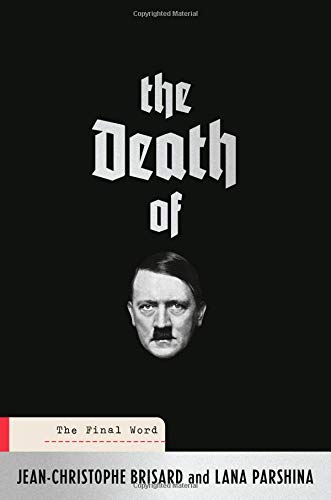
  • The Death of Hitler: The Final Word

    On April 30, 1945, Hitler committed suicide in his bunker as the Red Army closed in on Berlin. Within four days the Soviets had recovered his body. But the truth about what the Russian secret services found was hidden from history, when, three months later, Stalin officially declared to Truman and Churchill that Hitler was still alive and had escaped abroad. Reckless rumors about what really happened to Hitler began to spread like wildfire and, even today, they have not been put to rest. Until now.

    In 2017, after two years of painstaking negotiations with the Russian authorities, award-winning investigative journalists Jean-Christophe Brisard and Lana Parshina gained access to confidential Soviet files that finally revealed the truth behind the incredible hunt for Hitler’s body.

    Their investigation includes new eyewitness accounts of Hitler’s final days, exclusive photographic evidence and interrogation records, and exhaustive research into the power struggle that ensued between Soviet, British, and American intelligence services. And for the first time since the end of World War II, official, cutting-edge forensic tests have been completed on the human remains recovered from the bunker graves–a piece of skull with traces of a lethal bullet, a fragment of bone, and teeth.

    In The Death of Hitler–written as thrillingly as any spy novel–Brisard and Parshina debunk all previous conspiracy theories about the death of the Führer. With breathtaking precision and immediacy they penetrate one of the most powerful and controversial secret services to take readers inside Hitler’s bunker in its last hours–and solve the most notorious cold case in history.

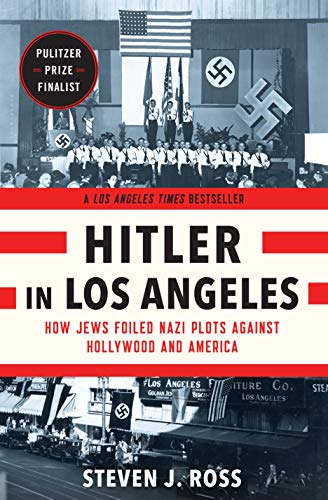
  • Hitler in Los Angeles: How Jews Foiled Nazi Plots Against Hollywood and America

    A 2018 FINALIST FOR THE PULITZER PRIZE

    The chilling, little-known story of the rise of Nazism in Los Angeles, and the Jewish leaders and spies they recruited who stopped it.

    No American city was more important to the Nazis than Los Angeles, home to Hollywood, the greatest propaganda machine in the world. The Nazis plotted to kill the city’s Jews and to sabotage the nation’s military installations: plans existed for hanging twenty prominent Hollywood figures such as Al Jolson, Charlie Chaplin, and Samuel Goldwyn; for driving through Boyle Heights and machine-gunning as many Jews as possible; and for blowing up defense installations and seizing munitions from National Guard armories along the Pacific Coast.

    U.S. law enforcement agencies were not paying close attention–preferring to monitor Reds rather than Nazis–and only Leon Lewis and his daring ring of spies stood in the way. From 1933 until the end of World War II, attorney Leon Lewis, the man Nazis would come to call “the most dangerous Jew in Los Angeles,” ran a spy operation comprised of military veterans and their wives who infiltrated every Nazi and fascist group in Los Angeles. Often rising to leadership positions, this daring ring of spies uncovered and foiled the Nazi’s disturbing plans for death and destruction.

    Featuring a large cast of Nazis, undercover agents, and colorful supporting players, Hitler in Los Angeles, by acclaimed historian Steven J. Ross, tells the story of Lewis’s daring spy network in a time when hate groups had moved from the margins to the mainstream.

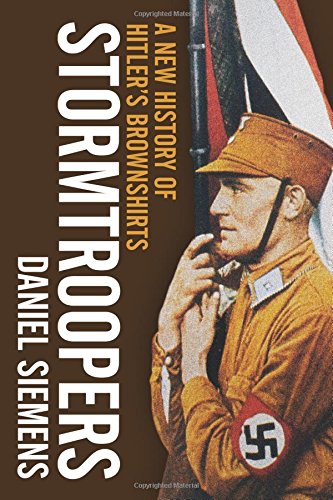
  • Stormtroopers: A New History of Hitler’s Brownshirts

    The first full history of the Nazi Stormtroopers whose muscle brought Hitler to power, with revelations concerning their longevity and their contributions to the Holocaust

    Germany’s Stormtroopers engaged in a vicious siege of violence that propelled the National Socialists to power in the 1930s. Known also as the SA or Brownshirts, these “ordinary” men waged a loosely structured campaign of intimidation and savagery across the nation from the 1920s to the “Night of the Long Knives” in 1934, when Chief of Staff Ernst Röhm and many other SA leaders were assassinated on Hitler’s orders.
     
    In this deeply researched history, Daniel Siemens explores not only the roots of the SA and its swift decapitation but also its previously unrecognized transformation into a million-member Nazi organization, its activities in German-occupied territories during World War II, and its particular contributions to the Holocaust. The author provides portraits of individual members and their victims and examines their milieu, culture, and ideology. His book tells the long-overdue story of the SA and its devastating impact on German citizens and the fate of their country.