HITLER

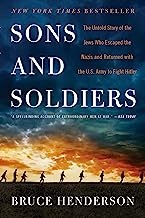
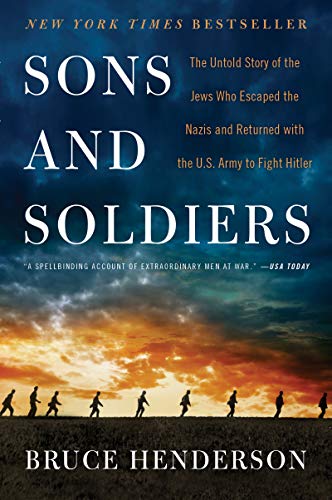
  • Sons and Soldiers: The Untold Story of the Jews Who Escaped the Nazis and Returned with the U.S. Army to Fight Hitler

    NEW YORK TIMES BESTSELLER • “An irresistible history of the WWII Jewish refugees who returned to Europe to fight the Nazis.” —Newsday

    They were young Jewish boys who escaped from Nazi-occupied Europe and resettled in America. After the United States entered the war, they returned to fight for their adopted homeland and for the families they had left behind. Their stories tell the tale of one of the U.S. Army’s greatest secret weapons.

    Sons and Soldiers begins during the menacing rise of Hitler’s Nazi party, as Jewish families were trying des-perately to get out of Europe. Bestselling author Bruce Henderson captures the heartbreaking stories of parents choosing to send their young sons away to uncertain futures in America, perhaps never to see them again. As these boys became young men, they were determined to join the fight in Europe. Henderson describes how they were recruited into the U.S. Army and how their unique mastery of the German language and psychology was put to use to interrogate German prisoners of war.

    These young men—known as the Ritchie Boys, after the Maryland camp where they trained—knew what the Nazis would do to them if they were captured. Yet they leapt at the opportunity to be sent in small, elite teams to join every major combat unit in Europe, where they collected key tactical intelligence on enemy strength, troop and armored movements, and defensive positions that saved American lives and helped win the war. A postwar army report found that nearly 60 percent of the credible intelligence gathered in Europe came from the Ritchie Boys.

    Sons and Soldiers draws on original interviews and extensive archival research to vividly re-create the stories of six of these men, tracing their journeys from childhood through their escapes from Europe, their feats and sacri-fices during the war, and finally their desperate attempts to find their missing loved ones. Sons and Soldiers is an epic story of heroism, courage, and patriotism that will not soon be forgotten.
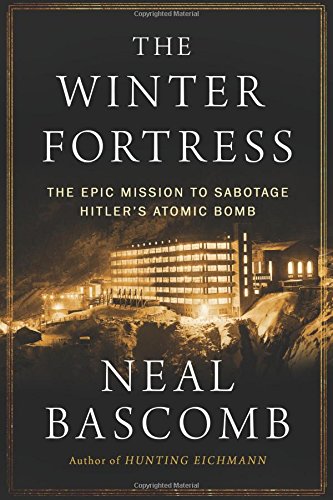
  • The Winter Fortress: The Epic Mission to Sabotage Hitler’s Atomic Bomb

    From the internationally acclaimed, best-selling author of Hunting Eichmann and The Perfect Mile, an epic adventure and spy story about the greatest act of sabotage in all of World War II.
     
    It’s 1942 and the Nazis are racing to be the first to build a weapon unlike any known before. They have the physicists, they have the uranium, and now all their plans depend on amassing a single ingredient: heavy water, which is produced in Norway’s Vemork, the lone plant in all the world that makes this rare substance. Under threat of death, Vemork’s engineers push production into overdrive.
     
    For the Allies, the plant must be destroyed. But how would they reach the castle fortress set on a precipitous gorge in one of the coldest, most inhospitable places on Earth?
     
    Based on a trove of top secret documents and never-before-seen diaries and letters of the saboteurs, The Winter Fortress is an arresting chronicle of a brilliant scientist, a band of spies on skies, perilous survival in the wild, sacrifice for one’s country, Gestapo manhunts, soul-crushing setbacks, and a last-minute operation that would end any chance Hitler could obtain the atomic bomb—and alter the course of the war.
     

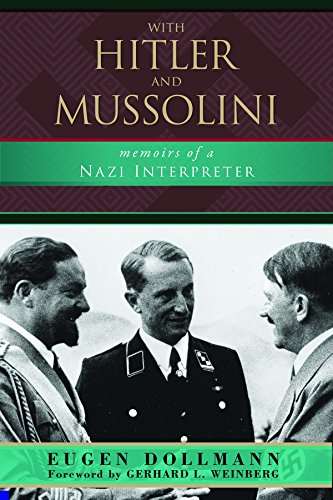
  • With Hitler and Mussolini: Memoirs of a Nazi Interpreter

    An insider’s view of Hitler, Himmler, Heydrich, and Mussolini.

    In the years before World War II, Eugen Dollmann arrived in Rome on a scholarship, intending to write a history of the Catholic Church. Instead he joined the Nazi Party and became an interpreter to various members of the German and Italian Fascist hierarchy.

    In this capacity Dollmann attended the Munich Conference of 1938 and was present at most of the important meetings between Hitler and Mussolini, also witnessing many of the endless squabbles between Mussolini’s son-in-law Galeazzo Ciano and Hitler’s foreign secretary, Joachim von Ribbentrop. He interpreted for Heinrich Himmler during his visits to Rome and was, curiously for one of his temperament, appointed Obersturmführer in the Allgemeine SS. He played a considerable role in the surrender of the German Army in Italy, helping to prevent the execution of Hitler’s scorched-earth orders.

    The book is full of piquant anecdotes—Himmler’s excavations for the legendary treasure of King Alaric; the visit of Reinhard Heydrich to the House of the Provinces, a brothel frequented by officers and men of means; Hitler’s dread and annoyance at being piloted into his newly conquered Ukraine by Mussolini—to mention only a few.

    Throughout, Dollmann makes no attempt to conceal or exonerate his association with the Nazis. With Hitler and Mussolini is a fascinating memoir filled with political intrigue, undercover activity, and insights into the biggest personalities connected to the Second World War.
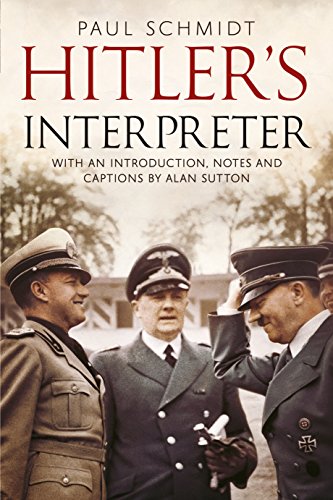
  • Hitler’s Interpreter

    As the main interpreter for Adolf Hitler during the key prewar moments, such as the Munich Agreement, the British Declaration of War and the surrender of France, Paul-Otto Schmidt was well placed to record his impressions of events from 1935 up to 1945.

    He was an interpreter working in the German foreign ministry where he served from 1923 to 1945, and being fluent in English and French he gained respect and was Hitler’s usual first choice for the important meetings. During the war years he served as Hitler’s interpreter during his meetings with Marshal Philippe Pétain and Francisco Franco.

    After the 1942 Dieppe Raid resulted in thousands of Canadian soldiers captured, Schmidt was in charge of their interrogations. Schmidt’s book is helpful in gaining an insight into the minutiae of Third Reich thinking and planning―as much as planning went beyond Hitler’s will. One classic nugget is from the early morning of 3 September 1939 when Britain issued its ultimatum to Germany, for it was Schmidt who had to hand the translation to Hitler: ‘After an interval which seemed an age, he turned to Ribbentrop, who had remained standing by the window. “What now?” asked Hitler with a savage look, as though implying that his Foreign Minister had misled him about England’s probable reaction.’

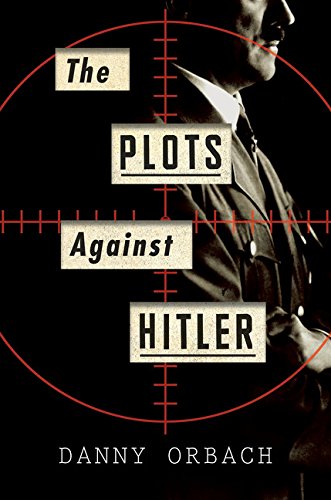
  • The Plots Against Hitler

    A new and definitive account of the anti-Nazi underground in Germany and its numerous efforts to assassinate Adolf Hitler

    In 1933, Adolf Hitler became Chancellor of Germany. A year later, all parties but the Nazis had been outlawed, freedom of the press was but a memory, and Hitler’s dominance seemed complete. Yet over the next few years, an unlikely clutch of conspirators emerged – soldiers, schoolteachers, politicians, diplomats, theologians, even a carpenter – who would try repeatedly to end the Fuhrer’s genocidal reign. This dramatic and deeply researched book tells the full story of those noble, ingenious, and doomed efforts. This is history at its most suspenseful, as we witness secret midnight meetings, crises of conscience, fierce debates among old friends about whether and how to dismantle Nazism, and the various plots themselves being devised and executed.
     
    Orbach’s fresh research takes advantage of his singular skills as linguist and historian to offer profound insight into the conspirators’ methods, motivations, fears, and hopes. Though we know how this story ends, we’ve had no idea until now how close it came – several times – to ending very differently. The Plots Against Hitler fundamentally alters our view of World War II and sheds bright – even redemptive – light on its darkest days.

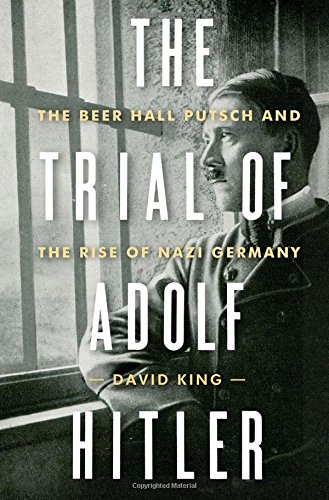
  • The Trial of Adolf Hitler: The Beer Hall Putsch and the Rise of Nazi Germany

    The never-before-told story of the scandalous courtroom drama that paved the way for the rise of Adolf Hitler and the Nazi Party.

    On the evening of November 8, 1923, the thirty-four-year-old Adolf Hitler stormed into a beer hall in Munich, fired his pistol in the air, and proclaimed a revolution. Seventeen hours later, all that remained of his bold move was a trail of destruction. Hitler was on the run from the police. His career seemed to be over.

    The Trial of Adolf Hitler tells the true story of the monumental criminal proceeding that followed when Hitler and nine other suspects were charged with high treason. Reporters from as far away as Argentina and Australia flocked to Munich for the sensational four-week spectacle. By its end, Hitler would transform the fiasco of the beer hall putsch into a stunning victory for the fledgling Nazi Party. It was this trial that thrust Hitler into the limelight, provided him with an unprecedented stage for his demagoguery, and set him on his improbable path to power.

    Based on trial transcripts, police files, and many other new sources, including some five hundred documents recently discovered from the Landsberg Prison record office, The Trial of Adolf Hitler is a gripping true story of crime and punishment―and a haunting failure of justice with catastrophic consequences.

    8 pages of illustrations

  • ROMMEL ROUTS BRITISH, TAKES TOBRUK STRONGHOLD

    Cairo, Egypt · June 21, 1942 After a disorderly retreat by the British Eighth Army into Egypt following Erwin Rommel’s break­through of the Gazala Line in mid-June, the Desert Fox (Rommel’s popular nick­name) stormed the British-held Mediter­ranean for­tress and harbor of Tobruk in Eastern Libya on this date in 1942. The newly minted German field…

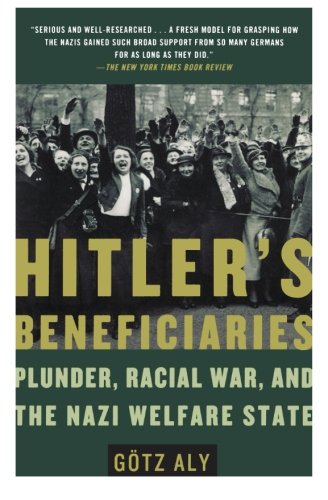
  • Hitler’s Beneficiaries: Plunder, Racial War, and the Nazi Welfare State

    A “provocative” account of great “intellectual significance,” illuminating the economic workings of the Third Reich―and the reasons ordinary Germans supported the Nazi state (The New York Times Book Review)

    In this groundbreaking book, historian Götz Aly addresses one of modern history’s greatest conundrums: How did Hitler win the allegiance of ordinary Germans? The answer is as shocking as it is persuasive: by engaging in a campaign of theft on an almost unimaginable scale―and by channeling the proceeds into generous social programs―Hitler literally “bought” his people’s consent.

    Drawing on secret files and financial records, Aly shows that while Jews and citizens of occupied lands suffered crippling taxation, mass looting, enslavement, and destruction, most Germans enjoyed an improved standard of living. Buoyed by millions of packages soldiers sent from the front, Germans also benefited from the systematic plunder of Jewish possessions. Any qualms were swept away by waves of tax breaks and government handouts.

    Hitler’s Beneficiaries has been hailed as “startling” by Richard Evans, and as “fascinating and important” by Christopher Browning. Above all, as Omer Bartov testifies, this remarkable book “irreversibly transforms our understanding of the Third Reich.”

  • GERMANS CRUSH DUTCH DEFENSES

    Rotterdam, The Netherlands • May 14, 1940 On this date in 1940 in Holland, the German Luft­waffe bombed Rotter­dam’s medi­e­val city cen­ter, killing nearly 1,000 people and leaving 85,000 home­less. Rather than endure more fero­cious bombings—leaf­lets dropped on Utrecht indi­cated it was next Dutch city in German cross­hairs—the Dutch Army surren­dered the next day. The German…

  • GERMANS SIGN UNCONDITIONAL SURRENDER

    Reims, France • May 7, 1945 Five days after the suicide of Adolf Hitler on April 30, 1945, Adm. Hans-Georg von Friede­burg, an emis­sary from Grand Admiral Karl Doenitz, arrived in the French cathe­dral town of Reims, head­quarters of Gen. Dwight D. Eisen­hower, Supreme Com­mander Allied Exped­i­tionary Force, looking pale and tired. For the second…