HOME FRONT (USA)

  • JAPANESE SUB SHELLS U.S. WEST COAST

    Santa Barbara, California • February 23, 1942 Japanese submarines initiated the first shore bom­bard­ments of the war with an attack on the U.S. Navy base at John­ston Island in the Paci­fic in mid-Decem­ber 1941, just days after Japa­nese carrier-based planes had destroyed, in their sur­prise attack on Pearl Harbor, Hawaii, one‑half of the United States’…

  • JAPANESE ON U.S. WEST COAST TO BE FORCIBLY RELOCATED

    Washington, D.C. • February 19, 1942 Eighty-four years ago on this date in 1942, cele­brated today as the Day of Remem­brance, Presi­dent Franklin D. Roose­velt signed Execu­tive Order 9066. It autho­rized the War Depart­ment to desig­nate “mili­tary areas” in the U.S. and admit, exclude, or remove from these areas any­one whom the depart­ment felt to…

  • ROOSEVELT: U.S. DEFENSE PLAN EMPHASIZES AIDING ALLIES

    Washington, D.C. • December 20, 1940 On this date in 1940 President Franklin D. Roose­velt appointed William Knud­sen to head a 4‑member board (Office of Pro­duc­tion Manage­ment, or OPM) to plan for national defense and coor­di­nate aid to Great Britain following Germany’s total block­ade of that island nation in mid-August (Battle of the Atlantic). A Danish…

  • JAPANESE BALLOON BOMBS STRIKE U.S. WEST COAST

    Seattle, Washington • November 3, 1944 On this date in 1944 Japan began an explosive balloon cam­paign against the U.S. and Canada. The date was chosen to com­memo­rate the birth­day of former Emperor Meiji (1852–1912). Over the next 5 months the Special Bal­loon Regi­ment of the Japa­nese Army launched some 6,000 to 9,300 (sources vary) hydro­gen-filled…

  • CONGRESS APPROVES WOMEN’S AUXILIARY ARMY CORPS (WAAC)

    Washington, D.C. • May 14, 1942 Early in 1941 Congresswoman Edith Nourse Rogers of Massa­chu­setts informed Army Chief of Staff Gen. George C. Marshall that she in­tended to intro­duce a bill in the U.S. Con­gress to estab­lish a volun­teer women’s Army corps, sepa­rate and dis­tinct from the existing Army Nurse Corps. After long debate—and after…

  • GROUND BROKEN FOR TULE LAKE RELOCATION CENTER

    Tulelake, Modoc County, California • April 15, 1942 On this date in 1942, in a remote, under­developed recla­ma­tion dis­trict roughly 35 miles/­56 kilo­meters south­east of Klamath Falls, Oregon, and about 10 miles/­16 kilo­meters from the town of Tule­lake (or Newell), the federal govern­ment began con­struc­tion of the Tule Lake Relo­ca­tion Center for persons of Japa­nese ances­try forci­bly deported from…

  • ROOSEVELT DIRECTS STEPS TO IMPROVE U.S. DEFENSES

    Washington, D.C. • September 8, 1939 On this date in 1939, 8 days after Nazi Germany invaded neigh­boring Poland and triggered World War II in Europe, Presi­dent Franklin D. Roose­velt declared a state of “limited national emer­gency.” The procla­ma­tion directed mea­sures “for the pur­pose of strengthening our [U.S.] national defense within the limits of peace­time authori­za­tions.”…

  • U.S. GOVERNMENT BEGINS ARRESTING ENEMY ALIENS

    Washington, D.C. • December 8, 1941 Although the devastating Japanese surprise attack on U.S. mili­tary instal­la­tions at Pearl Harbor, Hawaii, on Decem­ber 7, 1941, came as a shock to most Amer­i­cans, Presi­dent Franklin D. Roose­velt’s admin­is­tra­tion had already begun weighing pos­sible responses to an out­break of war with Japan, Germany, and Italy—countries treaty-bound in a mutual…

  • MASSIVE ESCAPE OF GERMAN POWs

    Bridgend, South Wales • March 10, 1945 Twenty-two miles west of the Welch capital, Cardiff, was a British prisoner-of-war camp built to house mainly Ger­man but also some Ital­ian pri­soners. Cap­able of accom­mo­dating 2,000 in­mates, the camp was called Island Farm. On this date in 1945, 67 POWs (one source says as many as 84 POWs) escaped from…

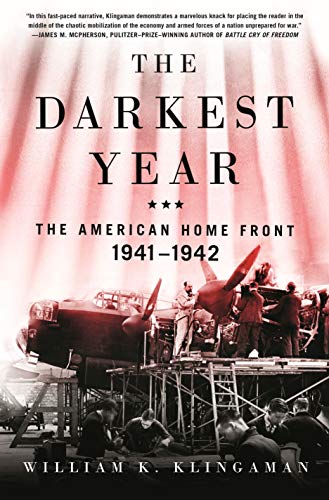
  • The Darkest Year: The American Home Front 1941-1942

    The Darkest Year is acclaimed author William K. Klingaman’s narrative history of the American home front from December 7, 1941 through the end of 1942, a psychological study of the nation under the pressure of total war.

    For Americans on the home front, the twelve months following the Japanese attack on Pearl Harbor comprised the darkest year of World War Two. Despite government attempts to disguise the magnitude of American losses, it was clear that the nation had suffered a nearly unbroken string of military setbacks in the Pacific; by the autumn of 1942, government officials were openly acknowledging the possibility that the United States might lose the war.

    Appeals for unity and declarations of support for the war effort in the aftermath of Pearl Harbor made it appear as though the class hostilities and partisan animosities that had beset the United States for decades ― and grown sharper during the Depression ― suddenly disappeared. They did not, and a deeply divided American society splintered further during 1942 as numerous interest groups sought to turn the wartime emergency to their own advantage.

    Blunders and repeated displays of incompetence by the Roosevelt administration added to the sense of anxiety and uncertainty that hung over the nation.

    The Darkest Year focuses on Americans’ state of mind not only through what they said, but in the day-to-day details of their behavior. Klingaman blends these psychological effects with the changes the war wrought in American society and culture, including shifts in family roles, race relations, economic pursuits, popular entertainment, education, and the arts.