PACIFIC THEATER

  • JAPAN DELIVERS FINAL PEACE OFFER TO U.S.

    Washington, D.C. • November 20, 1941 On this date in 1941 in Washington, Japanese ambassador Kichisa­burō Nomura pre­sented his govern­ment’s final pro­posal for peace in the Asia Pacific region. Through much of 1941, Ambas­sador Nomura had nego­ti­ated with U.S. Secre­tary of State Cordell Hull to resolve fes­tering bi­lat­eral issues. Chief among the issues were the…

  • FIVE SULLIVAN BROTHERS LOST WITH CRUISER

    Off Savo Island, Solomon Islands, South Pacific • November 13, 1942 Commissioned on February 14, 1942, the light antiaircraft cruiser USS Juneau (CL‑52), named after the capital city of Alaska, first saw ser­vice in the Carib­bean, where it per­formed block­ade patrol in early May off Marti­nique and Gua­de­loupe Islands to pre­vent the escape of Vichy French…

  • MEDICAL AIR EVAC PLANE VANISHES OVER ALBANIA

    Bari, Italy • November 8, 1943 On this date in 1943, 13 U.S. Army flight nurses, 13 young enlisted medics, and 3 flight crew boarded a Douglas C‑53 trans­port in Sicily for a 90‑minute flight to Bari on the Italian main­land. As a unit of the 807th Medical Air Evacu­a­tion Squa­dron, the team’s assign­ment was to…

  • ROOSEVELT, CHURCHILL IN SECRET DISCUSSIONS

    Quebec, Canada • August 18, 1943 On this date in 1943 in Quebec, Canada, President Franklin D. Roose­velt, British Prime Minis­ter Winston Chur­chill, and Cana­dian Prime Minis­ter Mac­kenzie King, along with their Com­bined Chiefs of Staff, set to work plan­ning Opera­tion Over­lord, the 1944 inva­sion of German-occupied France. At this first of two Quebec con­ferences,…

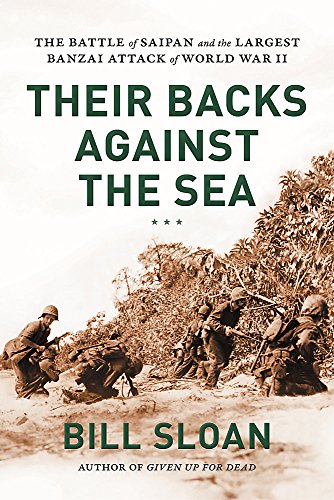
  • Their Backs against the Sea: The Battle of Saipan and the Largest Banzai Attack of World War II

    In the midst of the largest banzai attack of the war, US Army Lt. Col. William O’Brien, grievously wounded and out of ammunition, grabbed a sabre from a fallen Japanese soldier and flailed away at a small army of assailants, screaming to his men, “Don’t give them a damn inch!” When his body was recovered the next day, thirty dead enemies were piled around him.

    The Battle of Saipan lasted twenty-five hellish days in the summer of 1944, and the stakes couldn’t have been higher. If Japan lost possession of the island, all hope for victory would be lost. For the Americans, its capture would result in secure air bases for the new B-29s that would put them within striking distance of the Japanese homeland. The outcome of the war in the Pacific lay in the balance.

    In this gritty, vivid narrative, award-winning author Bill Sloan fuses fresh interviews, oral and unit histories, and unpublished accounts to describe one of the war’s bloodiest and most overlooked battles of the Pacific theater. Combining grunt’s-view grit with big picture panorama (and one of the ugliest inter-service controversies of the war), Their Backs against the Sea is the definitive dramatic story of this epic battle–and an inspiring chronicle of some of the greatest acts of valor in American military history.

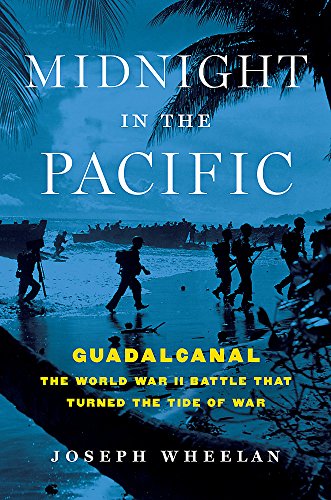
  • Midnight in the Pacific: Guadalcanal-The World War II Battle That Turned the Tide of War

    A sweeping narrative history–the first in over twenty years–of America’s first major offensive of World War II, the brutal, no-quarter-given campaign to take Japanese-occupied Guadalcanal

    From early August until mid-November of 1942, US Marines, sailors, and pilots struggled for dominance against an implacable enemy: Japanese soldiers, inculcated with the bushido tradition of death before dishonor, avatars of bayonet combat–close-up, personal, and gruesome. The glittering prize was Henderson Airfield. Japanese planners knew that if they neutralized the airfield, the battle was won. So did the Marines who stubbornly defended it.

    The outcome of the long slugfest remained in doubt under the pressure of repeated Japanese air, land, and sea operations. And losses were heavy. At sea, in a half-dozen fiery combats, the US Navy fought the Imperial Japanese Navy to a draw, but at a cost of more than 4,500 sailors. More American sailors died in these battles off Guadalcanal than in all previous US wars, and each side lost 24 warships. On land, more than 1,500 soldiers and Marines died, and the air war claimed more than 500 US planes. Japan’s losses on the island were equally devastating–starving Japanese soldiers called it “the island of death.”

    But when the attritional struggle ended, American Marines, sailors, and airmen had halted the Japanese juggernaut that for five years had whirled through Asia and the Pacific. Guadalcanal was America’s first major ground victory against Japan and, most importantly, the Pacific War’s turning point.

    Published on the 75th anniversary of the battle and utilizing vivid accounts written by the combatants at Guadalcanal, along with Marine Corps and Army archives and oral histories, Midnight in the Pacific is both a sweeping narrative and a compelling drama of individual Marines, soldiers, and sailors caught in the crosshairs of history.


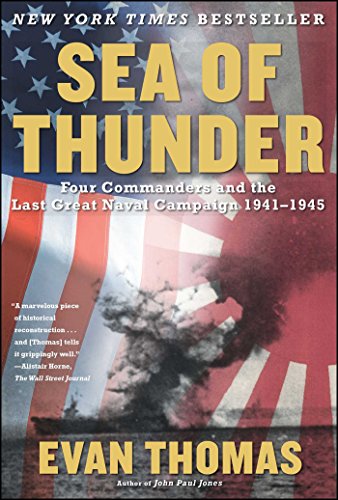
  • Sea of Thunder: Four Commanders and the Last Great Naval Campaign 1941-1945

    Sea of Thunder is a taut, fast-paced, suspenseful narrative of the Pacific War that culminates in the battle of Leyte Gulf, the greatest naval battle ever fought.

    Told from both the American and Japanese sides, through the eyes of commanders and sailors of both navies, Thomas’s history adds an important new dimension to our understanding of World War II.

    Drawing on oral histories, diaries, correspondence, postwar testimony from both American and Japanese participants, and interviews with survivors, Thomas provides an account not only of the great sea battle and Pacific naval war, but of the contrasting cultures pitted against each other.

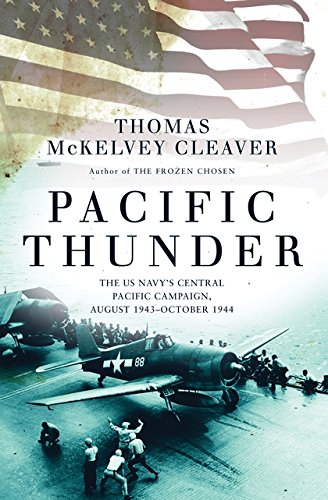
  • Pacific Thunder: The US Navy’s Central Pacific Campaign, August 1943–October 1944

    On 27 October 1942, four “Long Lance” torpedoes fired by the Japanese destroyers Makigumo and Akigumo exploded in the hull of the aircraft carrier USS Hornet (CV-8). Minutes later, the ship that had launched the Doolitte Raid six months earlier slipped beneath the waves of the Coral Sea 100 miles northeast of the island of Guadalcanal and just north of the Santa Cruz Islands, taking with her 140 of her sailors. With the loss of Hornet, the United States Navy now had one aircraft carrier left in the South Pacific, USS Enterprise (CV-6), herself badly damaged in the two previous days of the Battle of Santa Cruz, the fourth Japanese–American carrier battle since the Battle of the Coral Sea five months and three weeks before. Of the prewar carrier fleet the Navy had struggled to build over 15 years, only three were left: Enterprise licked her wounds at Espiritu Santo while USS Saratoga (CV-3) lay in dry dock at the Bremerton Navy Yard, victim of a Japanese submarine torpedo two months earlier. USS Ranger (CV-4) was in mid-Atlantic on her way to support Operation Torch, the invasion of North Africa.

    For the American naval aviators, it would be difficult to imagine that within 24 months of this event, Zuikaku, the last survivor of the Imperial Japanese Navy aircraft carriers that had attacked Pearl Harbor, would lie at the bottom of the Philippine Sea north of Cape Engano on the island of Luzon, alongside the other surviving Japanese carriers, sacrificed as lures in a failed attempt to block the American invasion of the Philippines after the Imperial Japanese Navy’s aviators had been destroyed as a viable fighting force in the Battle of the Philippines Sea, and that the United States Navy’s Task Force 38, composed of 16 fleet carriers, would reign supreme on the world’s largest ocean.

    Ten months after the loss of Hornet at Santa Cruz, an entirely new fleet of aircraft carriers would begin to make their presence known in the Pacific, starting with a raid by USS Essex (CV-9), class leader of the largest and most important class of capital ships ever built, and USS Lexington (CV-16), namesake of the carrier sunk at Coral Sea, against the Japanese-held island of Marcus. Fourteen months later, the islands of the south and central Pacific would be under American domination, led by the ships of the Fast Carrier Task Force, which would cement their position as the strongest naval fighting force ever to set sail, in the largest naval battle of history.

    The fourteen months of the Central Pacific Campaign constitute the most successful naval campaign ever undertaken and Pacific Thunder will put all elements of this campaign into historical context.

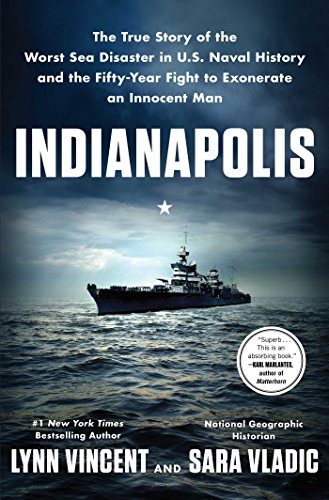
  • Indianapolis: The True Story of the Worst Sea Disaster in U.S. Naval History and the Fifty-Year Fight to Exonerate an…

    A human drama unlike any other—the riveting and definitive full story of the worst sea disaster in United States naval history.

    “ENTHRALLING.” —Kirkus Reviews (starred review) • “OUTSTANDING…A MUST-READ.” —Booklist (starred review) • “GRIPPING.” —Publishers Weekly

    Just after midnight on July 30, 1945, days after delivering the components of the atomic bomb from California to the Pacific Islands in the most highly classified naval mission of the war, USS Indianapolis is sailing alone in the center of the Philippine Sea when she is struck by two Japanese torpedoes. The ship is instantly transformed into a fiery cauldron and sinks within minutes. Some 300 men go down with the ship. Nearly 900 make it into the water alive. For the next five nights and four days, almost three hundred miles from the nearest land, the men battle injuries, sharks, dehydration, insanity, and eventually each other. Only 316 will survive.

    For the better part of a century, the story of USS Indianapolis has been understood as a sinking tale. The reality, however, is far more complicated—and compelling. Now, for the first time, thanks to a decade of original research and interviews with 107 survivors and eyewit­nesses, Lynn Vincent and Sara Vladic tell the complete story of the ship, her crew, and their final mission to save one of their own.

    It begins in 1932, when Indianapolis is christened and launched as the ship of state for President Franklin Roosevelt. After Pearl Harbor, Indianapolis leads the charge to the Pacific Islands, notching an unbroken string of victories in an uncharted theater of war. Then, under orders from President Harry Truman, the ship takes aboard a superspy and embarks on her final world-changing mission: delivering the core of the atomic bomb to the Pacific for the strike on Hiroshima. Vincent and Vladic provide a visceral, moment-by-moment account of the disaster that unfolds days later after the Japanese torpedo attack, from the chaos on board the sinking ship to the first moments of shock as the crew plunge into the remote waters of the Philippine Sea, to the long days and nights during which terror and hunger morph into delusion and desperation, and the men must band together to survive.

    Then, for the first time, the authors go beyond the men’s rescue to chronicle Indianapolis’s extraordinary final mission: the survivors’ fifty-year fight for justice on behalf of their skipper, Captain Charles McVay III, who is wrongly court-martialed for the sinking. What follows is a captivating courtroom drama that weaves through generations of American presidents, from Harry Truman to George W. Bush, and forever entwines the lives of three captains—McVay, whose life and career are never the same after the scandal; Mochitsura Hashimoto, the Japanese sub commander who sinks Indianapolis but later joins the battle to exonerate McVay; and William Toti, the captain of the modern-day submarine Indianapolis, who helps the survivors fight to vindicate their captain.

    A sweeping saga of survival, sacrifice, justice, and love, Indianapolis stands as both groundbreaking naval history and spellbinding narrative—and brings the ship and her heroic crew back to full, vivid, unforgettable life. It is the definitive account of one of the most remarkable episodes in American history.

  • U.S. MORTALLY WOUNDS JAPANESE NAVY

    Philippine Sea, North Pacific Ocean • June 19, 1944 On this date in 1944 a huge gale hit the two gigan­tic arti­ficial harbors known as Mul­berry har­bors that the British had built in England, floated across the English Chan­nel, and depos­ited on Normandy’s beaches seve­ral days after the Allies’ June 6 inva­sion. The gale inflicted losses…