THIRD REICH

  • HITLER SEEKS NAVAL BASES IN SPANISH CANARY ISLANDS

    Berlin, Germany • September 15, 1940 On this date in 1940 Adolf Hitler wrote a letter to Gen. Fran­cisco Franco, the Cau­dillo (politi­cal-mili­tary leader) of Spain, asking for naval bases for Germany in the Spanish Canary Islands off Africa’s west coast and in other places flying the flag of Spain. Hitler believed Franco owed him…

  • STRIKE INTO NAZI HEARTLAND TO GO THROUGH AACHEN

    SHAEF HQ, Versailles, France • September 5, 1944 On this date in 1944 Gen. Dwight D. Eisen­hower, Supreme Com­mander of the Allied Expedi­tionary Force, deter­mined that the route U.S. forces would take from liber­ated areas in France and Bel­gium east­ward into Nazi Ger­many would pass through the ancient city of Aachen, once the seat of…

  • HITLER PUTS POLAND INVASION ON HOLD

    Berlin, Germany • August 26, 1939 Serious discussions between the Nazi and Soviet regimes began secretly in late July 1939. On August 21 Germany announced that Foreign Minis­ter Joachim von Ribben­trop had been invited to Moscow. Two days later the world learned that Ribben­trop and his Soviet counter­part, Vyache­slav Molotov, had ini­tialed a neu­tral­ity pact between…

  • ITALY DECLARES WAR ON FRANCE, BRITAIN

    Rome, Italy · June 10, 1940 On March 18, 1940, at the Brenner Pass on the Italian-Austrian border, Adolf Hitler and Ital­ian strong­man Benito Mus­so­lini met face to face. Hitler had requested the sum­mit in order to force the Duce (Italian, “leader”) to take sides within the frame­work of the German-Ital­ian Pact of Steel, signed…

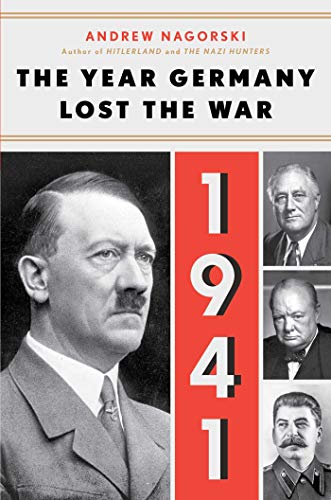
  • 1941: The Year Germany Lost the War

    Bestselling historian Andrew Nagorski takes a fresh look at the decisive year 1941, when Hitler’s miscalculations and policy of terror propelled Churchill, FDR, and Stalin into a powerful new alliance that defeated Nazi Germany.

    In early 1941, Hitler’s armies ruled most of Europe. Churchill’s Britain was an isolated holdout against the Nazi tide, but German bombers were attacking its cities and German U-boats were attacking its ships. Stalin was observing the terms of the Nazi-Soviet Pact, and Roosevelt was vowing to keep the United States out of the war. Hitler was confident that his aim of total victory was within reach.

    \By the end of 1941, all that changed. Hitler had repeatedly gambled on escalation and lost: by invading the Soviet Union and committing a series of disastrous military blunders; by making mass murder and terror his weapons of choice, and by rushing to declare war on the United States after Japan’s attack on Pearl Harbor. Britain emerged with two powerful new allies—Russia and the United States. By then, Germany was doomed to defeat.

    Nagorski illuminates the actions of the major characters of this pivotal year as never before. 1941: The Year Germany Lost the War is a stunning examination of unbridled megalomania versus determined leadership. It also reveals how 1941 set the Holocaust in motion, and presaged the postwar division of Europe, triggering the Cold War. 1941 was a year that forever defined our world.


  • LONDON’S ST. PAUL’S SURVIVES OVERNIGHT HIT

    London, England • April 16, 1941 This night and early the next morning in 1941, when London’s his­toric St. Paul’s Cathe­dral was bombed and damaged, marked the start of the final phase of the Blitz (Septem­ber 7, 1940, to May 21, 1941), which reached its climax on May 10 with a deadly raid that hit the House of Com­mons,…

  • GERMAN ARMY BACKS HITLER

    Berlin, Germany • April 11, 1934 On this date in 1934 German Chan­cellor Adolf Hitler sec­retly met with Ger­man War Minis­ter Gen. Wer­ner von Blom­berg, the un­offi­cial repre­sen­ta­tive of the officer corps of the Reichs­wehr (Ger­man armed forces), and reached an agree­ment that sealed the fate of the post-World War I Wei­mar Republic. Behind titu­lar Presi­dent…

  • MASSIVE ESCAPE OF GERMAN POWs

    Bridgend, South Wales • March 10, 1945 Twenty-two miles west of the Welch capital, Cardiff, was a British prisoner-of-war camp built to house mainly Ger­man but also some Ital­ian pri­soners. Cap­able of accom­mo­dating 2,000 in­mates, the camp was called Island Farm. On this date in 1945, 67 POWs (one source says as many as 84 POWs) escaped from…

  • BRITISH RUSH TROOPS TO AID GREECE

    Cairo, Egypt • March 7, 1941 On this date in 1941 in Greece, a British expe­di­tion­ary force from Egypt arrived just two days before the army of Ital­ian dictator Benito Mus­so­lini started its last unsuc­cess­ful cam­paign against Greek forces. The pre­vious Octo­ber the Ital­ian Army had crossed Greece’s north­west­ern fron­tier from neigh­boring Albania, launching the…