U.S. AIR FORCE

  • THIRD B-29 RAID ON JAPANESE CAPITAL TOKYO

    Tinian, Mariana Islands • December 3, 1944 On this date in 1944 86 4-engine B‑29 Super­for­tresses belonging to XXI Bomber Com­mand, a unit of the U.S. Twen­tieth Air Force, left the north­western Pacific Mari­ana Islands base on Tinian on their third Tokyo bombing mis­sion. Ten days earlier 111 of these 4‑engine heavy bombers had launched the…

  • BOEING B-29 SUPERFORTRESS FIRST FLIGHT

    Seattle, Washington State • September 21, 1942 On this date Boeing’s largest-to-date, 4‑engine heavy bomber lifted off on its maiden flight from its name­sake’s air­field in Seattle, Washing­ton. Three years earlier the fore­runner of the U.S. Army Air Forces had expressed its interest in a replace­ment bomber for the com­pany’s first 4‑engine heavy bomber, the…

  • U.S. EIGHTH AIR FORCE TESTS DAYLIGHT PRECISION BOMBING

    Rouen, Normandy, Occupied France • August 17, 1942 On ­July 4, 1942, a dozen Douglas A-20 Havoc medium bombers took off from a small, grassy air­strip in Norfolk, about 100 miles/­161 km north­east of London, Eng­land, and headed for Nazi-occupied Holland. Half the bombers were Amer­i­can, part of the U.S. Army Air Force’s Eighth Air Force 15th…

  • U.S., BRITISH AIR FORCES KICK OFF COMBINED BOMBER OFFENSIVE

    London, England • June 10, 1943 On this date in 1943 U.S. and British air forces unleashed their Com­bined Bomber Offen­sive (CBO) against indus­trial targets valu­able to Nazi Germany’s war machine, partic­u­larly to the Luft­waffe. The CBO had several ante­cedents. In late 1942 both the British and the Amer­i­cans had iden­tified “bottle­neck” German indus­tries (Great…

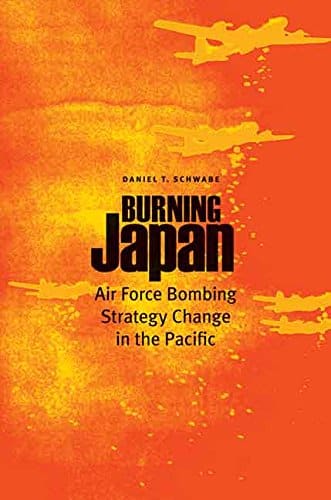
  • Burning Japan: Air Force Bombing Strategy Change in the Pacific

    Between the grinding battles of the Philippines, Iwo Jima, and Okinawa and the finality of the atomic bomb strikes on Hiroshima and Nagasaki, the U.S. Air Force conducted a bombing campaign against the Japanese home islands that escalated to new levels of destruction.


    Burning Japan is an investigation of how and why the air force shifted its tactics against Japan from a precision bombing strategy to area attacks. The guiding doctrine of the 1930s and 1940s called for focused attacks on specific targets deep behind enemy lines. Eager to prove itself, the nascent Army Air Force at first lauded the indispensability of strategic bombardment in areas otherwise unreachable by the army or navy. But when strategic bombing failed to yield the desired results in Europe and in initial efforts against Japan, the United States switched tactics, a shift that culminated in the area firebombing of nearly every major Japanese metropolis and the burning of sixty-six cities to the ground.


    Daniel T. Schwabe closely examines the planning and implementation of these incendiary missions to determine how an organization dedicated to precision decided on such a dramatic change in tactics. Ultimately, Schwabe maintains, this strategic reimagining helped create a comprehensive offensive strategy that did immense amounts of destruction which crippled Japan and brought an end to World War II.


     

  • THIRD B-29 RAID ON TOKYO

    Tinian, Mariana Islands · December 3, 1944 On this date in 1944 eighty-six 4-engine B‑29 Super­for­tresses belonging to XXI Bomber Com­mand, a unit of the U.S. Twen­tieth Air Force, left the north­western Pacific Mari­ana Islands base on Tinian on their third Tokyo bombing mis­sion. Ten days earlier 111 of these heavy bombers had launched the first raid…

  • THIRD B-29 RAID ON TOKYO

    Tinian, Mariana Islands · December 3, 1944 On this date in 1944 eighty-six B‑29 Super­for­tresses belonging to XXI Bomber Com­mand, a unit of the U.S. Twen­tieth Air Force, left the north­western Pacific Mari­ana Islands base on Tini­an on their third Tokyo bombing mis­sion. Ten days earlier 111 of these heavy bombers had launched the first raid on…