U.S. ARMY

  • MEDICAL AIR EVAC PLANE VANISHES OVER ALBANIA

    Bari, Italy • November 8, 1943 On this date in 1943, 13 U.S. Army flight nurses, 13 young enlisted medics, and 3 flight crew boarded a Douglas C‑53 trans­port in Sicily for a 90‑minute flight to Bari on the Italian main­land. As a unit of the 807th Medical Air Evacu­a­tion Squa­dron, the team’s assign­ment was to…

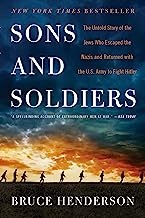
  • Sons and Soldiers: The Untold Story of the Jews Who Escaped the Nazis and Returned with the U.S. Army to Fight Hitler

    NEW YORK TIMES BESTSELLER • “An irresistible history of the WWII Jewish refugees who returned to Europe to fight the Nazis.” —Newsday

    They were young Jewish boys who escaped from Nazi-occupied Europe and resettled in America. After the United States entered the war, they returned to fight for their adopted homeland and for the families they had left behind. Their stories tell the tale of one of the U.S. Army’s greatest secret weapons.

    Sons and Soldiers begins during the menacing rise of Hitler’s Nazi party, as Jewish families were trying des-perately to get out of Europe. Bestselling author Bruce Henderson captures the heartbreaking stories of parents choosing to send their young sons away to uncertain futures in America, perhaps never to see them again. As these boys became young men, they were determined to join the fight in Europe. Henderson describes how they were recruited into the U.S. Army and how their unique mastery of the German language and psychology was put to use to interrogate German prisoners of war.

    These young men—known as the Ritchie Boys, after the Maryland camp where they trained—knew what the Nazis would do to them if they were captured. Yet they leapt at the opportunity to be sent in small, elite teams to join every major combat unit in Europe, where they collected key tactical intelligence on enemy strength, troop and armored movements, and defensive positions that saved American lives and helped win the war. A postwar army report found that nearly 60 percent of the credible intelligence gathered in Europe came from the Ritchie Boys.

    Sons and Soldiers draws on original interviews and extensive archival research to vividly re-create the stories of six of these men, tracing their journeys from childhood through their escapes from Europe, their feats and sacri-fices during the war, and finally their desperate attempts to find their missing loved ones. Sons and Soldiers is an epic story of heroism, courage, and patriotism that will not soon be forgotten.

  • The 101st Airborne in Normandy: June 1944 (Casemate Illustrated)

    101st Airborne Division was activated in August 1942 in Louisiana, and its first combat mission was Operation Overlord. On D-Day—June 6, 1944—101st and 82nd Airborne dropped onto the Cotentin peninsula hours before the landings, tasked with capturing bridges and positions, taking out German strongpoints and batteries, and securing the exits from Utah and Omaha Beaches. Things did not initially go smoothly for 101st Airborne, with cloud and antiaircraft fire disrupting the drops, resulting in some units landing scattered over a large area outside their designated drop zones and having to waste time assembling—stymied by lost or damaged radio equipment—or trying to achieve their objectives with severely reduced numbers.

    Casualties were high in some areas due to heavy pre-registered German fire. Nevertheless, the paratroopers fought on and they did manage to secure the crucial beach exits, even if they only achieved a tenuous hold on some other positions. A few days later, 101st Airborne were tasked with attacking the German-held city of Carentan as part of the consolidation of the US beachheads and establishment of a defensive line against the anticipated German counteroffensive. The 101st forced their way into Carentan on 10 and 11 June. The Germans withdrew the following day, and a counteroffensive was put down by elements of the 2nd Armored Division.

    This fully illustrated book details the planning of the airborne element of D-Day, and the execution of the plans until the troops were withdrawn to prepare for the next big airborne operation, Market Garden.

    Table of Contents

    Planning and Preparation
    Airborne Invasion
    “E” is for Easy
    The 101st in Carentan

  • Patton’s First Victory: How General George Patton Turned the Tide in North Africa and Defeated the Afrika Korps at El…

    American troops invaded North Africa in November 1942, but did not face serious resistance until the following February, when they finally tangled with Rommel’s Afrika Korps—and the Germans gave the inexperienced Americans a nasty drubbing at Kasserine Pass. After this disaster, Gen. George Patton took command and reinvigorated U.S. troops with tough training and new tactics. In late March, at El Guettar in Tunisia, Patton’s men defeated the Germans. It was a morale-boosting victory—the first American success versus the Germans and the first of Patton’s storied World War II career—and proved to the enemy, the British, and the Americans themselves that the U.S. Army could fight and win.

  • Arnhem: The Battle for the Bridges, 1944

    The great airborne battle for the bridges in 1944 by Britain’s Number One bestselling historian and author of the classic Stalingrad On 17 September 1944, General Kurt Student, the founder of Nazi Germany’s parachute forces, heard the growing roar of aero engines. He went out on to his balcony above the flat landscape of southern Holland to watch the vast air armada of Dakotas and gliders,carrying the British 1st Airborne and the American 101st and 82nd Airborne Divisions. He gazed up in envy at the greatest demonstration of paratroop power ever seen. Operation Market Garden, the plan to end the war by capturing the bridges leading to the Lower Rhine and beyond, was a bold concept: the Americans thought it unusually bold for Field Marshal Montgomery. But the cost of failure was horrendous, above all for the Dutch who risked everything to help. German reprisals were cruel and lasted until the end of the war. The British fascination for heroic failure has clouded the story of Arnhem in myths, not least that victory was possible when in fact the plan imposed by Montgomery and General ‘Boy’ Browning was doomed from the start. Antony Beevor, using many overlooked and new sources from Dutch, British, American, Polish and German archives, has reconstructed the terrible reality of this epic clash. Yet this book, written in Beevor’s inimitable and gripping narrative style, is about much more than a single dramatic battle. It looks into the very heart of war.

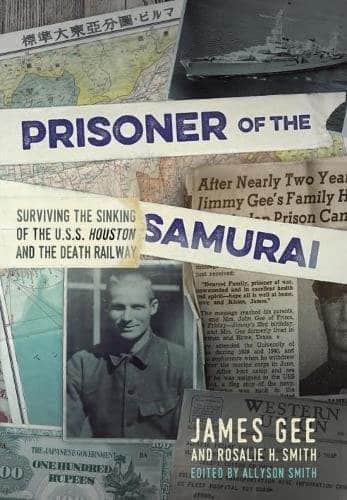
  • Prisoner of the Samurai: Surviving the Sinking of the USS Houston and the Death Railway

    During World War II, Lt. Rosalie Hamric was an R.N., serving as Charge Nurse in the Psychiatric Ward of the Guantanamo Bay Naval Hospital. At the end of the war, a group of liberated prisoners of war from Southeast Asia, survivors of the sinking of the USS Houston in 1942, was sent to the ward for treatment. Many were encouraged to write down their experiences as part of their therapy. One, James Gee, PFC, USMC did a particularly detailed job. His account covers the sinking of the Houston, his rescue by a Japanese ship, and his experiences in Japanese camps over the next three years.

    Initially a prisoner in Java forced to load and unload enemy ships, then in Batavia, he was then transferred to Burma where he worked on the “death railway,” living on the banks of the River Kwai. Those who survived the hard labor and harsh conditions there would be sent onto Thailand, then Singapore before arriving in Japan in 1945, spending the last few months of the war working in coal mines just 40 miles outside Nagasaki. Rosalie worked his accounts into a manuscript, which following her sudden death, languished in an attic for over thirty years. Now rediscovered, James’s story can be told to a new generation.

  • JOINT U.S.-CANADIAN SPECIAL OPS FORCE ACTIVATED

    Fort William Henry Harrison, Helena, Montana • July 9, 1942 On this date in 1942 the First Special Service Force was acti­vated as a joint U.S.-Cana­dian force. Regarded as parents of the U.S. Green Berets, the United States Special Opera­tions Com­mand, and the Cana­dian Special Opera­tions Forces Com­mand, these volun­teers were the shock troops of the…

  • RECORD YEAR-END DELIVERY OF B-29s

    Washington, D.C. · December 31, 1943 By this date in 1943 Boeing delivered its 92nd B‑29 Super­for­tress to the U.S. govern­ment after the giant bomber began rolling off the assem­bly line the pre­vious Septem­ber. Even before the coun­try was at war and govern­ment funds had been allo­cated, Boeing had produced a proto­type of the long-range…

  • NAZIS FORCE BULGE IN ALLIED LINES IN BELGIUM

    SHAEF HQ, France · December 16, 1944 “It is essential to deprive the enemy of his belief that victory is cer­tain,” Adolf Hitler told his gene­rals on Decem­ber 12, 1944. Four days later, on this date in 1944, ele­ments of four Ger­man armies, com­prising nearly 300,000 Ger­man troops in 14 in­fan­try and 5 armored (panzer) divi­sions (tank divisions), smashed…