VICHY FRANCE

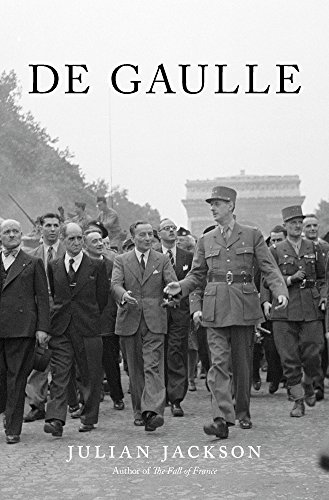
  • De Gaulle

    “A masterly study of Charles de Gaulle…that leaves not a scintilla of doubt about his greatness.”
    Sunday Times

    “In crafting the finest one-volume life of de Gaulle in English, Julian Jackson has come closer than anyone before him to demystifying this conservative at war with the status quo, for whom national interests were inseparable from personal honor.”
    ―Richard Norton Smith, Wall Street Journal

    In the early summer of 1940, when France was overrun by German troops, one junior general who had fought in the trenches in Verdun refused to accept defeat. He fled to London, where he took to the radio to address his compatriots back home. “Whatever happens,” he said, “the flame of French resistance must not be extinguished and will not be extinguished.” At that moment, Charles de Gaulle entered history.

    For the rest of the war, de Gaulle insisted he and his Free French movement were the true embodiment of France. Through sheer force of personality he inspired French men and women to risk their lives to resist the Nazi occupation. Sometimes aloof but confident in his leadership, he quarreled violently with Churchill and Roosevelt. Yet they knew they would need his help to rebuild a shattered Europe. Thanks to de Gaulle, France was recognized as one of the victorious Allies when Germany was finally defeated. Then, as President of the Fifth Republic, he brought France to the brink of a civil war over his controversial decision to pull out of Algeria. He challenged American hegemony, took France out of NATO, and twice vetoed British entry into the European Community in his pursuit of what he called “a certain idea of France.”

    Julian Jackson’s magnificent biography, the first major reconsideration in over twenty years, captures this titanic figure as never before. Drawing on the extensive resources of the recently opened de Gaulle archives, Jackson reveals the conservative roots of de Gaulle’s intellectual formation, sheds new light on his relationship with Churchill, and shows how he confronted riots at home and violent independence movements from the Middle East to Vietnam. No previous biography has so vividly depicted this towering figure whose legacy remains deeply contested.
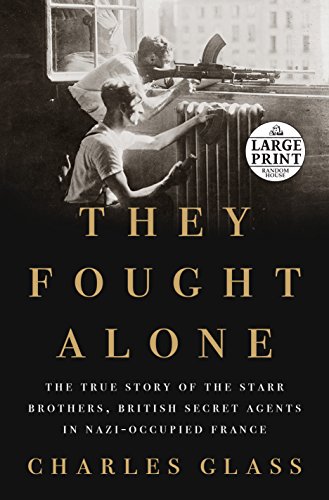
  • They Fought Alone: The True Story of the Starr Brothers, British Secret Agents in Nazi-Occupied France

    From the bestselling author of Americans in Paris and The Deserters, the untold story of Britain’s Special Operations Executive, one of World War II’s most important secret fighting forces

    As far as the public knew, Britain’s Special Operations Executive did not exist. After the defeat of the French Army, Prime Minister Winston Churchill created the top-secret espionage operation to “set Europe ablaze,” and the SOE remained below the radar until the end of World War II. The agents infiltrated Nazi-occupied France, parachuting behind enemy lines and hiding in plain sight, quietly but forcefully recruiting, training, and arming the local French résistants willing to aid in sabotage of the German war machine. The SOE would not only change the course of the war, but the very nature of combat itself. Of the many brave men and women conscripted, two Anglo-American recruits, the Starr brothers, stood out to become legendary figures to the guerillas, assassins, and saboteurs they led.

    While both brothers were sent across the channel to organize against the Germans, their fates in war could hardly have been more different. Captain George Starr commanded networks of résistants in southwest France, cutting German communications, destroying weapons factories, and delaying the arrival of Nazi troops to Normandy by seventeen days after D-Day. Younger brother Lieutenant John Starr laid groundwork for resistance in the Burgundy countryside until he was betrayed, captured, tortured and imprisoned at Gestapo headquarters and forced labor camps. Feats of boldness and bravado were many, but appalling scandals, including George’s supposed torture and execution of Nazis prisoners, and John’s alleged collaboration with his German captors, overshadowed them all. At the war’s end, Britain, France, and the United States awarded both brothers medals for heroism, and George would become one of only three among thousands of SOE operatives to achieve the rank of colonel. Yet, their battle honors did little to allay post-war allegations against them, and when they returned to England, their government accused both brothers of war crimes.

    Here, for the first time, is the story of one of the last secret organizations of World War II, and of two brothers whose ordeals during and after the war challenged the accepted myths of Britain’s wartime resistance in occupied France. Written with complete and unrivaled access to only recently declassified documents from Britain’s SOE, family letters, diaries, and court records, along with interviews from surviving wartime Resistance fighters, They Fought Alone is a real-life thriller. Renowned journalist and war correspondent Charles Glass exposes a dramatic tale of spies, sabotage, and the daring men and women who risked everything to change the course of World War II.

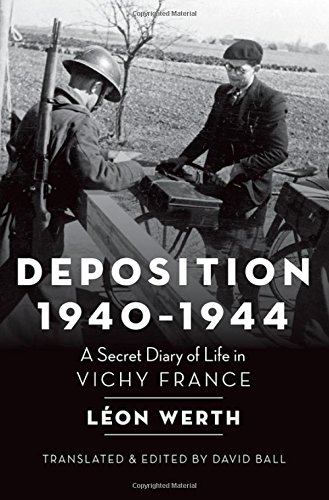
  • Deposition 1940-1944: A Secret Diary of Life in Vichy France

    Historians agree: the diary of Léon Werth (1878-1955) is one of the most precious–and readable–pieces of testimony ever written about life in France under Nazi occupation and the Vichy regime. Werth was a free-spirited and unclassifiable writer. He is the author of eleven novels, art and dance criticism, acerbic political reporting, and memorable personal essays. He was Jewish, and left Paris in June 1940 to hide out in his wife’s country house in Saint-Amour, a small village in the Jura Mountains. His short memoir 33 Days recounts his struggle to get there. Deposition tells of daily life in the village, on nearby farms and towns, and finally back in Paris, where he draws the portrait of a Resistance network in his apartment and writes an eyewitness report of the insurrection that freed the city in August, 1944.

    From Saint-Amour, we see both the Resistance in the countryside, derailing troop trains, punishing notorious collaborators–and growing repression: arrests, torture, deportation, and executions. Above all, we see how Vichy and the Occupation affect the lives of farmers and villagers and how their often contradictory attitudes evolve from 1940-1944. Werth’s ear for dialogue and novelist’s gift for creating characters animate the diary: in the markets and in town, we meet real French peasants and shopkeepers, railroad men and the patronne of the café at the station, schoolteachers and gendarmes. They come off the page alive, and the countryside and villages come alive with them.

    With biting irony, Werth records, almost daily, what Vichy-German propaganda was saying on the radio and in the press. We follow the progress of the war as people did then, day by day. These entries make interesting, often amusing reading, a stark contrast with his gripping entries on the persecution and deportation of the Jews. Deposition is a varied and complex piece of living history, and a pleasure to read.

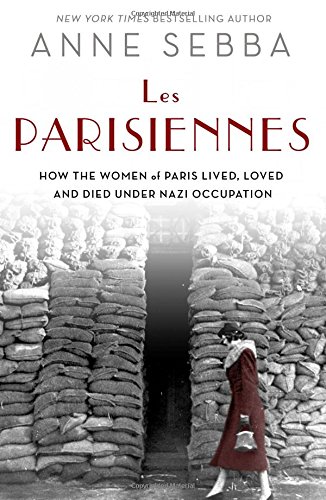
  • Les Parisiennes: How the Women of Paris Lived, Loved, and Died Under Nazi Occupation

    “Anne Sebba has the nearly miraculous gift of combining the vivid intimacy of the lives of women during The Occupation with the history of the time. This is a remarkable book.” ―Edmund de Waal, New York Times bestselling author of The Hare with the Amber Eyes

    New York Times bestselling author Anne Sebba explores a devastating period in Paris’s history and tells the stories of how women survived―or didn’t―during the Nazi occupation.

    Paris in the 1940s was a place of fear, power, aggression, courage, deprivation, and secrets. During the occupation, the swastika flew from the Eiffel Tower and danger lurked on every corner. While Parisian men were either fighting at the front or captured and forced to work in German factories, the women of Paris were left behind where they would come face to face with the German conquerors on a daily basis, as waitresses, shop assistants, or wives and mothers, increasingly desperate to find food to feed their families as hunger became part of everyday life.

    When the Nazis and the puppet Vichy regime began rounding up Jews to ship east to concentration camps, the full horror of the war was brought home and the choice between collaboration and resistance became unavoidable. Sebba focuses on the role of women, many of whom faced life and death decisions every day. After the war ended, there would be a fierce settling of accounts between those who made peace with or, worse, helped the occupiers and those who fought the Nazis in any way they could.

  • JAPAN TO WORLD: FRENCH INDOCHINA IS NOW OURS

    Saigon (Ho Chi Minh City), French Indochina • July 25, 1941 On September 21, 1937, Japanese planes bombed the capi­tal of China, Nan­king, shortly after igniting the Second Sino-Japa­nese War. Presi­dent Franklin D. Roose­velt expressed the shock of “every civil­ized man and woman” over “the ruth­less bombing” of Chinese civil­ians. Gen­er­ally, how­ever, U.S. and Euro­pean reac­tion…

  • DE GAULLE LOYALISTS SEIZE VICHY FRENCH ISLANDS OFF CANADA

    Washington, D.C. • December 24, 1941 At dawn on this grim date, Christmas Eve 1941, a tiny piece of Vichy France—the Atlan­tic islets of Saint Pierre and Miquelon, whose 93 sq. miles­/242 sq. km of wind­blown gra­nite out­crop­pings lay just 12 miles/­19 km off the New­found­land coast adja­cent to Canada—fell to the forces of Free France with­out a drop of…

  • FREE FRENCH SEIZE ISLANDS OFF CANADA

    Washington, D.C. · December 24, 1941 On this grim date, Christmas Eve 1941, a tiny piece of Vichy France—the Atlan­tic islets of Saint Pierre and Miquelon, whose gra­nite out­crop­pings lay just 12 miles off the New­found­land coast adja­cent to Canada—fell to the forces of Free France. It was the first French territ­ory to be lib­er­ated in…

  • JAPAN: NO U.S. AGGRESSION, NO WAR

    Tokyo, Japan · December 9, 1940 On September 27, 1940, Nazi Germany, Fascist Italy, and Imperial Japan signed the Tri­par­tite Pact, or Axis Pact as it was also known. The Pact was an out­growth of the “Rome-Berlin Axis” cele­brated by the Italo-Ger­man “Pact of Steel,” which Adolf Hitler’s foreign minis­ter Joachim von Rib­ben­trop and Benito…

  • FRENCH SCUTTLE FLEET TO AVOID CAPTURE

    Toulon Harbor, French Mediterranean · November 27, 1942 Between November 10 and 12, 1942, Germany and Italy engaged in a joint opera­tion (German, Unter­nehmen Anton, or Case Anton) to occupy Marshal Philippe Pétain’s Vichy France, the French Riviera, and the French Medi­ter­ra­nean island of Cor­sica. These three areas com­prised the so-called “Free Zone,” which was…

  • JAPAN TO GARRISON FRENCH INDOCHINA

    Vichy, France · September 22, 1940 As early as June 1940, after French resistance to the Ger­man con­quest of France crumbled, Japan made over­tures to Vichy French author­ities for per­mis­sion to sta­tion troops in French Indo­china (now Viet­nam, Laos, and Cam­bodia) and for their war­ships to take up naval sta­tions off North­ern Indo­chinese ports. On…