WEHRMACHT

  • GERMANS TRY PUSHING ALLIES OFF ANZIO BEACHHEAD

    Anzio, Italy • February 16, 1944 On this date in 1944, a day after the historic Bene­dictine abbey at Monte Cas­sino was bombed by Allied air­craft, the Germans launched their long-delayed counter­attack on the Allied-held beach­head at Anzio, a small Medi­ter­ranean resort and port some 35 miles/­56 kilo­meters south of the Ital­ian capi­tal, Rome. Just the month…

  • EARLY RUSSIAN WINTER UPSETS BLITZKRIEG SUCCESS

    Moscow, Soviet Union • October 15, 1941 On June 22, 1941, the day Adolf Hitler sprang his surprise attack on the Soviet Union, a country of 180 mil­lion people to Germany’s east, he report­edly con­fided to some of his inti­mates: “I feel as if I have opened a door into a dark, unseen room—with­out knowing what lies behind…

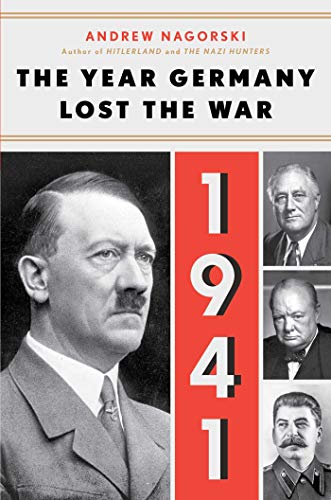
  • 1941: The Year Germany Lost the War

    Bestselling historian Andrew Nagorski takes a fresh look at the decisive year 1941, when Hitler’s miscalculations and policy of terror propelled Churchill, FDR, and Stalin into a powerful new alliance that defeated Nazi Germany.

    In early 1941, Hitler’s armies ruled most of Europe. Churchill’s Britain was an isolated holdout against the Nazi tide, but German bombers were attacking its cities and German U-boats were attacking its ships. Stalin was observing the terms of the Nazi-Soviet Pact, and Roosevelt was vowing to keep the United States out of the war. Hitler was confident that his aim of total victory was within reach.

    \By the end of 1941, all that changed. Hitler had repeatedly gambled on escalation and lost: by invading the Soviet Union and committing a series of disastrous military blunders; by making mass murder and terror his weapons of choice, and by rushing to declare war on the United States after Japan’s attack on Pearl Harbor. Britain emerged with two powerful new allies—Russia and the United States. By then, Germany was doomed to defeat.

    Nagorski illuminates the actions of the major characters of this pivotal year as never before. 1941: The Year Germany Lost the War is a stunning examination of unbridled megalomania versus determined leadership. It also reveals how 1941 set the Holocaust in motion, and presaged the postwar division of Europe, triggering the Cold War. 1941 was a year that forever defined our world.


  • BRITISH RUSH TROOPS TO AID GREECE

    Cairo, Egypt • March 7, 1941 On this date in 1941 in Greece, a British expe­di­tion­ary force from Egypt arrived just two days before the army of Ital­ian dictator Benito Mus­so­lini started its last unsuc­cess­ful cam­paign against Greek forces. The pre­vious Octo­ber the Ital­ian Army had crossed Greece’s north­west­ern fron­tier from neigh­boring Albania, launching the…

  • SOVIETS TRAP GERMANS IN HUNGARY’S CAPITAL

    Budapest, Hungary • January 4, 1945 In March 1944 Adolf Hitler ordered the Wehrmacht (German armed forces) to occupy his wavering Axis ally Hun­gary, whose oil reserves and fuel storage tanks at Nagy­kanizsa (German, Gross­kirchen) south­west of the capi­tal Buda­pest in the Lake Balaton (German, Plattensee) area had grown stra­te­gi­cally more impor­tant to the German…

  • GERMANS CRUSH DUTCH DEFENSES

    Rotterdam, The Netherlands • May 14, 1940 On this date in 1940 in Holland, the German Luft­waffe bombed Rotter­dam’s medi­e­val city cen­ter, killing nearly 1,000 people and leaving 85,000 home­less. Rather than endure more fero­cious bombings—leaf­lets dropped on Utrecht indi­cated it was next Dutch city in German cross­hairs—the Dutch Army surren­dered the next day. The German…

  • GERMANS SIGN UNCONDITIONAL SURRENDER

    Reims, France • May 7, 1945 Five days after the suicide of Adolf Hitler on April 30, 1945, Adm. Hans-Georg von Friede­burg, an emis­sary from Grand Admiral Karl Doenitz, arrived in the French cathe­dral town of Reims, head­quarters of Gen. Dwight D. Eisen­hower, Supreme Com­mander Allied Exped­i­tionary Force, looking pale and tired. For the second…

  • STRUGGLE FOR STALINGRAD INTENSIFIES

    Stalingrad, Soviet Union • November 1, 1942 By one German count, over five million Red Army sol­diers had been taken pri­soner since Adolf Hitler unleashed Opera­tion Bar­ba­rossa, the inva­sion of the Soviet Union begun 16 months ear­lier. As for the num­ber of Soviet ser­vice per­son­nel killed and dis­abled, there was only a rough esti­mate, but clearly…