U.S. POUNDS NUREMBERG IN FOLLOW-UP RAID
SHAEF HQ, Reims, France · February 21, 1945
On this date in 1945 U.S. fighter-bombers attacked the Berghof, Adolf Hitler’s Alpine retreat on the Obersalzberg near Berchtesgaden on the Bavarian-Austrian border. The Berghof served as an outpost of Hitler’s Berlin chancellery, making it an obvious target. Further north, in a less symbolic move, more than 1,200 U.S. bombers returned to the skies over Nuremberg for the second time in two days. The city was an important aircraft, submarine, and tank engine manufacturing site and, from 1943 onwards, was severely pummeled in Allied strategic bombing raids. Just the month before, on January 2, 1945, the RAF had systematically bombed Nuremberg. Within an hour 90 percent of the medieval city center was destroyed, displacing roughly 100,000 residents, wounding 5,000, and leaving 1,800 dead. In the February 20–21 raids, over 1,300 more residents were killed and a further 70,000 rendered homeless. The next day the Allies launched Operation Clarion, a massive daytime bombing attack by 10,000 aircraft based in Britain, Italy, France, Holland, and Belgium to cut transportation lines in central Germany and paralyze the enemy’s capability to continue the war. The Allies’ overall sense was that Nazi Germany was on the ropes, and this only made the apparent victors more ruthless in their resolve to utterly destroy Hitler’s war machine and finish off his regime. The firebombing of Dresden a week earlier, the firebombing of Pforzheim near Stuttgart two days after Nuremberg, which killed a quarter of that city’s 79,000 inhabitants, and a raid on the Nazi capital itself in broad daylight that killed 3,000 Berliners and left 100,000 homeless were making clear the price of ongoing resistance to the inevitable capitulation of Germany. Unbelievably, the fanatical determination of the Third Reich’s leaders to hang in there as the country’s military situation grew progressively more hopeless played out in surreal scenes as ordinary Germans tried to maintain a semblance of normalcy: on April 12, 1945, the Berlin Philharmonic performed a concert, filmed by crews from Joseph Goebbels’ propaganda ministry, less than three weeks before Hitler’s and Goebbels’ suicides and the unconditional German surrender by Hitler’s successor, Grand Admiral Karl Doenitz, on May 7 and 8, 1945.
[fblike]
[amazon_carousel widget_type=”ASINList” width=”600″ height=”200″ title=”Recommended Reading” market_place=”US” shuffle_products=”False” show_border=”False” asin=”0802715656,0231133812,0451230086,0440226481,0306811693,1574889990,0700611037,1500840890,0743235452,0615513654″ /]
Nuremberg Before and After the War
 |
 |
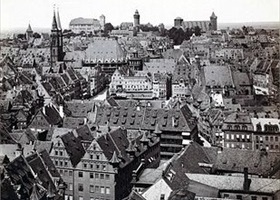
Left: View of Nuremberg’s Altstadt (Old Town) at the end of the 19th century. In the middle ground is the twin-spired St. Lorenz Church (Lorenzkirche). During the 1930s Nuremberg earned the nickname “City of the Party Rallies” (Stadt der Reichsparteitage), for it was here that the Nazis held their annual party extravaganzas celebrating the achievements of National Socialism. The city was also home to over 120 armament firms. From September 1942 on, the U.S. Army Air Forces employed a team of civilian economists to assist with target selection that aligned with military and political aims of the war. The goal of the Enemy Objectives Unit was straightforward: maximize the efficiency and effectiveness of U.S. air power to produce the greatest effects on Germany’s war economy.
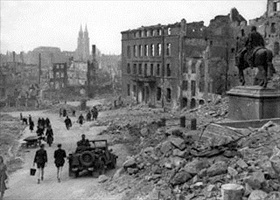
Right: Nuremberg in the summer of 1945. In the distance, St. Lorenz Church. The city, particularly the Altstadt, had a large proportion of half-timbered houses with high wood content, making the buildings highly combustible and attractive to an air attack by Allied bombers using a combination of high explosives and incendiary bombs. Because cloud cover over the target on February 20–21, 1945, prevented precision bombing of military targets, the bombardiers dropped their bombs blind over the whole of Nuremberg, rendering 70,000 residents homeless.
 |
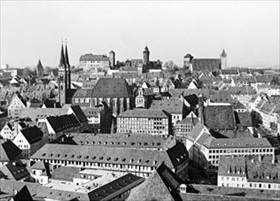 |
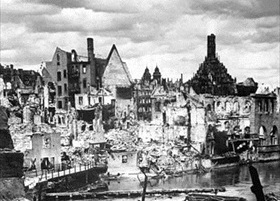
Left: Nuremberg in the summer of 1945. In the distance is St. Mary’s Church (Frauenkirche). Behind the destroyed buildings is the Hauptmarkt, the main market. After Cologne, Dortmund, and Kassel, Nuremberg had the largest amount of rubble per capita: half of all residences in the city were destroyed and those that remained for the population of 195,000 were mostly damaged.
Right: View of Nuremberg’s Altstadt in 1969 after its restoration.
Operation Clarion: Largest, Most-Expansive Air Assault of the War on Germany’s Transportation Network
httpv://youtu.be/J4ERXN_RRT8