TANK BATTLE AT KURSK BLUNTS NAZI DRIVE
Near Kursk, Russia · July 5, 1943
On this date in 1943 Germans and Soviets unleashed the largest tank battle in history, the Battle of Kursk. Following the surrender of the German Sixth Army at Stalingrad (January 31, 1943), Soviet advances during the first months of 1943 pushed deep into German-held territory to recapture the Ukrainian city of Kharkov (now Kharkiv). The successful German counterstrike at Kharkov, which ended on March 15, 1943, inspired Adolf Hitler to order new attacks near the town of Kursk, in the heart of the Soviet Union and 280 miles southwest of its capital, Moscow.
Both sides marshaled gargantuan forces. German forces stood at 435,000 soldiers, 9,960 artillery pieces and mortars, 3,155 tanks, and 1,860 aircraft. First-line Soviet defenses included one million soldiers, 13,013 artillery pieces and mortars, and 3,275 tanks. Unknown to the Germans, behind Soviet lines were half again as many men and pieces of equipment. Thus the Soviets enjoyed over a 2.5-to-1 manpower advantage, a 2-to-1 advantage in armored vehicles, and a 4-to-1 advantage in artillery.
The Germans were caught off guard and outmatched before they could start Operation Zitadelle (Citadel), the name they gave to their disastrous, self-defeating attack on Kursk. A brutal all-day tank battle involving 1,200 armed vehicles ended in a draw on July 12, while in the air the Red Air Force prevented Hermann Goering’s Luftwaffe from gaining air superiority over the battlefield. The Soviet demand on the Western Allies to open a second front in Europe materialized when Hitler was forced to call off his offensive in the East (July 16) to move troops to Italy to meet the Anglo-American invasion of Sicily (Operation Husky), which began on July 10, 1943.
From July 12 on, starting with an operation 100 miles north of Kursk at Orel (ending on August 18), Soviet armed forces were on the attack, driving their adversaries westward with relentless ground and aerial bombardments, which chewed up Axis resources and reserves. Kursk was the beginning of the end for the Third Reich. Italy and Romania withdrew their Eastern forces, leaving the Germans practically alone to fight a losing rearguard operation—in the east (Russia, Ukraine, and Belarus), in the south (Italy), and in the west (France). Kursk, it can be said, was the Soviets’ critical contribution to winning the war against Hitler and his Third Reich.
Battle of Kursk, July 5–16, 1943: Death Bell Tolls for Third Reich
 |
Above: Kursk salient (bulge) front lines and the German plan (Unternehmen Zitadelle; English, Operation Citadel) to eliminate the salient, July 4–17, 1943. The Russian city of Kursk, 280 miles southwest of Moscow, lies immediately to the left of the blue up and down arrows (Zentralfront on the map). The bulge sucked in huge numbers of opposing tanks and men, making it the arena for the greatest armored battle of World War II.
 |
 |
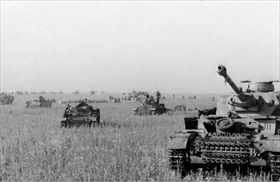
Left: German Tiger IIIs and IVs on the move near Belgorod directly to the south and outside the Kursk salient, June 21, 1943. Their aim: penetrate and eliminate the Kursk salient.
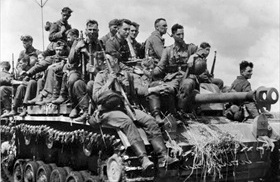
Right: German tanks of the “Grossdeutschland Division” take up positions in the Kursk salient in early July 1943. The Grossdeutschland was considered to be the premier unit of the German Army, receiving equipment before almost all other units. The new Panthers model D that the division received on the eve of the Battle of Kursk were plagued by technical problems, suffering from engine fires and mechanical breakdowns, with many becoming disabled before reaching the battlefield.
 |
 |
Left: Soviet armor advances to engage the enemy. The combined Voronezh and Steppe Fronts (Woroneshfront and Steppenfront on the map) deployed about 2,418 tanks and 1,144,000 men.
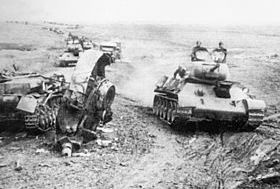
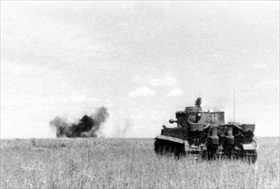
Right: A Waffen-SS Tiger I tank scores a direct hit on a Soviet T‑34 medium tank during the Battle of Kursk, July 10, 1943. The quality of the optics of the Tiger I and the high velocity 88mm gun it mounted allowed it to devastate targets at long range with great accuracy.
 |
 |
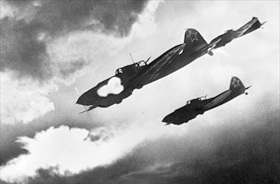
Left: Soviet IL-2 combat aircraft attack an enemy formation in the southern (Voronezh) sector of the Kursk salient, July 1943.
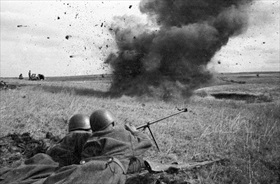
Right: Soviet antitank riflemen take aim at an enemy tank after the Battle of Kursk had wound down, July 20, 1943. The Battle of Kursk was the first battle in which a Blitzkrieg (“lightning war”) offensive had been defeated before it could break through enemy defenses and into its strategic depths.
Timeline’s Battle of Kursk, July 1943 (Skip first 30 seconds)
httpv://youtu.be/fHHCt6EV2kU