NAZI-BACKED ARROW CROSS SEIZE POWER IN HUNGARY
Budapest, Occupied Hungary • October 17, 1944
On this date in 1944 Adm. Miklós (Nicholas) Horthy, regent of the Kingdom of Hungary since 1920, left his native country as a prisoner of Nazi Germany. Horthy had angered Adolf Hitler after the latter had received confidential reports that the 76‑year-old Hungarian head of state was secretly negotiating a peace agreement with the Soviet Union in order to prevent an invasion of his country. If Horthy had succeeded, more than a million German soldiers could conceivably have wound up as prisoners of the Red Army, now closing in on Hungary’s eastern border. Only the kidnapping at gunpoint of Horthy Sr.’s son, “Miki” Horthy Jr., who 2 days earlier had been captured meeting with envoys of anti-Nazi Yugoslavian leader Josip Broz Tito in Budapest—a “snatch operation” (Operation Panzerfaust, or Armor Fist, aka Operation Mickey Mouse) engineered by Hitler’s swashbuckling commando, SS Major Otto Skorzeny—convinced the regent to abdicate in favor of a pro-German puppet government of Hungarian fascists, the Arrow Cross, who fought on the side of the Axis for the remainder of the war.
In the summer of 1944, after 11 divisions of the Wehrmacht had crossed into Hungary on March 19 (Operation Margarethe) and while Horthy was still head of state, the elite Nazi guard, the Schutzstaffel (SS), and their Hungarian accomplices had succeeded in deporting half a million Jews to the Auschwitz ovens in neighboring Poland. Under the post-Horthy Arrow Cross government, the roundup, deportation, and killing of Hungary’s remaining Jews, estimated at a quarter million, shifted into high gear under the watchful eye of SS Lt. Col. Adolf Eichmann. (Eichmann and his SS detachment facilitated and managed the logistics of the mass deportation of Hungary’s Jews to ghettos and Nazi concentration and death camps in Poland and Austria.) Gangs of trigger-happy Arrow Cross youths armed with automatic weapons pulled hundreds from their homes or off the streets, beat and plundered them, and executed them in broad daylight. Jewish corpses lay pooled in blood on Budapest’s streets. Other Jews were marched to bridges across the Danube or to the riverbank, cursed at and shot, their bodies tossed into the swirling gray water or onto floating ice. Some Jews preferred suicide; others were successful in dodging Arrow Cross gangs to find refuge with Christian friends who bravely agreed to hide them or in “safe houses” established and protected by humanitarian organizations and networks such as the one established by Swedish diplomat Raoul Wallenberg.
The fortunes of the Nazi-client Arrow Cross government were being reversed even as the reins of power shifted from Horthy to Ferenc Szálasi (1897–1946) and his virulently anti-Semitic thugs. Their nemesis was the Red Army and its (now) Romanian ally, whose combined forces began encircling the Hungarian capital on November 19, 1944. During the 102‑day siege of Budapest, German and Hungarian armies fell back from Pest across the Danube to Buda. Szálasi escaped the city on December 9. Eichmann was gone by December 24. Despite a lack of supplies, Axis troops refused to surrender and defended every street and house. Finally, on the night of February 11, 1945, some 28,000 desperate German and Hungarian troops attempted a breakout. The majority of the escapees were killed, wounded, or captured. The remaining defenders surrendered on February 13, 1945. The Soviet-led Battle of Budapest and the ensuing Vienna Offensive were dress rehearsals before the final Battle of Berlin (April 16 to May 2, 1945) and the apocalyptic collapse of Hitler’s Third Reich.
Timeline: Liquidating Hungary’s Jews, 1941–1945
 |
 |
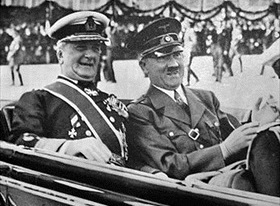
Left: Miklós Horthy (1868–1957) and Adolf Hitler in Nazi puppet state Slovakia (the eastern half of the former Czechoslovakia), 1938. For half a decade Horthy had hitched his country’s fortunes to Hitler’s Germany. He allowed the Wehrmacht (German armed forces) to stage units on Hungarian soil that overthrew governments in Yugoslavia and Greece in April 1941; he sent well over 160,000 Hungarians, among them tens of thousands of Jewish forced laborers, to their death or into brutal captivity in the Soviet Union in 1941–1943 (Operation Barbarossa and Battle of Stalingrad). An anti-Semite all his life, he dispatched half a million Hungarian Jews to die in Nazi extermination camps in neighboring Poland, chiefly at Auschwitz. Even before then Horthy had come to realize he’d made a poor wager and looked for ways to extricate his nation from the predictable calamity that the Allied armies would inflict—indeed, were already inflicting—on their enemies. As it turned out, it was all too late.
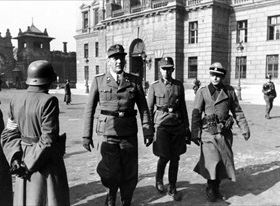
Right: SS-Sturmbannfuehrer (Major) Otto Skorzeny (left) and 2 SS colleagues on Castle Hill, the government district in Buda, October 16, 1944. Hitler entrusted Skorzeny—famous for having snatched Hitler’s Italian pal Benito Mussolini from his Allied captors the year before—with kidnapping Miklós (“Miki”) Horthy, Jr. Kidnapping the younger Horthy was intended to force his regent father to abdicate as head of state following the preliminary armistice terms Hungarian emissaries had eked out with the Soviet Union on October 11. (Horthy Sr. abdicated in exchange for his son’s life.) Skorzeny took father and son back to Germany, where the senior Horthy lived under round-the-clock SS guard until freed by elements of Lt. Gen. Alexander Patch’s Seventh U.S. Army. The younger Horthy survived his imprisonment at Dachau concentration camp. Escaping postwar trial at Nuremberg, Skorzeny consulted for several unsavory individuals and groups. The 2 Horthys went into exile in Portugal after the war.
 |
 |
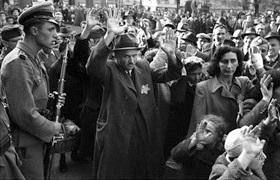
Left: A gendarme from the Hungarian Interior Ministry assists in sweeping up Budapest’s Jews. In the middle of June 1944 the Jews of Budapest, who made up just under one-quarter of the capital’s population, were forcibly relocated and required to reside in designated “yellow-star houses,” 1,944 single-building mini-ghettos identified by a yellow Star of David over the entrance. In the first days of the Arrow Cross coming to power in mid-October, thousands of Jews were forced to move again, this time into 2 ghetto districts, where neutral states (Sweden, Switzerland, Portugal, Spain, and the Vatican) and the International Red Cross provided protection for those holding Schutzpaesse, or protective passports. Issued by employees of the neutral legations, these passport-like documents with official-looking stamps frequently saved Jews from deportation to the death camps.
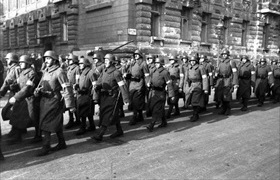
Right: Arrow Cross militiamen cross St. George Square in the Castle Hill district of Buda near the Royal (Buda) Castle, the former residence of the deposed Hungarian regent and head of state, Adm. Miklós Horthy. Photo probably taken on October 15 or 16, 1944, when the anti-Semitic, pro-Nazi Arrow Cross Party seized power in a German-engineered coup d’état.
 |
 |
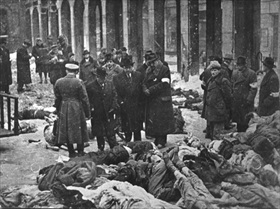
Left: Jewish victims of Arrow Cross militia lie strewn in the courtyard-cum-cemetery of the Dohány Street Synagogue, which anchored the southern end of Budapest’s sealed-off General Ghetto of 70,000 Jews. The largest synagogue in Europe and the second-largest Jewish place of worship in the world, “The Great Synagogue” (or “Tabakgasse Synagogue” by which it was also known) was used as a base for German radio broadcasts and as a stable during the war. Over 2,000 ghetto residents who died from hunger and cold during the harsh winter of 1944–1945 were buried here. A rear courtyard a short distance away holds the “Memorial of the Hungarian Jewish Martyrs”—at least 400,000 Hungarian Jews were murdered by the Nazis and their Hungarian collaborators. The memorial is a polished metal sculpture resembling a weeping willow whose leaves bear inscriptions with the names of victims.
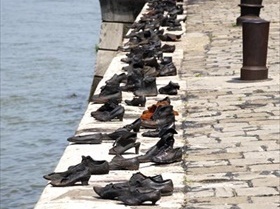
Right: “The Shoes on the Danube Promenade” memorial on the Pest (eastern) bank of the river in Budapest not far from the Hungarian Parliament building. Executing the capital’s Jews on the bloodstained bank of the Danube was convenient because the river carried the bodies away. The Arrow Cross murderers—many of them still in their teens—would often force their victims—men, women, and children—to remove their shoes before shooting them. After all, shoes were a valuable commodity that could be used immediately or else traded on the black market. During the Arrow Cross Party’s reign of terror (mid-October 1944 to late January 1945), the Danube was known as “the Jewish Cemetery.” Installed in 2005, Can Togay and Gyula Pauer’s poignant cast iron memorial of 60 pair of ownerless shoes commemorates the 38,000 victims of such unimaginable hatred, brutality, and immorality.
Scenes from the Battle of Budapest 1944–1945 Set to Music and Words
httpv://youtu.be/Vg8a3pI3Dwc