
GERMANS REEL FROM ENORMOUS RED PUNCH
Moscow, Soviet Union · June 23, 1944
On this date in 1944 along a 450-mile front some 2.4 million Soviet frontline and support troops, 5,200 tanks, and 5,300 aircraft smashed through German lines in present-day Belarus (White Russia in some earlier sources). Sabotage of rail networks and bridges by guerrillas several days before June 23 impeded German movement of ammunition, food, and reinforcements to the German-Soviet front. The full weight of the Soviet attack came on the third anniversary of the German invasion of the Soviet Union (Operation Barbarossa), when Germans had poured into Russia, in the words of one Soviet citizen, “marching and singing, whistling and spitting.” Three German armies—Third Panzer, Fourth, and Ninth, whose frontline numbers approached a half-million men—each lost a majority of their strength. The initial target of the Soviet blitzkrieg, Minsk, capital of Belarus, was captured on July 3. Operation Bagration, named for Gen. Piotr Bagration, a storied general who had fought Napoleon in 1812, produced a major crisis for the Wehrmacht and demonstrated just how much the Soviet army and air force had learned in two years. German Army Group Center was virtually wiped out, losing over 300,000 men in 22 divisions; Army Group North on the Baltic coast was for the most part isolated, to be exterminated later at leisure; and the Soviet advance had almost reached East Prussia, all within five weeks. German casualties for all three Army groups, which included a large proportion of Luftwaffe field units, security troops, Hungarian and Slovak divisions, and Volksdeutsche (ethnic Germans from the occupied territories), were close to 400,000. Soviet casualties, who included partisan irregulars, were also substantial, with roughly 180,000 killed and missing and just under 600,000 wounded. Also lost were nearly 3,000 Soviet tanks, over 2,400 artillery pieces, and 822 aircraft. None of the losses deterred the Red Army from massing that summer within sight of Warsaw, Poland, the country where Adolf Hitler had embarked on his brutal war of conquest nearly five years before. Col. Gen. Heinz Guderian’s assumption of command on the Eastern Front, as well as shifting men and resources to the weakest sectors to stabilize German defense lines, did little to stop the rot in Nazi fortunes.
[fblike]
[amazon_carousel widget_type=”ASINList” width=”600″ height=”200″ title=”Recommended Reading” market_place=”US” shuffle_products=”False” show_border=”False” asin=”0764302663,1898800073,1612000983,0140271694,1844158667,0700608990,1848840527,0982577907,0700617760,1855324784″ /]
Operation Bagration, June 23 to August 19, 1944
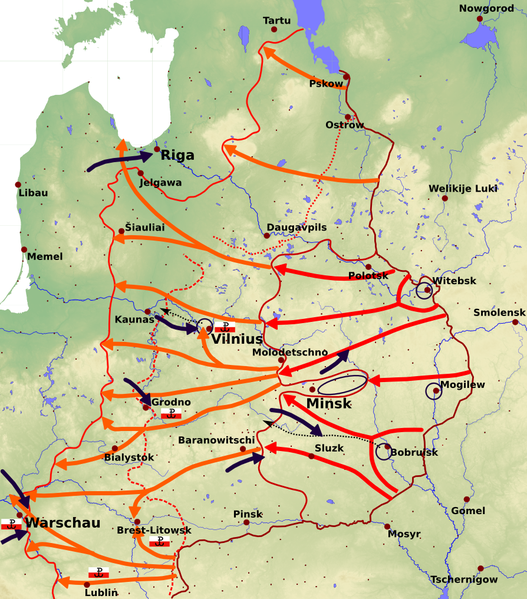 |
Above: Overview of military operations conducted by the Red Army in the Baltic states, Belarus, and Poland during Operation Bagration. Soviet offensive operations during the first phase are shown by red arrows ending at the brown line in the middle of the map, the following phase by orange arrows. German counterattacks are shown by short dark blue arrows. Geographically, Bagration dwarfed the Western Allies’ campaign for Normandy, launched just three weeks earlier. The Soviet blitzkrieg was intended to support Allied operations in France (Operation Overlord), liberate Soviet territory the Germans had seized in their 1941 assault on the Soviet Union (Operation Barbarossa), and break the back of the Wehrmacht once and for all. It achieved all three goals.
 |
 |
Left: By the time the Soviets launched Operation Bagration, partisan numbers in Belarus had swelled to between 143,000 and 374,000. German anti-partisan operations between January and April 1944 had exterminated entire villages. All told, an estimated 1 million people, including Belarus’ entire Jewish population, had been killed. The Red Army directed partisan forces, increasingly well organized behind German lines, to maximum advantage before and after Bagration’s start date.
Right: Dead crew members and two destroyed Panzer IVs belonging to the German 20th Panzer Division were among the 50,000 troops killed and 20,000 captured by Gen. Konstantin Rokossovsky’s First Belorussian Front in the Babrujsk (Bobruisk) salient in Belarus by end of June 1944 (map, lower left). Rokossovsky was the Soviet general who had accepted the surrender of the German Sixth Army at Stalingrad in early February 1943.
 |
 |
Left: Abandoned vehicles of the German Ninth Army, Babrujsk, Belarus, late June 1944. A disorganized and demoralized Wehrmacht never recovered from losses of manpower and equipment incurred during the Soviet offensive. Manpower losses alone were roughly a quarter of its Eastern Front strength, similar to the percentage of German losses at Stalingrad (November 1942 to January 1943).
Right: German POWs in Moscow, July 1944. Compared to other battles, Bagration was by far the greatest Soviet victory in numerical terms. In order to show the outside world the magnitude of their victory, the Soviets paraded 50,000 German prisoners taken from the encirclement east of Minsk through Moscow’s streets. Marching quickly and twenty abreast, the German POWs took 90 minutes to pass the reviewing cameras.
Operation Bagration and the Destruction of German Army Group Center
httpv://youtu.be/6k5iutz0-Qg